
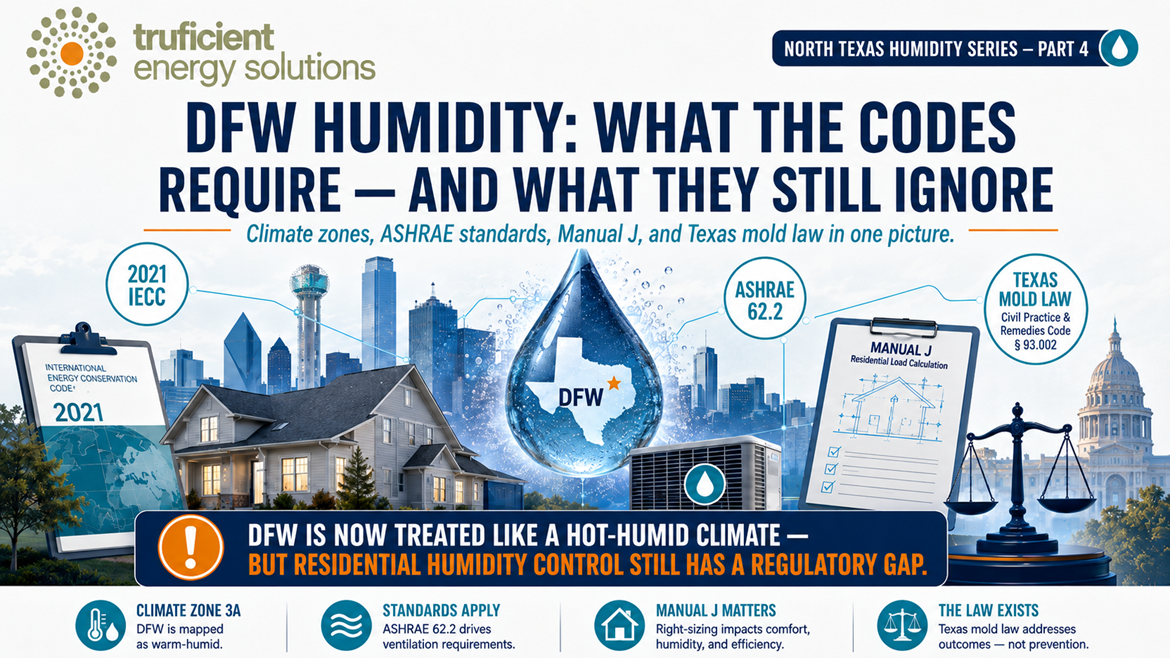
The 2021 IECC reclassified core DFW counties to Climate Zone 2A — Hot-Humid. Here's what ASHRAE and Texas code now require for indoor humidity, ventilation, and equipment.
The Rule That Changes Everything — and Nobody Told You About It
In the 2021 edition of the International Energy Conservation Code, the International Code Council did something that most DFW homeowners, contractors, and even building officials have not fully processed: they reclassified Dallas County, Tarrant County, Ellis County, Johnson County, and Navarro County from Climate Zone 3A to Climate Zone 2A. That single change moved the core of the Dallas–Fort Worth metroplex into the same official climate classification as Houston, New Orleans, Tampa, and Miami — "Hot-Humid" — rather than merely "Warm-Humid."[1]
It is not a semantic change. Climate Zone 2A triggers different insulation requirements, different equipment efficiency thresholds, different design assumptions, and different latent load calculations. The science of the reclassification is confirmed by the data in Part 1 of this series: DFW's rising dew points, expanding urban heat island, and reservoir-amplified moisture load have pushed its thermodynamic profile firmly into hot-humid territory. The ICC's climate science confirmed what the humidity is now doing in the field.
Understanding this reclassification — and the full body of ASHRAE and Texas code requirements that surround it — is the foundation for every professional humidity discussion in DFW. For contractors, it defines what the code requires. For building owners, it defines what can become a liability. For homeowners, it defines what they are legally entitled to expect from a code-compliant building.
Part 1: The DFW Climate Zone Map
Before any standard or code provision makes sense, the applicable climate zone must be correct. As of the 2021 IECC, DFW is divided:
| County | Climate Zone | Classification | Code Implication |
|---|---|---|---|
| Dallas | 2A[1] | Hot-Humid | Higher insulation, higher equipment efficiency thresholds |
| Tarrant | 2A[1] | Hot-Humid | Same as Dallas County |
| Ellis | 2A[1] | Hot-Humid | Same as Dallas County |
| Johnson | 2A[1] | Hot-Humid | Same as Dallas County |
| Navarro | 2A[1] | Hot-Humid | Same as Dallas County |
| Collin | 3A[2] | Warm-Humid | 2021 IECC Zone 3 insulation and fenestration standards |
| Denton | 3A[2] | Warm-Humid | 2021 IECC Zone 3 standards |
This split within the metroplex has direct mechanical system design consequences. A home in Frisco (Collin County, 3A) and a home in Dallas (Dallas County, 2A) are in different climate zones under the 2021 IECC, even though they are 25 miles apart and experience essentially the same weather. Both are hot-humid. Both require aggressive latent load management. The zone 3A vs. 2A classification affects primarily the prescriptive building envelope requirements, but both zones fall within ASHRAE's hot-humid climate design guidance for HVAC systems.
Part 2: The Texas Code Patchwork — Where You Build Determines What You Must Build
Texas's energy code structure is unlike most states. Rather than adopting a single statewide code, Texas operates as a "home rule" state where the legislature establishes a minimum baseline but municipalities can — and the larger ones frequently do — adopt more stringent codes independently.[3][4][5]
The Statewide Minimum
The Texas Building Energy Performance Standards (34 TAC §19.53) set the statewide mandatory baseline. As of 2026, the statewide residential minimum remains the 2015 International Residential Code, Chapter 11 (Energy Efficiency), which is functionally equivalent to the residential provisions of the 2015 IECC. The Texas State Energy Conservation Office (SECO) and the Energy Systems Laboratory at Texas A&M University are responsible for evaluating new code editions — a process that requires a formal stakeholder review and public comment period before any new code becomes mandatory statewide.[6][7][8]
This means that while the 2021 and 2024 IECC editions have been published by the ICC, no mandate exists at the Texas state level to build to those editions in jurisdictions that have not independently adopted them. The state has been at the 2015 baseline since September 1, 2016.[3][6]
The Municipal Override
Major DFW municipalities have exercised their home rule authority to adopt stricter codes. The result is a patchwork that directly affects what any given building in DFW must comply with:
| Municipality | Residential Energy Code | Commercial Energy Code | Notes |
|---|---|---|---|
| City of Dallas | 2021 IECC (effective May 12, 2023)[9][10] | 2021 IECC / ASHRAE 90.1-2019[11] (effective May 2023) | Most comprehensive adoption in DFW |
| Plano | 2021 IECC (adopted 2022)[2] | 2021 IECC | Among first DFW cities to adopt |
| City of Fort Worth | **2015 IECC** (energy)[12] | **2015 IECC** (energy)[12] | Adopted 2021 IBC/IMC but retained 2015 energy code |
| Most DFW suburban cities | 2015 IECC (state minimum) | 2015 IECC | Unless locally amended |
| Unincorporated county areas | 2015 IECC (state minimum) | 2015 IECC |
The practical implication: a new home built in Fort Worth must comply with a substantially less stringent energy and ventilation code than a new home built in Dallas — despite being in the same DFW market with the same outdoor humidity conditions.
What the 2021 IECC Changed for Mechanical Systems
For jurisdictions that have adopted the 2021 IECC — primarily the City of Dallas and Plano — several mechanical system requirements changed materially:
R403.6: Mechanical ventilation is now mandatory. Where the 2015 IECC required a whole-house ventilation system design on construction documents, the 2021 IECC and its testing provision make the performance of that system a code-required verified outcome.[13][1]
R403.6.3: Testing is now required. Mechanical ventilation systems must be tested and verified to provide minimum airflow rates. Testing must be performed per equipment manufacturer instructions or with a calibrated flow measurement device. Where the code official requires it, third-party testing is mandatory. A written report signed by the testing party must be provided to the code official. This is a significant enforcement tool that did not exist in the 2015 code. It means a system that exists on paper but is not operating correctly is now a code violation that can be documented and cited.[13][1]
R403.7: Equipment sizing. Manual J load calculations remain mandatory for permitted HVAC work in both 2015 and 2021 IECC editions — this provision was not new to 2021, but the 2021 code's tighter performance envelope makes correct sizing more consequential than ever.[1]
R408.2: Additional efficiency options. The 2021 IECC requires that all new construction select and implement one of five additional efficiency packages. The five options are:[1] 1. R408.2.1: Enhanced thermal envelope (5% below prescriptive UA) 2. R408.2.2: Higher-efficiency HVAC (≥95 AFUE / 16 SEER minimum) 3. R408.2.3: High-efficiency water heating 4. R408.2.4: Ducts in conditioned space (100%) 5. R408.2.5: Improved air sealing (≤3 ACH50) plus ERV or HRV
Option #5 is the critical moisture pathway. When a builder selects R408.2.5, an ERV becomes a code-required component — and the ERV must meet specific performance thresholds: ≥75% Sensible Recovery Efficiency (SRE), ≤1.1 CFM per watt, and for the ERV specifically, ≥50% Latent Recovery/Moisture Transfer (LRMT). This is where code and humidity management intersect most directly. Builders and contractors who select option #5 are installing ERVs to comply with code, not as a luxury upgrade — and those ERVs must be configured for humidity management per the 2021 IECC performance requirements.[14][1]
Part 3: The ASHRAE Standards Framework
ASHRAE publishes the primary technical standards that define what buildings and HVAC systems should achieve for occupant health, comfort, and moisture safety. These standards are not all code-mandatory, but they carry enormous legal weight as the industry's recognized standard of care.
ASHRAE Standard 55-2023: Thermal Comfort
Purpose: Specifies the combinations of indoor environmental factors — temperature, thermal radiation, humidity, air speed — and personal factors — activity and clothing — that produce thermal comfort for at least 80% of occupants.[15][16]
Humidity relevance: ASHRAE 55 does not mandate a single relative humidity percentage. Instead, it defines a comfort zone based on the interaction between operative temperature and humidity ratio. The upper humidity limit in the Standard 55 comfort zone corresponds approximately to a humidity ratio of 0.012 lb water per lb dry air, which at typical indoor temperatures equates to roughly a 60°F dew point — well below what DFW homes experience in summer without active dehumidification.[17][16][18]
B2B implication: ASHRAE 55 compliance is referenced in LEED certification, WELL Building Standard, and green building programs. Any commercial project seeking these certifications must demonstrate that the mechanical system maintains conditions within the ASHRAE 55 comfort zone — including the humidity constraint. An HVAC system that cannot maintain the humidity ratio below 0.012 in DFW summer conditions is not ASHRAE 55 compliant.
ASHRAE Standard 62.2-2025: Ventilation for Residential Buildings
Purpose: Defines minimum ventilation rates and IAQ requirements for residential buildings — the cornerstone standard for ventilation design in homes.[19][20][21]
Core formula: Whole-building ventilation rate (CFM) = (number of bedrooms + 1) × 7.5 CFM + 1% of conditioned floor area. For a 3-bedroom, 2,500 sq ft home in Plano: (3+1) × 7.5 + 25 = 55 CFM continuous outdoor air required. Every cubic foot of that 55 CFM of outdoor air arrives in DFW summer at 70–75°F dew point, carrying enormous latent load.[22]
Major 2025 changes: The 2025 edition upgraded filtration requirements from MERV 6 to MERV 11 — a significant change requiring physical filter upgrades in many existing systems. New compartmentalization requirements for attached dwelling units. New requirements for local exhaust in toilet rooms.[20]
Humidity gap: ASHRAE 62.2 specifies how much outdoor air must be brought in. It does not specify how the resulting latent load must be managed. This is the ventilation-humidity paradox: proper 62.2 compliance in DFW increases the moisture burden on the HVAC system, but no corresponding dehumidification mandate exists in the standard. The 2025 edition adds humidity control requirements — but their scope and implementation are still being absorbed by the industry.
Code adoption status: ASHRAE 62.2 is mandated for ENERGY STAR-certified homes and DOE-funded weatherization projects nationally. It is referenced in the 2021 IECC's ventilation provisions. In DFW, R403.6 of the IECC references the International Residential Code's ventilation provisions, which track closely with 62.2 requirements.[21][22]
ASHRAE Standard 62.1-2025: Ventilation for Commercial Buildings
Purpose: The commercial equivalent of 62.2 — specifies minimum outdoor air rates by occupancy type and establishes the IAQ framework for commercial buildings.[20]
2025 updates: New humidity control requirements added. Demand control ventilation sequences updated. New methods for exhaust airflow calculation. Emergency control requirements for ventilation systems.[20]
Hot-humid climate specifics: For Climate Zones 0A, 1A, 2A, and 3A — all of which apply to DFW — the standard's latent load calculation requirements are particularly important. The residential ventilation paper from Lawrence Berkeley National Laboratory documented the core problem in 2003 and it remains true today: "Meeting this standard in new construction requires the use of mechanical ventilation, which in turn can often significantly increase the latent load faced in new homes. As the thermal performance of houses improves, sensible loads have decreased and existing equipment may not be able to deal with the remaining latent load. Failure to take this load into account can result in poor indoor air quality and moisture-related problems."[23]
ASHRAE Standard 90.1-2022: Energy Standard for Commercial Buildings
Purpose: The primary commercial energy efficiency standard, referenced by the 2021 IECC commercial provisions. In the City of Dallas, commercial buildings can comply via ASHRAE 90.1-2019 prescriptive path.[11]
The humidity-specific Addendum cy (2022): This addendum, published in the current ASHRAE 90.1-2022 edition, is among the most significant regulatory developments for DFW commercial HVAC in recent years. For Climate Zones 0A, 1A, 2A, and 3A — the entire DFW market — Addendum cy:
- Effectively requires humidity sensors in HVAC zones (or a single representative zone)[24]
- Requires supply air temperature reset capability while dehumidification is provided[24]
- Mandates that air economizers be locked out when dehumidification control is active[24]
- Applies specifically to the humid climate zones where outdoor air economizers would otherwise introduce excess moisture into the building
This addendum closes a significant performance loophole: commercial systems serving DFW's hot-humid zones can no longer operate economizer modes that admit high-dew-point outdoor air without dehumidification control. Any commercial HVAC system designed under 90.1-2022 in DFW must include the sensors and control sequences to manage humidity independently of temperature.
ASHRAE Standard 160-2021: Moisture-Control Design Analysis
Purpose: The building science community's most comprehensive moisture design standard — specifies performance-based criteria for predicting and preventing moisture damage to building envelope, materials, components, and systems.[25][26][27]
What it does: Standard 160 provides engineers and designers a methodology for analyzing whether a proposed building assembly will stay below moisture thresholds under actual climate conditions at the project location. Inputs include climate data, construction type, HVAC system design, and indoor moisture generation rates. Outputs include predicted moisture content of envelope components and mold risk indices.[26][28]
The 2021 update — Moisture Design Reference Year (MDRY): The most significant change in the 2021 edition is the introduction of the Moisture Design Reference Year concept. Before 2021, engineers could select any historical weather year for moisture analysis, which allowed cherry-picking of favorable years. The MDRY methodology requires selection of a weather year specifically chosen for its moisture-damage potential at that location — meaning the design must survive a realistic worst-case humidity year, not just an average one.[29][26]
For DFW in 2026, the MDRY methodology essentially mandates use of weather data that looks like recent summers — not the DFW summers of the 1980s. Given the dew point trend data from Part 1 of this series, this is a consequential change. Moisture control designs calibrated to historical "average" DFW weather will fail the MDRY analysis using recent actual conditions.
Code adoption status: Standard 160 is not currently mandatory code in Texas or most U.S. jurisdictions. However, it is the recognized standard of care for moisture control design in the building science and forensic engineering communities. In mold litigation and building failure disputes, Standard 160 compliance — or non-compliance — is a central technical argument. A contractor or designer who installed an HVAC system without considering the Standard 160 latent load criteria for a DFW hot-humid climate location may face significant professional and legal exposure when moisture damage emerges.
Part 4: ACCA Manual J — The Law Everyone Ignores
ACCA's Manual J (ANSI/ACCA 2 Manual J, 8th Edition) is the national standard for residential HVAC load calculation. It is required by IECC Section R403.7 for all permitted HVAC work in both the 2015 and 2021 editions. It is required for ENERGY STAR certification, utility incentive programs, and the full suite of HERS-rated projects.[30][31][1]
In practice, it is regularly bypassed in the replacement HVAC market across DFW. A contractor who replaces a system by matching the old equipment's tonnage — or by upsizing "for safety" — is violating a mandatory code provision in any jurisdiction where a mechanical permit is required for the work.
The stakes are specific to DFW's climate:
- North Texas design conditions: 101°F dry bulb, 78°F wet bulb, with summer humidity of 65–75% outdoor RH[32]
- North Texas latent load fraction: 25–35% of total cooling load is latent — meaning up to one-third of the work the AC must do is removing moisture, not temperature[32]
- Oversizing penalty in humid climates: A system that is 50–100% oversized — which is the documented range of oversizing errors in North Texas — will short-cycle on every mild day of the year, removing almost no moisture while keeping the temperature comfortable[33][32]
- Professional Manual J cost: $300–$800, preventing equipment oversizing that costs an average of $3,200+ in excess operating costs over the system lifetime[32]
The Manual J requirement also encompasses Manual S (equipment selection — ensuring the chosen equipment actually matches the calculated loads, not just the rounded-up tonnage) and Manual D (duct design — ensuring the distribution system delivers air at the correct CFM to each room at the correct static pressure). A technically compliant HVAC installation in a 2021 IECC jurisdiction requires all four documents: J, S, D, and the energy code compliance certificate.[34][1]
Part 5: Texas Mold Law — What Property Owners and Contractors Must Know
Texas is one of the few states with specific statutory mold legislation, and it carries real teeth for building owners and contractors working in DFW's humidity environment.
The Licensing Framework
Texas Occupations Code Chapter 1958 governs the regulation of mold assessors and remediators. The implementing rules are found in Texas Administrative Code Title 16, Chapter 78 — administered by the Texas Department of Licensing and Regulation (TDLR).[35]
Key requirements: - Licensed contractors required: Any mold remediation affecting 25 contiguous square feet or more must be performed by a TDLR-licensed mold remediation contractor[35] - Separation of assessment and remediation: The company that assesses the mold problem cannot be the same company that performs the remediation — a conflict-of-interest protection that applies strictly[36] - Insurance requirement: Licensed contractors must carry $1 million in commercial general liability insurance[35] - Training requirement: Contractors must complete 40 hours of accredited training and pass a state licensing examination[35]
Senate Bill 1255 — September 1, 2025 Changes
Texas Governor Greg Abbott signed Senate Bill 1255 on June 20, 2025, effective September 1, 2025. The key changes:[37][38][39]
- No more unlicensed employees under supervision: The repealed Section 1598.102(b) previously allowed unlicensed employees to perform mold assessment or remediation while supervised by a licensed professional. That exemption is gone. Every person performing regulated mold work now must hold their own individual license or registration[39][37]
- Mycotoxins excluded from "mold" definition: Section 1958.001(4) is amended to remove mycotoxins from the legal definition of mold — reflecting a distinction between mold spores and their metabolic byproducts[38][37]
- Post-disaster demolition exempted: Demolition work after a fire or disaster is excluded from regulated mold activities, as long as it is not formally designated as mold cleanup[37][39]
For property managers and commercial landlords: SB 1255's individual licensing requirement means larger remediation operations can no longer use unlicensed field staff. This raises the cost and extends the timeline of remediation projects — making prevention significantly more cost-effective than response.
Landlord and Tenant Rights Under Texas Property Code
Texas Property Code Section 92.052 requires landlords to repair conditions that materially affect the physical health or safety of an ordinary tenant. Texas courts have applied this provision to mold — meaning a landlord who is notified in writing of a mold condition and fails to remediate is potentially liable for the tenant's remediation costs, relocation expenses, and health damages. Texas tenants have rights to repair-and-deduct and lease termination in uninhabitable conditions caused by mold.[35]
For commercial leases, the liability framework is contract-dependent, but a commercial landlord who can be shown to have known of a chronic moisture problem that led to mold damage faces significant exposure in both direct remediation costs and tenant business interruption claims.
Part 6: The Regulatory Gap — What the Standards Don't Require
Having mapped the full standards framework, the most important single finding for DFW building owners and contractors is the gap that these standards collectively leave:
There is no Texas code provision — at the state level or in any major DFW municipality — that mandates a specific indoor relative humidity setpoint or requires dedicated dehumidification equipment in residential construction.
The 2021 IECC requires mechanical ventilation. ASHRAE 62.2 specifies how much outdoor air must enter a building. ASHRAE 55 defines a comfort zone with humidity boundaries. ASHRAE 160 provides a framework for analyzing moisture risk. ASHRAE 90.1 Addendum cy requires humidity sensors in commercial zones in hot-humid climates. But none of these standards, in their current form as adopted by Texas jurisdictions, contain a direct requirement that a DFW home or commercial building maintain indoor relative humidity below 60%, or that a dedicated dehumidifier must be installed.
The consequence: a building can be fully code-compliant, permitted, inspected, and certified — and still maintain indoor humidity levels of 65–70% during DFW shoulder seasons, creating active mold growth conditions. The building passed code. The occupants are developing mold-related health problems. The contractor is not technically in violation. This gap is the reason the building science community uses the term "regulatory vacuum" to describe humid-climate moisture management.
This gap creates several professional imperatives that Truficient addresses directly:
- Manual J latent load compliance is required code but infrequently enforced — making its correct execution a professional differentiator, not just a legal requirement
- The 2021 IECC testing requirements (R403.6.3) in Dallas and Plano are enforceable — and any contractor installing ventilation systems in those jurisdictions who cannot document tested airflow rates is operating outside the code
- ASHRAE 90.1-2022 Addendum cy applies to commercial design in DFW's climate zones 2A and 3A — humidity sensors and dehumidification control sequencing are now part of the standard of care for commercial HVAC design
- Standard 160's MDRY methodology is the legal framework for moisture damage disputes — buildings designed to 2010 weather data do not satisfy the 2021 standard's requirements for the current DFW moisture environment
Part 7: What Compliance Actually Looks Like in DFW
For New Residential Construction (City of Dallas and Plano)
A code-compliant new residential HVAC installation under the 2021 IECC requires: - Manual J load calculation documented and submitted with permit — latent load specifically broken out[1][32] - Manual S equipment selection — selected equipment must match calculated loads within ACCA-allowable variance - Manual D duct design — each supply branch sized for correct CFM and static pressure - Mechanical ventilation system designed and documented on construction drawings[1] - R403.6.3 ventilation testing — documented measured airflow provided to code official[13][1] - One of five additional efficiency packages selected and noted on the energy code compliance certificate[1] - If R408.2.5 selected: ERV or HRV installed and meeting performance standards (≥75% SRE, ≥50% LRMT for ERVs)[14][1]
What code does NOT require: a dehumidifier. What Truficient recommends: a dehumidifier anyway.
For New Residential Construction (Jurisdictions Still on 2015 IECC)
- Manual J load calculation required[6]
- Mechanical ventilation design required (but not tested/verified)
- No measured airflow verification requirement
- No mandatory additional efficiency package
- No ERV requirement of any kind
This lower standard in suburban municipalities outside Dallas and Plano means new homes in Forney, Waxahachie, McKinney (depending on local adoption), Celina, Prosper (depending on local adoption), and similar fast-growing communities may be built to significantly less humidity-protective standards than homes in Dallas proper.
For Commercial Buildings (City of Dallas — 2021 IECC / 90.1-2019)
- ASHRAE 90.1-2019 prescriptive or performance compliance[11]
- Demand control ventilation per 62.1 where required
- Equipment efficiency minimums per ASHRAE 90.1 Table 6.8
- For 90.1-2022 projects: Addendum cy humidity sensor and dehumidification control sequence requirements apply in Climate Zones 2A and 3A[24]
The Standard of Care Regardless of Code
In professional liability terms, the "standard of care" for HVAC design and installation in DFW's hot-humid climate encompasses what a competent professional would do in the same situation — which includes following ASHRAE guidance even where it is not code-mandated. ASHRAE 160's moisture design analysis, ASHRAE 55's humidity comfort criteria, and the industry's documented best practices for hot-humid climate HVAC systems are all components of the standard of care that a forensic engineer would reference in a moisture damage or mold liability case.
A contractor who installs an oversized single-stage system in a 2-A climate zone Dallas home, who fails to perform Manual J, whose installation results in documented humidity above 60%, and against whom a mold remediation claim is filed, cannot simply point to the permit being issued. The permit verifies code compliance at the minimum standard. The standard of care may require more — and increasingly, it does.
Conclusion: The Professional Imperative in 2026
DFW's regulatory environment for humidity management is in active evolution. The 2021 IECC climate zone reclassification has formally recognized that Dallas and Tarrant Counties belong in the same hot-humid category as the Gulf Coast cities that have long demanded aggressive moisture management. ASHRAE 90.1's Addendum cy has added mandatory humidity controls to the commercial standard for DFW's climate zones. The Texas mold licensing tightening under SB 1255 has raised the cost of reactive mold response. And ASHRAE 160-2021's MDRY framework has effectively shifted the moisture design reference weather to match current DFW conditions rather than historical averages.
What the regulations have not yet done is mandate a complete humidity solution from the residential new construction side. That gap — and the building failures it is producing in new construction across DFW's suburban frontier — is the professional opportunity that contractors who understand this space are positioned to capture.
Homeowners and building owners who understand this regulatory landscape are better equipped to ask the right questions, evaluate proposals correctly, and hold their HVAC contractors to the professional standards that apply in DFW's increasingly hostile humidity environment — whether or not those standards are yet codified in every municipal jurisdiction across the metroplex.
This concludes the four-part DFW Humidity Deep Dive series by Truficient Energy Solutions. This series is intended as a professional and educational resource for homeowners, contractors, property managers, and commercial building owners in the Dallas–Fort Worth metroplex. For jurisdiction-specific code questions, consult the relevant municipal building department. For ASHRAE standard copies, visit ashrae.org. For Texas mold licensing verification, visit tdlr.texas.gov.
Sources: ANSI/ASHRAE Standards 55-2023, 62.1-2025, 62.2-2025, 90.1-2022, 160-2021; 2021 IECC text and Conserve North Texas residential code training materials; NAHB State Adoption Status of IECC (November 2024); Building Codes Assistance Project Texas profile; City of Dallas 2021 IECC adoption documentation; City of Fort Worth adopted codes documentation; Fox Energy Specialists Texas energy code overview; Texas Department of Licensing and Regulation (TDLR) SB 1255 implementation; Texas Occupations Code Chapter 1958; ACCA Manual J 8th Edition; Lawrence Berkeley National Laboratory ventilation hot-humid climate research; Positive Energy building science blog; AutoHVAC.ai Texas Manual J requirements; Jupitair HVAC North Texas load calculation guide; ASHRAE 90.1-2022 Addendum cy documentation.
References
- [[PDF] Significant Changes 2021 IECC Residential - Conserve North Texas](https://www.conservenorthtexas.org/SharedMedia/ConserveNorthTexas/Documents/2021-IECC-Changes-Res-plus-HVAC-Updated.pdf)
- [[PDF] 2021 IECC Residential - Green Building Energy Sustainability](https://greenbuildingenergysustainability.com/wp-content/uploads/2024/10/GBES_2021_IECC_DFW_Residential_handout.pdf)
- Energy Code Inspections & Testing - Single Family - However, many Texas municipalities have adopted more stringent stretch codes (i.e. 2018 IECC, 2021 I...
- What is the Texas Energy Code and Why Does It Matter? - Texas operates as a “home rule” state, offering significant flexibility within its statewide minimum...
- Energy Code Stringency - ACEEE | Policy Database - The State of Texas allows its local jurisdictions to adopt building energy codes more stringent than...
- Texas Adopts 2015 IRC Energy Provisions with Amendments ... - ICC - The legislation requires all Texas homes to meet the energy efficiency requirements of Chapter 11 in...
- Step 10: Make the Most of the Energy Code - SPEER - The energy code only results in more energy efficient performance of buildings if local jurisdiction...
- Texas - The Building Codes Assistance Project - Texas adopts a mandatory statewide energy code – the Texas Building Energy Performance Standards (34...
- Permitting & Inspections 2021 residential energy code - City of Dallas - For Residential new construction and addition permit applications filed prior to May 12, 2023: You ...
- City of Dallas Nearing Adoption of 2021 I-Codes with Local ... - As reported in December, the City of Dallas has undergone the process of drafting their adoption of ...
- [[PDF] City of Dallas - Commercial Energy Compliance Path - 2021 (IECC)](https://dallascityhall.com/departments/sustainabledevelopment/buildinginspection/DCH%20documents/pdf/code_amendments/2021_codes/2021_Commercial_Energy_Code_Compliance_Path_Form_051223.pdf) - City of Dallas - Commercial Energy Compliance Path - 2021 (IECC) ... 5 shall be met; and a list of t...
- Building & Energy Codes - the City of Fort Worth - The city has currently adopted the 2021 International Building, Mechanical, Plumbing, Fuel Gas, Fire...
- [[PDF] 2021 Mechanical Ventilation - Shums Coda Associates](https://www.shumscoda.com/wp-content/uploads/2025/10/2021-Mechanical-Ventilation.pdf) - R403.6: Mechanical ventilation is mandatory in all dwellings. R403.6.1: In Climate Zones 7 & 8 → HRV...
- [[PDF] Slides – Energy Code Webinar Series: Introduction to the 2021 IECC](https://files.hudexchange.info/resources/documents/Energy-Code-Webinar-Series-Introduction-to-the-2021-IECC-Slides.pdf) - Ventilation. Requirements R403.6. Source: Building America Solution Center (www.basc.pnnl.gov). • HR...
- ANSI/ASHRAE 55-2023: Thermal Environmental Conditions for ...
- [[PDF] Standard 55-2023 - ASHRAE](https://www.ashrae.org/file%20library/about/government%20affairs/advocacy%20toolkit/virtual%20packet/standard-55-fact-sheet.pdf) - This standard addresses six general environmental and personal factors: temperature, thermal radiati...
- Thermal Comfort Basics: What is ASHRAE 55? | SimScale Blog - Learn what is ASHRAE 55 standard, the parameters that comply with thermal comfort regulations, and h...
- Thermal Environmental Conditions for Human Occupancy - ASHRAE
- ANSI/ASHRAE 62.2-2022: Ventilation in Residential Buildings - ANSI/ASHRAE 62.2-2022 covers ventilation and acceptable indoor air quality (IAQ) in residential buil...
- Standards 62.1 & 62.2 - ASHRAE - ANSI/ASHRAE Standard 62.1-2019 and Standard 62.2-2019 are the recognized standards for ventilation s...
- ASHRAE Standard 62.2. Ventilation and Acceptable Indoor Air ... - This is why the ASHRAE 62.2 residential ventilation standard is critical to transforming the residen...
- ASHRAE 62.2 for New Construction - How to Calculate the Required ... - Continuous exhaust is one approach to achieving the ASHRAE 62.2 ventilation requirement. This strate...
- Ventilation requirements in hot, humid climates - Meeting this standard in new construction requires the use of mechanical ventilation, which in turn ...
- [[PDF] Energy Standard for Sites and Buildings Except Low ... - ASHRAE](https://www.ashrae.org/file%20library/technical%20resources/standards%20and%20guidelines/standards%20addenda/90_1_2022_cy_20251205.pdf) - In Climate Zones 0A, 1A, 2A, and 3A, the system design shall allow supply air temperature reset whil...
- ANSI/ASHRAE Standard 160-2016 Criteria for Moisture-Control ... - ASHRAE Standard 160 specifies performance-based design criteria for predicting, mitigating, or reduc...
- Controlling Moisture: The Key to Good Buildings | ashrae.org - Standard 160 specifies performance-based design criteria for predicting, mitigating or reducing mois...
- Commercial Mold Testing in Texas Under Senate Bill 1255 - In Texas, 2025 marks a turning point for how environmental service companies operate and for how bus...
- [[PDF] ASHRAE Standard 160P__Criteria for Moisture Control ...](https://www.fpl.fs.usda.gov/documnts/pdf2008/fpl_2008_tenwolde001.pdf)
- [[PDF] Criteria for Moisture-Control Design Analysis in Buildings - ASHRAE](https://www.ashrae.org/file%20library/technical%20resources/standards%20and%20guidelines/standards%20addenda/160_2021_a_20240131.pdf) - ” This standard guide is complementary to ASHRAE Standard 160 ... Time series of surface temperature...
- Manual J® Residential Load Calculation - ACCA - Manual J 8th Edition provides detailed requirements for producing a residential load calculation per...
- Manual J Requirements in Texas: Free Online Calculator | AutoHVAC - Is a Manual J calculation required in Texas? Yes. Texas follows 2021 IECC which requires heating and...
- HVAC Load Calculation (Manual J) North Texas - Professional HVAC load calculations using Manual J methodology cost $300-$800 and prevent the 50-100...
- Is Your HVAC System Too Big? How Oversized Units Can ... - Oversized HVAC systems can short cycle, leaving humidity behind in your home. Learn the signs, why i...
- Understanding Calculations for Manual J, S, T and D - MRCOOL - The Manual J load calculation is a formula used to identify a building's HVAC capacity and the size ...
- Texas Mold Laws and Tenant Rights - Contractors must complete 40 hours of accredited training, pass a state exam, and maintain $1 millio...
- Mold Remediation Cost in Dallas: All 2026 Prices - Wondering how much mold remediation costs in Dallas? Learn average mold removal prices, basement and...
- TDLR Mold Monitor - July 2025 - GovDelivery - SB 1255 will go into effect on September 1, 2025. What do I need to do? Employees who are not curren...
- TDLR Mold Program Update - Texas.gov - Legislation related to the regulation of mold assessors and remediators went into effect on Septembe...
- SB 1255 - Texas State - Legislative Auditor: PoliScore - This bill updates how Texas oversees people and companies that test for and clean up mold. It change...