
Upgrade a 2,700 sq. ft. Texas ranch home with a high-efficiency Mitsubishi Mini VRF dual-zone system and spray foam insulation. Read this case study to see how a full HVAC and envelope upgrade solved poor system balance, corrected airflow issues, and delivered balanced comfort and efficiency for extreme weather.
We recently took on an interesting project for a customer in a 2,700 sq. ft. ranch-style home here in Texas. This homeowner came to us with a keen understanding of energy efficiency, thanks to his background in BPI (Building Performance Institute) and HERS (Home Energy Rating Service) ratings. He knew his home's comfort and efficiency were suffering.
His primary issues were:
An original duct system (a mix of old hard duct and some later flex duct) that resulted in poor system balance across the house.
An aging furnace—over 20 years old.
A strong desire to incorporate spray foam insulation and a high-efficiency, multi-zone HVAC solution like Mitsubishi.
The customer was looking for a contractor who not only installed multi-zone systems but understood the deeper science of building performance to ensure maximum efficiency. The Solution: A Custom Dual-Zone Mitsubishi System and Full Envelope Upgrade
Drawing on our experience from hundreds of similar installations, we designed a comprehensive solution to tackle both the comfort and efficiency challenges simultaneously.
1. Strategic Zoning for Maximum Comfort
We settled on a 2-zone system to provide precise climate control where it matters most:
Zone 1: All bedrooms (for quiet and focused control overnight).
Zone 2: All living space, kitchen, and game room area (the high-activity, high-load areas).
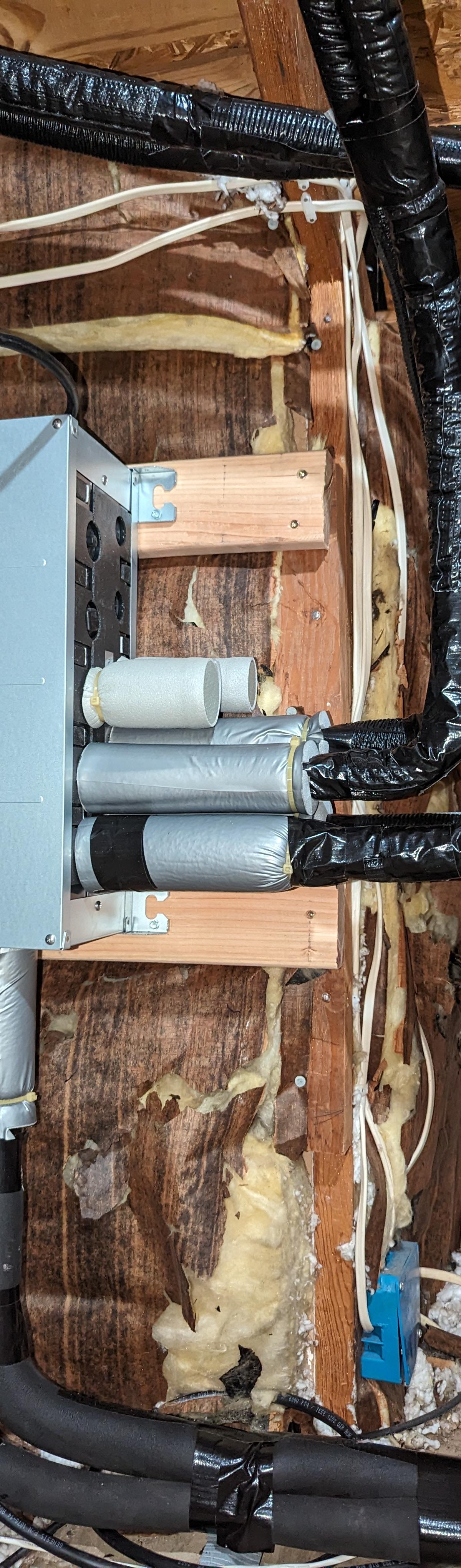
The system utilizes a Mitsubishi MXZ-60 outdoor unit with a PAC-MK30 branch box, connecting a 2.5-ton and a 3-ton air handler.
2. Addressing Extreme Weather with Conservative Sizing
Our design philosophy, especially in Texas, is to be conservative—meaning we slightly oversized the capacity. Why? Because Texas weather demands it. With summer 2023 seeing 30 consecutive days above 85°F at night and winter storms driving temperatures down to 0°F, variable speed units offer the necessary flexibility and security.
The beauty of the Mitsubishi Mini VRF system is its modulation. It can use as little as 15% of its capacity, ensuring it runs efficiently and, crucially, excels at removing humidity without always operating at max speed.
3. Correcting Critical Airflow Issues
An energy-efficient home is only as good as its airflow. During the process, we discovered that the original wall returns were not ducted properly and were pulling unconditioned air directly from the attic. This required immediate correction:
Sealing: We sealed off all attic return areas with duct board and mastic to ensure air was pulled solely from the conditioned space.
Adding Capacity: We added several ceiling returns to accommodate the higher airflow needs of the new 5.5-ton (2.5T + 3T) zoned system.
4. The Envelope Upgrade: Spray Foam Insulation
To truly reduce the heat load on the house, we removed the old insulation and installed spray foam insulation on the roof deck. This envelope upgrade was essential for pairing with the new HVAC system, helping to keep the entire 2,700 sq. ft. home consistently comfortable and efficient. The Results
The combination of a properly designed, high-efficiency Mitsubishi multi-zone system and a fully sealed, insulated roof deck provides the customer with:
Balanced Comfort: True dual-zone control, finally solving the uneven temperature problems.
High Efficiency: A modern, modulating system that uses minimal energy while offering ample capacity for extreme Texas weather.
Peace of Mind: The system is designed to handle temperatures below the customer's typical set-point (75-78°F), leaving flexibility for events or unusually hot periods.