
Texas faces a 74 billion water crisis over the next 50 years, and North Texas — with DFW projected to grow to 12 million by 2050 — sits at the epicenter. What homeowners need to know about supply shortfalls, city restrictions, and conservation actions you can take now.
Executive Summary
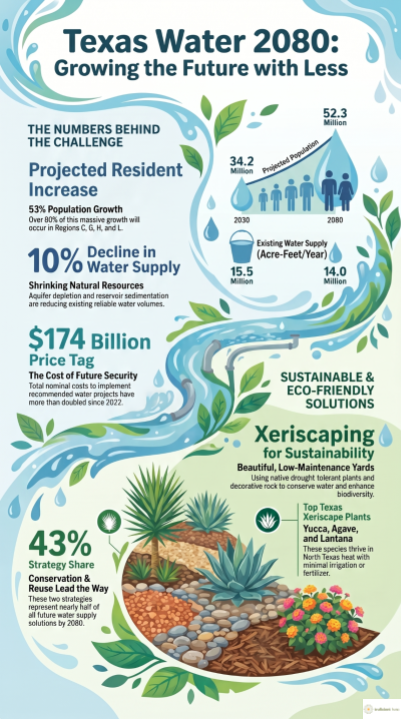
Texas is facing an escalating water crisis that will intensify across the next five decades. According to a landmark state analysis released in April 2026, Texas communities will need to spend $174 billion over the next 50 years just to avert a severe water crisis — more than double the $80 billion projected just four years ago. North Texas, the fastest-growing region of the state, sits at the epicenter of this challenge. With the Dallas-Fort Worth metroplex projected to balloon from roughly 8.3 million residents today to over 12 million by 2050, and with water supplies simultaneously expected to shrink, the region faces a "perfect rainless storm" of compounding pressures that every homeowner should understand now — before the taps tighten.[1][2][3][4]
The Texas Tribune Article: What You Need to Know
The April 15–16, 2026 Texas Tribune investigation — "Texas needs at least $174 billion to avoid water crisis, state says" — serves as a critical wake-up call for all Texans. The report follows the Texas Water Development Board's authorization of a new 50-year draft water plan, the most expansive and alarming in the state's history.[1]
Key findings from the article include:[5][1]
- Texas communities will need $174 billion over 50 years to avert a water crisis — more than double the 2022 projection of $80 billion.
- The state's water supplies are expected to drop by roughly 10% between 2030 and 2080.
- The maximum amount of water communities can draw is also projected to decline by 9% in that same window.
- The plan encompasses 3,000 projects, from regional infrastructure upgrades to drilling new water wells.
- If Texas does nothing, a single severe drought in 2030 could trigger an estimated $91 billion in economic damages.
- The $20 billion water package voters approved in 2025 "falls dramatically short of the needed cash," according to experts quoted in the article.[1]
Perry Fowler, executive director of the Texas Water Infrastructure Network, issued a stark warning: "What this number tells me at the end of the day is if we don't get serious about funding water projects, there are going to be serious consequences for Texas."[1]
Jeremy Mazur of think tank Texas 2036 went further, noting that the $174 billion figure only covers water supply projects and does not account for aging infrastructure — meaning the actual price could reach a quarter of a trillion dollars.[1]
North Texas in the Crosshairs: Population Growth
No region in Texas — or arguably the country — is facing the intersection of explosive growth and water scarcity more acutely than North Texas.
DFW Growth by the Numbers
- The DFW metroplex currently houses approximately 8.3–8.6 million people (as of 2024–2025).[6][7]
- From July 2023 to July 2024 alone, the region added an estimated 177,922 new residents — averaging roughly 487 new people every single day.[7]
- DFW's population is projected to grow from 8 million to 12 million by 2050, and to as many as 14.7 million by 2070.[8][4]
- By 2060, North Texas's population is estimated to have grown to more than 13 million, with water demands in the area increasing by 86 percent.[9]
- The 16-county North Texas region is expected to grow by 91 percent over the next 50 years.[9]
- Official state projections suggest DFW could surpass Los Angeles by 2060 to become the second most populous metropolitan area in the nation.[10]
Collin County and Denton County — two of the fastest-growing counties in the state — are each projected to more than double their populations by 2050. The suburban sprint northward from Dallas has been documented, with cities like Frisco, McKinney, Allen, and Prosper absorbing tens of thousands of new residents annually.[11]
Water Demand vs. Supply: A Widening Gap
The math is unforgiving. North Texas depends on surface water resources for more than 90 percent of its water supply, and North Central Texas is expected to face an estimated supply shortfall of 456 billion gallons of water by 2070. The Texas Water Development Board projects the state's existing water supply will decrease by 18 percent by 2070 while demand increases by 9 percent. By 2030, without implementation of key water strategies, the state's municipal supply could fail to meet demand if a severe drought strikes.[12][13][9]
The Region C Water Planning Group — which covers 16 counties including Collin, Dallas, Denton, Ellis, Kaufman, and Tarrant — projects its population to exceed 15.1 million by 2080 and has identified more than 170 water management strategies at a total estimated cost of roughly $49 billion. Notably, nearly 45% of new water supplies called for in the plan will come from conservation and reuse.[14]
The "Perfect Rainless Storm": Climate Change + Growth
Water planning experts are sounding increasingly urgent alarms about the dual threats confronting North Texas.
Robert Mace, executive director of the Meadows Center for Water and the Environment at Texas State University, described the situation succinctly: "The combination of rapidly increasing population and these warming temperatures and what it means for increasing drought in Texas, it's like the perfect rainless storm of challenges that we're facing."[2]
Mace warned that traditional water planning benchmarks are becoming obsolete. Texas water plans have historically been modeled around the 1950s "drought of record," a severe seven-year drought. But climate change is producing more frequent droughts that surpass that historical benchmark. As of mid-2025, nearly 30% of Texas was experiencing "extreme drought", with another 16% under "exceptional drought".[2]
"If the warming continues, the expectation is that we're going to see less water coming into our rivers, which means less water coming into our reservoirs," Mace stated. He added that with some cities and counties expected to triple or quadruple in population over the next 50 years, "the easy water is gone."[2]
Climate data validates these concerns:
- Medina Lake (Texas Hill Country) fell to just 2.1% capacity in 2025.[15]
- Lake Travis dropped more than 40 feet below full capacity during the 2025 drought.[15]
- The Barton Springs–Edwards Aquifer Conservation District declared an exceptional drought, triggering mandatory reductions of 30–100% in groundwater pumping across Central Texas.[15]
- The Ogallala Aquifer — the largest aquifer in the United States, underlying the Texas Panhandle — is being depleted faster than it can naturally recharge, with groundwater availability projected to fall 25 percent from 2020 to 2070.[16][17]
Corpus Christi: A Warning Shot for All of Texas
While North Texas has more water infrastructure than South Texas, the crisis unfolding in Corpus Christi in 2026 is a harbinger of what inadequate planning can produce — and it's happening now.
A historic, multi-year drought has depleted Corpus Christi's water reserves so gravely that the city, home to roughly 317,000 people and a major petrochemical hub, is scrambling to prevent a full-scale water shortage. By April 2026, city leaders warned that a Level 1 water emergency could be triggered as soon as May 2026, when the city's water supply would be projected to fall short of demand within 180 days.[18][19][20][21]
The Texas Tribune article cites Corpus Christi as a present-tense warning for the rest of Texas: "This week, Corpus Christi officials said the city may be just months away from declaring a water emergency. Meanwhile, other rural cities by the Coastal Bend are rapidly drilling wells to avoid a crisis. Residents in North Texas have also been bracing for groundwater shortages."[1]
The Corpus Christi situation has prompted direct intervention from Governor Greg Abbott and renewed urgency from state planners. The city manager acknowledged: "We just have not kept up with water supply and water infrastructure like we should have. And it's decades in the making."[21]
What North Texas Cities Are Doing Right Now
North Texas water utilities are not waiting for a crisis before imposing conservation measures. In fact, restrictions are in place across the region even in years when reservoir levels appear relatively stable — a proactive strategy that reflects just how seriously water managers take the long-term threat.
Dallas Water Utilities
Dallas operates under a permanent water conservation ordinance that limits outdoor irrigation to a maximum of twice per week based on address (even or odd), with no watering permitted between 10 a.m. and 6 p.m. from April 1 through October 31. The city's ordinance notes that outdoor water usage can exceed 50% of total summer water use, making irrigation control critical to extending existing infrastructure and delaying costly future expansion. Dallas also operates a tiered water rate system — the more water used, the higher the rate — designed to financially incentivize conservation.[22]
Fort Worth / Tarrant Regional Water District
Fort Worth enforces year-round outdoor water restrictions as part of its formal water conservation and drought management plans. Residential watering is assigned to two specific days per week based on address (even addresses water Wednesday and Saturday; odd addresses water Thursday and Sunday), with no irrigation by sprinkler permitted on Mondays and no irrigation between 10 a.m. and 6 p.m. on any day. Violations result in administrative fees on water bills, with repeated violations triggering escalating penalties.[23]
The Tarrant Regional Water District (TRWD), which supplies water to Fort Worth and surrounding communities, updated its Integrated Water Supply Plan in August 2025 to chart a 50-year course through population growth and climate uncertainty. As of January 2026, TRWD's reservoirs — including Arlington, Benbrook, Bridgeport, Cedar Creek, Eagle Mountain, and Richland-Chambers — were all below their conservation pool levels, even outside of a declared drought emergency.[24][25][26]
Frisco
Frisco's City Council unanimously approved a Water Efficiency Plan in May 2024, with the new rules in place as of 2025. The plan limits irrigation with sprinkler or rotor systems to once per week — specifically, the same day as the homeowner's trash/recycling pickup. Watering is prohibited between 10 a.m. and 6 p.m. from April 1 through October 31. This represents a significantly more restrictive posture than traditional twice-weekly schedules.[27]
McKinney
McKinney operates a tiered drought response system. Under Stage 2 Drought Response, even-addressed properties may irrigate only on Monday, Wednesday, and Friday; odd-addressed properties water Sunday, Tuesday, and Thursday — with no irrigation on Saturday at all. Each irrigation zone is capped at 30 minutes per day. McKinney has also implemented smart irrigation standards, requiring all systems to have functional rain/freeze sensors.[28][29]
Richardson
Richardson implements its Summer Water Conservation Plan each year from April 1 through October 31, assigning even-numbered addresses to water Tuesdays and Saturdays, and odd-numbered addresses to water Wednesdays and Sundays. Irrigation between 10 a.m. and 6 p.m. is prohibited, and the North Texas Municipal Water District (NTMWD) can impose more severe restrictions during drought conditions.[30][31][32]
North Texas Municipal Water District (NTMWD)
The NTMWD currently supplies water to more than 2.3 million residents — a service area that grew from 2 million in 2020 — and projects its service area population will reach 4.5 million by 2080. The District is investing an estimated $1.7 billion during fiscal year 2026 alone as part of its capital improvement program, with more than $1.3 billion devoted specifically to water supply reliability, including the "Texoma Two-Step" — two new pipelines from Lake Texoma to NTMWD treatment plants, with completion targeted for late 2029. In its 2024 Water Conservation Plan, NTMWD acknowledged that conservation and reuse already account for about 30% of the water it supplies — equivalent to an entire reservoir's worth of supply.[33][34][35][36]
Texas' Strategic Response: Big Projects, Big Price Tags
The 2027 State Water Plan draft — authorized by the Texas Water Development Board in April 2026 — outlines the roadmap for addressing the crisis. Key strategies include:[37][38][5]
| Strategy | Description |
|---|---|
| New Reservoirs | 23 new major reservoirs identified, including the controversial Marvin Nichols Reservoir in Northeast Texas, which would serve DFW into the 22nd century[8][39] |
| Water Pipelines | The single largest project: a ~$10 billion pipeline to transport water from Toledo Bend Reservoir on the Louisiana border to DFW[5] |
| Aquifer Storage & Recovery | Injecting water into aquifers during wet periods for extraction during droughts |
| Brackish Groundwater Treatment | Treating salty, non-potable groundwater for use |
| Desalination | Projected to supply ~4% of future water supply[5] |
| Conservation & Reuse | Nearly 45% of new water supplies in Region C's plan will come from this source[14] |
| Infrastructure Repair | Texas loses approximately 186 billion gallons annually to leaking pipes[40] |
Voters approved Proposition 4 in November 2025, dedicating up to $20 billion in sales tax revenue to the Texas Water Fund from 2027 to 2047. While historic, experts note this amount still falls far short of the $174 billion need identified in the 2027 State Water Plan.[41][1]
What North Texas Homeowners Can Do Today
Every gallon saved by homeowners contributes to extending existing supplies and reducing pressure on infrastructure that is already under immense stress. The following actions are practical, cost-effective, and — in many cases — already required by your city's ordinances.
Outdoor Water Conservation (The Biggest Impact)
Outdoor irrigation represents more than 50% of residential summer water use. Reducing this single category has an outsized effect.[22]
- Follow your city's watering schedule strictly. Dallas, Fort Worth, Frisco, Richardson, McKinney, and virtually every North Texas city has a designated watering day schedule. Know yours and stick to it.
- Never water between 10 a.m. and 6 p.m. Most North Texas cities prohibit this for good reason: evaporation rates during peak heat hours can rob your lawn of 30–50% of the water you apply. This applies in cities including Dallas, Fort Worth, Frisco, Richardson, and McKinney.[29][23][27][30][22]
- Install a smart irrigation controller. "Smart" or weather-based controllers automatically skip watering cycles when rain has been recent or conditions don't require it. They can reduce outdoor water use by 20–50% over standard timer-based systems.[42]
- Check your irrigation system for leaks regularly. A single broken sprinkler head can waste hundreds of gallons per week.[42]
- Shift to drip irrigation. Drip systems deliver water directly to root zones, bypassing evaporation. Most North Texas city ordinances exempt drip irrigation from day/time restrictions, allowing homeowners to use drip systems any day, any time.[32][30]
- Use a rain barrel. Collecting rainwater from roof runoff for garden and landscape use is legal in Texas and reduces demand on treated municipal water.[42]
Xeriscaping: The Long Game
The most durable water savings come from reducing how much landscape irrigation is needed in the first place. Xeriscaping — landscaping that uses low-water or native plants — is well-suited to North Texas's climate and increasingly encouraged by HOAs and city ordinances.[43]
Native plants and drought-resistant species that thrive in North Texas include:[44][43]
- Texas Sage (Leucophyllum frutescens) — evergreen shrub with silver-green foliage and purple blooms
- Lantana — colorful blooms in warm shades, attracts pollinators, loves full sun
- Red Yucca (Hesperaloe parviflora) — attracts hummingbirds, excellent for borders and rock gardens
- Little Bluestem — a native ornamental grass that provides seasonal color and texture
- Agave and Yucca varieties — iconic, drought-resistant structural plants
- Muhly Grass and Feathergrass — movement, texture, and soft contrast to desert-style beds
Replacing traditional turf with native groundcovers, mulch beds, or decomposed granite can dramatically reduce long-term irrigation needs while also reducing maintenance costs.[43][44]
Indoor Water Conservation
- Fix leaks immediately. A dripping faucet wastes thousands of gallons per year. Texas loses approximately 186 billion gallons annually from leaking pipes statewide — a loss that starts at the individual level.[40]
- Install WaterSense-labeled fixtures. WaterSense-certified faucets, showerheads, and toilets use significantly less water without sacrificing performance.
- Run full loads. Only run dishwashers and washing machines with full loads.
- Check for toilet leaks. A running toilet can waste up to 200 gallons per day. Add a few drops of food coloring to your tank — if it seeps into the bowl without flushing, you have a leak.
- Take shorter showers. Cutting shower time by two minutes saves roughly 10 gallons per shower.
Know Your City's Drought Stage Response
Every North Texas city has a multi-stage drought response plan. Stage 2 conditions in McKinney, for example, drop irrigation to three times per week and cap zone run times at 30 minutes. Stage 3 restrictions in some North Texas districts have historically limited landscape watering to once every two weeks. Knowing where your city stands — and staying ahead of restrictions rather than reacting to them — is the smart homeowner's approach.[45][28]
The North Texas Municipal Water District maintains updated conservation resources at ntmwd.com, and the Tarrant Regional Water District publishes monthly water resource updates tracking reservoir levels at each of its lakes.[25][24]
The Broader Picture: Conservation as a Civic Responsibility
The water crisis arriving in North Texas is not a distant abstraction. The Corpus Christi emergency of 2026, the below-conservation-pool reservoir levels across TRWD's system, and the $174 billion price tag revealed by the 2027 State Water Plan are data points in a trend that has been building for decades. As Sarah Kirkle, director of policy at the Texas Water Association, told the Texas Tribune: "Population growth, extreme weather, and economic development needs are all increasing demands on our infrastructure, and the state is going to need more water, sooner."[19][18][25][1]
For North Texas homeowners, the connection between individual water habits and regional water security is real. Conservation extends existing supply, reduces strain on treatment infrastructure, and delays the need for costly new projects that will ultimately be reflected in water rates. The NTMWD saved more than 26 million gallons of water in a single year — roughly 20% of the municipal supply — through conservation education programs targeting irrigation practices.[46]
At Truficient Energy Solutions, our commitment to efficiency extends beyond HVAC systems to the broader question of how we use and conserve the resources that power our homes and communities. Water and energy are deeply linked — treating and moving water is energy-intensive, and wasting water means wasting energy. Helping North Texans stay informed about these converging challenges is part of how we fulfill our mission to provide the professional's edge in home efficiency.
Sources: Texas Tribune (April 2026), Texas Water Development Board, North Texas Municipal Water District, Tarrant Regional Water District, Texas Standard, KERANEWS, Texas Comptroller's Office, Dallas Federal Reserve, Texas 2036, and city-level water conservation programs for Dallas, Fort Worth, Frisco, McKinney, and Richardson.
---
References
- Texas needs at least $174 billion to avoid water crisis, state says — That new amount is more than double the amount predicted four years ago. The new forecast comes as s...
- 'Perfect rainless storm': North Texas water planning faces climate ... — As regions work on new 50-year water plans, experts say North Texas faces dual crises to meet increa...
- Texas weighs $174 billion plan to avert water crisis — The $174 billion price is more than double the $80 billion cost that the Texas Water Development Boa...
- Dallas-Fort Worth's population is predicted to grow from 8 million to ... — Dallas-Fort Worth's population is predicted to grow from 8 million to 12 million by 2050, and The Ne...
- Texas' plan to meet future water demand swells to $174 billion — The largest project in the plan, coming in at a price tag of about $10 billion, is a plan to pipe wa...
- Population Forecast | Dallas-Fort Worth-Arlington, TX — PopStat's Trend models indicate a 5 year population change of 6.1%, resulting in a Population of 9,0...
- DFW population surges but it no longer leads nation : r/Dallas - Reddit — DFW added an estimated 177,922 residents from July 1, 2023 to July 1, 2024, to reach an estimated 8....
- Population growth — and climate change — may force Texans to ... — Regional planners in Dallas-Fort Worth are looking for ways to ensure residents have enough water fo...
- Water Scarcity in North Texas | Natural Awakenings Dallas -Fort Worth Metroplex Edition — North Texas’ water woes are well documented; from the “Red River Smackdown” war between Texas and Ok...
- Dallas-Fort Worth to Top Los Angeles? Official State Population ... — Over the following 10 years, the gap is projected to increase to nearly 5,000,000, with Texas at 44....
- Innovative Water... — Comptroller’s Report Highlights Challenges, Progress in Providing Water for a Growing State
- Texas is running out of water. Here's why and what state leaders plan to do about it. — The state’s water supply faces numerous threats. And by one estimate, the state’s municipal supply w...
- North Texas' 2026 Water Plan is drafted. Here's how the public can ... — Region C's plan projects its population to exceed 15.1 million by 2080, and recommends more than 170...
- The state of water in Texas: challenges, innovation, and the rise of ... — Texas faces mounting pressure on its water supplies in 2026. The state's population and economic act...
- Shoring up water supply, curbing demand key to Texas' future growth — Funding for water infrastructure improvements has emerged as a priority for the Legislature during i...
- Texas aquifer is running dry, jeopardizing agriculture industry — The Ogallala Aquifer serves farming communities in multiple states. When it runs dry, the agricultur...
- Corpus Christi water emergency may be just two months away, city ... — Corpus Christi city leaders warn a Level 1 water emergency could be triggered by May 2026 as reservo...
- Corpus Christi Water Crisis and What Comes Next — Local officials have warned that, under worsening conditions, the region could approach critically l...
- How Corpus Christi is trying to avoid a water crisis - The Texas Tribune — A historic drought has gripped Corpus Christi, the eighth-largest city in Texas, placing unprecedent...
- Years of drought has Corpus Christi, Texas, wrestling with water crisis — The city is in a water emergency when it has 180 days before water supply can't keep up with demand....
- City of Dallas Water Conservation Ordinance — Maximum twice-weekly watering allowed according to address (see chart below). · Don't water your yar...
- Year-round outdoor watering requirements - the City of Fort Worth — No watering by irrigation systems or sprinklers between 10 a.m.-6 p.m. · Watering by hand-held hose ...
- Planning for Our Water Future: TRWD's Integrated Water Supply ... — This includes conservation ... The public may submit feedback through the public inquiry form or by ...
- January 2026 Water Resources Update — Want to know more about the state of the TRWD system? See the Water Resources Update as presented by...
- Water Efficiency Plan | Frisco, TX - Official Website — No watering between 10 a.m. to 6 p.m. from April 1 to October 31. The option to water using a hand-h...
- Stage 2 Drought Conditions - McKinney Water District — Landscaping, lawns, and open ground must not be watered: (1) between the hours of 10:00 AM and 4:00 ...
- Outdoor Water Use | McKinney, TX - Official Website — April 1 - October 31: No watering between 10 a.m. and 6 p.m. This allows the ground to absorb the wa...
- 2025 Richardson Water Restrictions — Richardson's 2025 Summer Water Conservation Plan sets clear, citywide rules to reduce waste and keep...
- Summer Water Conservation Begins April 1 | Richardson Today — Sprinkler system watering is not permitted between 10 a.m.-6 p.m. from April 1-Oct. 31, unless the N...
- Landscape Watering Schedule Changed to Summer Conservation — The plan restricts the times for sprinkler system irrigation citywide to evening, night and early mo...
- NTMWD Presents Annual Update - Richardson Today
- NTMWD Investing More Than $1.7 Billion in Regional Infrastructure in ...
- Planning for the Future | North Texas Municipal Water District, TX — Water is a finite resource that is essential for our quality of life.
- News Flash • NTMWD Investing More Than $1.7 Billion in Regio
- 2027 State Water Plan - Texas Water Development Board — The 2027 plan identifies thousands of actionable strategies and projects—complete with projected cos...
- Mission Critical: The State Water Plan, Explained — The 2022 State Water Plan detailed water conservation and drought management strategies for municipa...
- North Texas searches for more water as growth and climate change ... — Regional planners in Dallas-Fort Worth are looking for ways to ensure residents have enough water fo...
- Water Wonks 2026 lecture 2:How Water Utilities Can ... - YouTube — ... water supply are very similar while other methodologies seem very different. Suzanne will talk a...
- Around the Bend: A Water Policy Recap and a 2026 Look Ahead — 2025 joined the ranks of 1917, 1957, and 1997 as landmark years in the history of Texas water infras...
- Outdoor Conservation Tips | TxWaterCo | Make Every Drop Count — Use native and drought tolerant plants that do not require a lot of water. Check out our Plant List ...
- HOA-friendly Xeriscaping ideas and options - Lawns of Dallas — Xeriscaping offers a sustainable, visually appealing way to conserve water, reduce maintenance, and ...
- Top Xeriscape Plants for North Texas Yards in 2025 — Xeriscaping uses resilient, low-water plants and smart design techniques to minimize irrigation need...
- Tips for a Healthy Lawn Under Stage 3 Water Restrictions — The limitation of landscape watering to once every two weeks will continue with subsequent monthly e...
- Can Texas Avoid a Water Crisis? - Governing Magazine — If nothing is done, residential water supplies may stop flowing within the next few decades. Legisla...