
Zoning is one of the most powerful ways to improve home comfort and cut energy waste — but the equipment behind the zones matters just as much as the zones themselves. Not every system handles zoning equally. This guide breaks down five tiers of zoning from worst to best, explains the physics, and shows why variable speed and multi-zone systems are the gold standard for homeowners who want real comfort and efficiency.
The Core Problem: Static Pressure
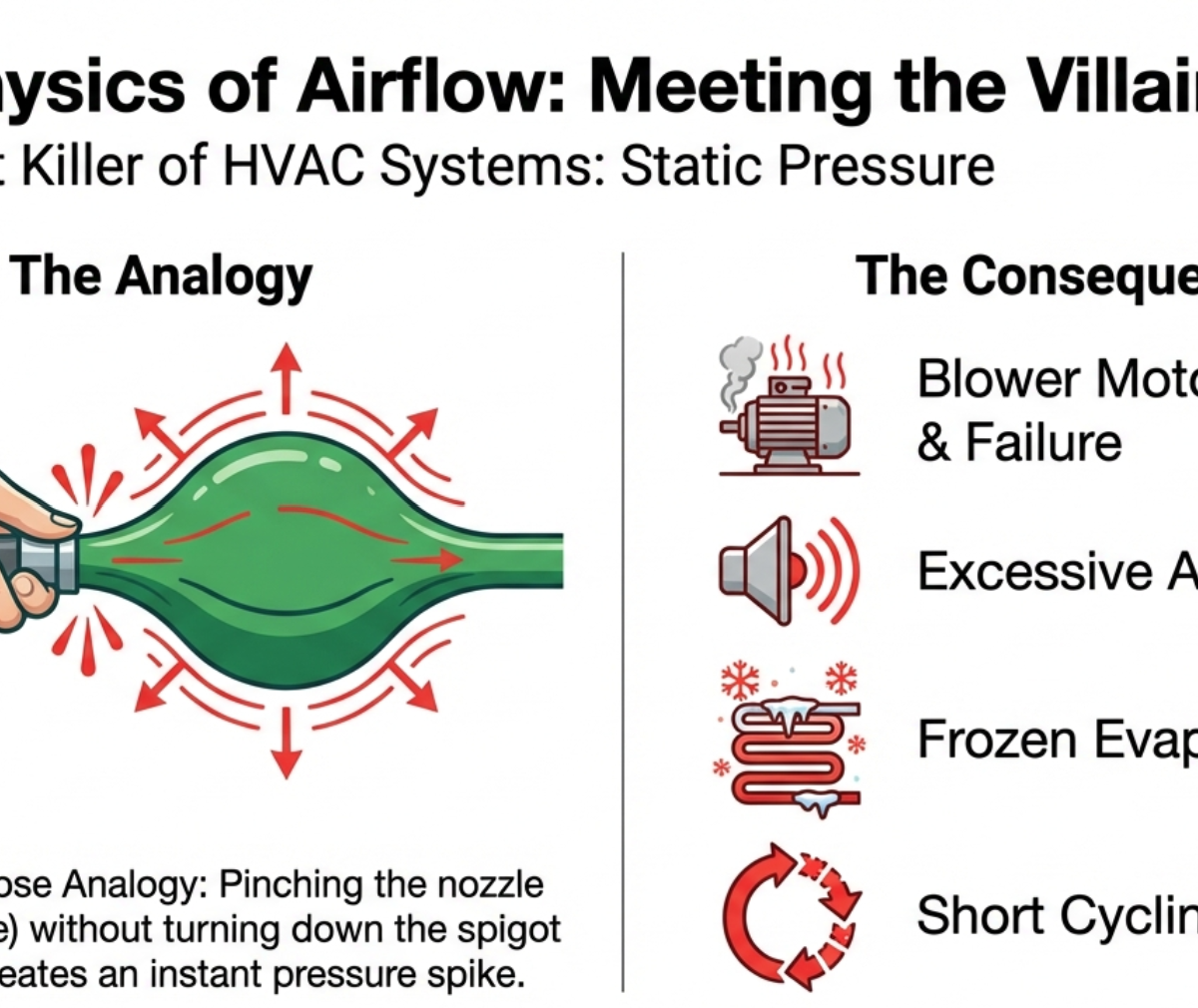
Before diving into system types, every homeowner needs to understand one concept: static pressure. When zone dampers close to redirect airflow, the remaining open ductwork has to handle the full output of the blower. If the equipment can't reduce its output to match, pressure spikes inside the ducts. This leads to:
Blower motor strain and premature failure
Loud air noise through supply registers
Short cycling (system turns on and off too quickly)
Frozen evaporator coils
Poor humidity removal
Higher energy bills
The way each system type manages this pressure problem is what separates good zoning from bad zoning.
Tier 1: Single Stage Systems with Zoning
How It Works
A single-stage system has one speed: full blast. It runs at 100% capacity until the thermostat is satisfied, then shuts off completely. When you add zone dampers to this type of system, you create a serious airflow mismatch — the blower pushes the same volume of air regardless of how many zones are calling.
The Bypass Damper Band-Aid
To prevent the system from destroying itself, installers add a bypass damper — a short-circuit duct that dumps excess supply air back into the return plenum. While this prevents equipment damage, it recirculates already-cooled air (around 55°F) back over the coil, which can drop temperatures to freezing and coat the evaporator in ice.
Pros
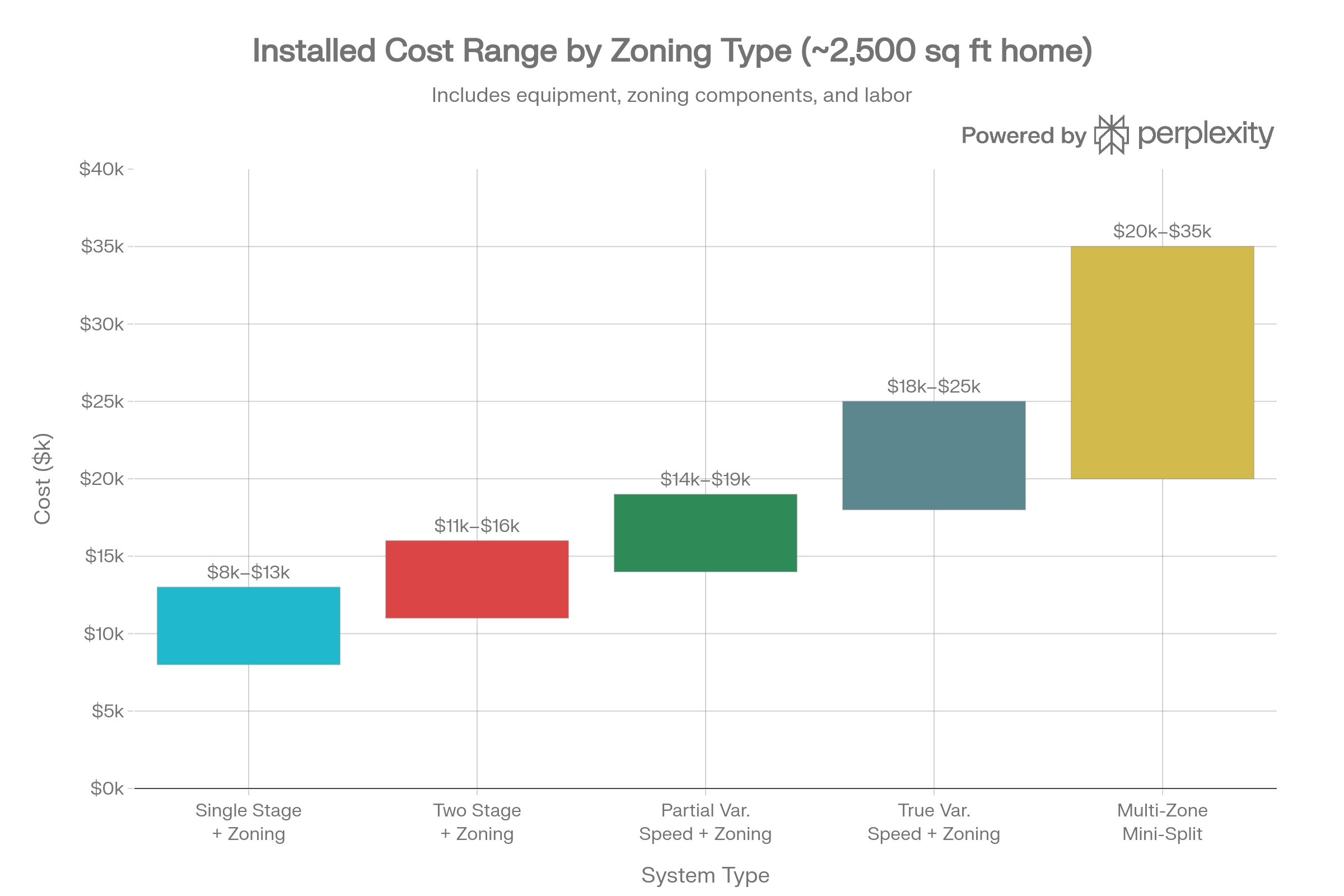
Lowest equipment cost (single-stage furnace installed: $2,000–$4,000)
Simple operation and widely available parts
Familiar to virtually all HVAC technicians
Cons
Not recommended for zoning — high static pressure when dampers close
Bypass dampers waste energy by recirculating cold air
Prone to short cycling and poor humidity control
Uneven temperatures and noisy operation
Risk of frozen coils and premature blower motor failure
Verdict
Can it be done? Technically, yes. Should it be done? Not if you can avoid it. If a single-stage system is already installed and you have zones, a bypass damper is the minimum safety measure needed. But waiting to upgrade to variable speed equipment is the far better path.
Tier 2: Two-Stage Systems with Zoning
How It Works
A two-stage system operates at two capacity levels — typically around 65–70% (low stage) and 100% (high stage). The system automatically selects the appropriate stage based on demand. When only one zone is calling, the system can drop to low stage, reducing both airflow and capacity.
Why It's Better Than Single Stage
Low-stage operation reduces the volume of air the system pushes through the ductwork. This meaningfully lowers static pressure when some zones close. Many two-stage systems paired with proper zoning boards can deliver decent comfort without massive bypass dampers — or in some cases with only a small bypass.
Pros
More consistent indoor temperatures than single stage
Quieter operation on low stage
Better humidity removal due to longer, lower-capacity run times
Moderate equipment cost (mid-range between single stage and variable speed)
Some humidity control improvement
Cons
Still only two operating points — not precise enough for fine-tuned zoning
May still require a bypass damper in multi-zone configurations
Struggles to balance airflow in larger homes with many zones
Higher upfront cost than single stage
Less precise than variable speed systems
Verdict
Two-stage systems are a solid middle ground. You can get good results, especially in homes with two or three zones where the smallest zone isn't drastically undersized. They're a reasonable option for homeowners who want better comfort without the full investment of variable speed.
Tier 3: Partial Variable Speed Systems with Zoning
How It Works
"Partial variable speed" refers to systems where either the outdoor compressor or the indoor blower (or both) can modulate, but the system doesn't have full communicating capability between all components. The most common version: a variable-speed or multi-speed indoor blower (ECM motor) paired with a two-stage or basic inverter outdoor unit.
These systems can ramp blower speed up or down in response to static pressure changes. When only one zone calls, the blower reduces speed, reducing the amount of air forced through the open zone.
The Bypass Situation
Partial variable speed systems dramatically reduce the need for bypass, but may not eliminate it entirely. In systems with high zoning variation — say, a small bedroom zone that's only 20% of total airflow — the blower and compressor may not ramp down far enough to match. A small bypass or "dump zone" strategy (always leaving one large area partially open) may still be needed.
Pros
Fantastic for zoning — can closely match capacity with outdoor unit output
Significant energy savings over single and two-stage
Quieter operation at reduced speeds
Better humidity control through longer, lower-speed cycles
Compatible with smart zoning boards and communicating thermostats
Cons
Indoor blower may still need a small bypass or dump zone for extreme zoning scenarios
Higher equipment cost than two-stage
More complex installation and commissioning
Requires knowledgeable HVAC contractor
Verdict
This is where zoning starts to really shine. Partial variable speed systems deliver excellent airflow to each zone and can match outdoor capacity closely. The remaining limitation — the occasional need for a small bypass — is minor compared to the comfort and efficiency gains. For most homeowners, this tier represents a major upgrade in daily comfort.
Tier 4: True Variable Speed Systems with Zoning
How It Works
True variable speed means both the outdoor compressor (inverter-driven) and the indoor blower modulate continuously. These are communicating systems where the thermostat, zone board, air handler, and outdoor unit all talk to each other in real time. Examples include the Carrier Infinity with Greenspeed Intelligence, the Trane XV20i with TruComfort, and similar flagship products.
The compressor adjusts in increments as small as 0.1% of capacity. If only one small zone is calling and the demand is 40% of total capacity, the compressor runs at 40% and the blower ramps down proportionally. No pressure spike. No bypass needed.
Why This Eliminates Bypass Dampers
With true variable speed, the system modulates capacity and airflow to match whatever the zones demand. As long as the smallest zone represents roughly 25–40% or more of total system capacity, there is absolutely no need for a bypass damper. The system simply runs at the exact output required, maintaining proper static pressure at all times.
The Trane XV20i, for example, adjusts in 1/10 of 1% increments and maintains within 0.5°F of the thermostat setting. The Carrier Greenspeed can modulate down to 40% of full capacity with its inverter compressor.
Pros
Maximum energy efficiency — the system only uses the energy needed at any given moment
Eliminates bypass dampers in properly designed systems
Superior humidity control through long, low-speed dehumidification cycles
Very quiet operation (Trane XV20i: ~55 dB; among the quietest in the industry)
Ideal for smart home integration and communicating zoning
Fewer hot and cold spots — truly balanced airflow
Systems rated up to 22–26 SEER2, cutting cooling costs by 45–50% vs. old 10-SEER units
Equipment lifespan of 15–20 years with proper maintenance
Cons
Highest upfront cost for a ducted central system ($18,000–$25,000+ installed for a ~2,500 sq ft home)
Complex components mean costlier repairs if something fails
Requires a qualified contractor experienced with communicating systems
Ductwork may need inspection or upgrades to handle variable airflow properly
Payback
While variable speed equipment costs $2,500–$4,000 more than single-stage, it can pay for itself in 5–7 years through lower energy bills — especially in climates like North Texas where the AC runs nearly year-round. For larger homes (3,000+ sq ft), the energy savings compound significantly because the system avoids conditioning unoccupied zones at full capacity.
Verdict
True variable speed with zoning is the best ducted solution available. It delivers balanced airflow, real energy efficiency, and eliminates the engineering compromises (bypass dampers, dump zones) that plague lesser systems. For homeowners who prioritize comfort and are planning to stay in their home long-term, this is the tier to target.
Tier 5: Multi-Zone (Mini-Split / VRF) Systems
How It Works
Multi-zone systems take a fundamentally different approach. Instead of one central air handler pushing air through a shared duct system, a single outdoor condensing unit connects to multiple independent indoor units (2 to 8 units per outdoor unit). Each indoor unit has its own thermostat and operates independently.
The outdoor compressor uses inverter technology to adjust total output based on combined demand from all active zones. Each indoor unit can be:
Ductless — wall-mounted, floor-mounted, or ceiling cassette
Ducted — concealed horizontal air handler with short duct runs
A mix of both — ducted units for main living areas, ductless units for bedrooms or additions
Why This Is the Ultimate Airflow Design
Multi-zone systems solve the static pressure problem entirely by eliminating the shared duct system. Each indoor unit has its own dedicated connection to the outdoor unit via individual refrigerant lines. There are no zone dampers, no bypass dampers, and no dump zones. Each room gets precisely the heating or cooling it needs, independently.
Key advantages of this architecture:
Short duct runs (ducted heads) or no ducts at all (ductless heads), eliminating duct losses
Precise room-by-room control — set every zone to a different temperature simultaneously
No duct chases — reduces construction complexity in new builds and renovations
Inverter-driven efficiency — many systems achieve 20–33 SEER ratings
Heating and cooling from one system — full heat pump capability
Mixed Ducted and Ductless Configurations
One of the most powerful features of modern multi-zone systems (from manufacturers like Mitsubishi, Daikin, and Fujitsu) is the ability to mix indoor unit types on a single outdoor unit. For example:
A ducted air handler serving the main living area and kitchen (hidden in a soffit or closet)
Ductless wall units in each bedroom for individual control
A ceiling cassette in a home office or media room
This flexibility lets you design the system around how the home is actually used, rather than forcing one duct network to serve every room equally.
Pros
Ultimate comfort — true independent zone control for every room
Highest efficiency available — up to 33 SEER in some models
No bypass dampers, no dump zones, no shared duct pressure issues
Eliminates duct losses (which can account for 25–30% of energy waste in traditional systems)
One outdoor unit serves the entire home (supports 2–8 indoor units)
Whisper-quiet indoor operation
Multi-stage filtration improves indoor air quality
Flexible indoor unit styles — wall, floor, ceiling, ducted
Smartphone and smart home control
Federal tax credits and utility rebates often available
Cons
Higher upfront cost — $5,000–$8,000 per zone; whole-home systems $20,000–$35,000+
Wall-mounted ductless units are visible (aesthetic concern for some homeowners)
Each indoor unit needs periodic filter cleaning
Installation requires a certified contractor experienced with refrigerant line sets
If the single outdoor unit fails, all zones lose conditioning (no redundancy)
More complex installation with individual refrigerant and electrical runs per head
Verdict
For larger homes, multi-zone systems offer the best return on energy efficiency and the highest level of comfort control. The ability to mix ducted and ductless heads means you can design the system around your lifestyle. For new construction, additions, or homes where ductwork is inadequate or nonexistent, this is the gold standard.
The Bottom Line for Homeowners
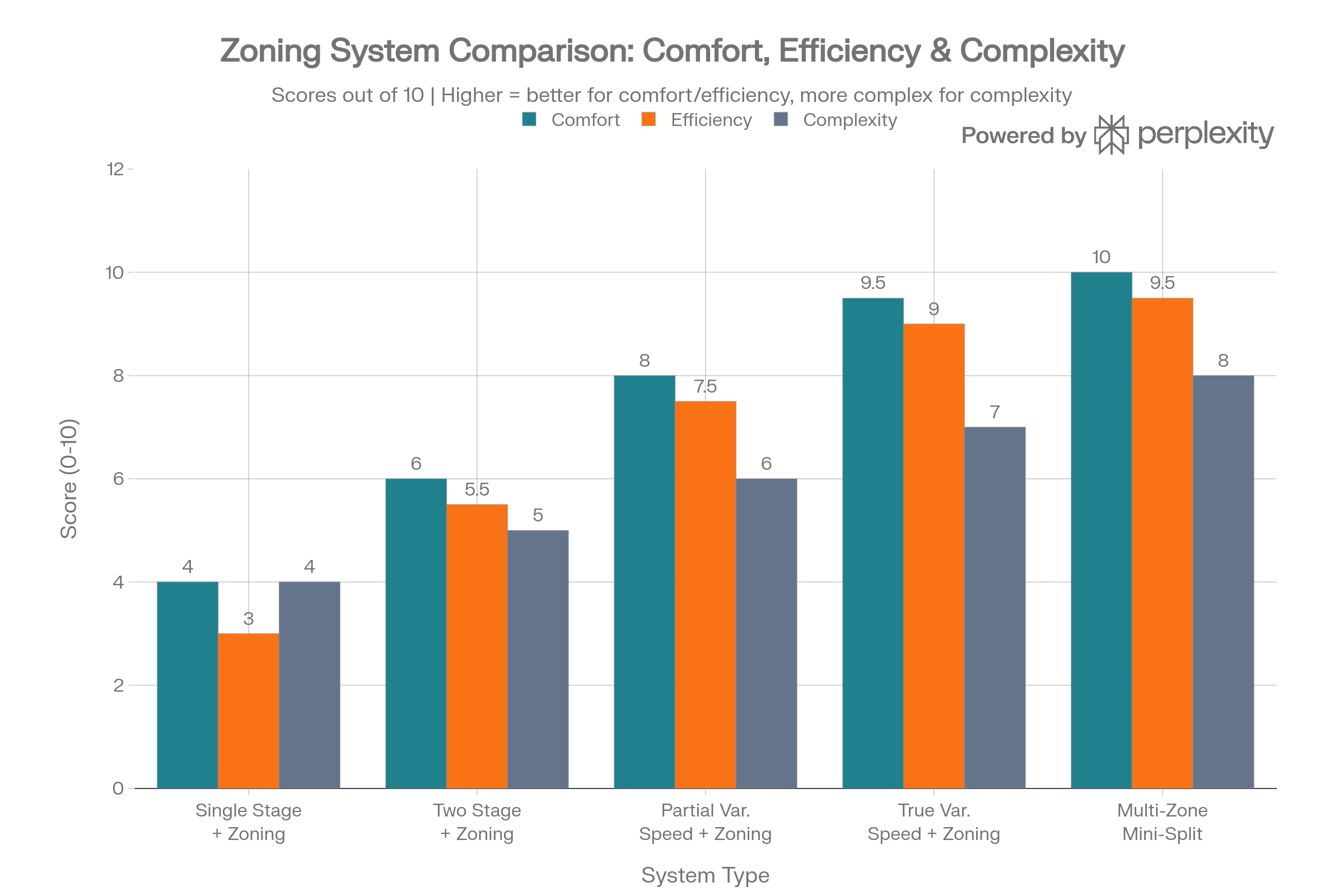
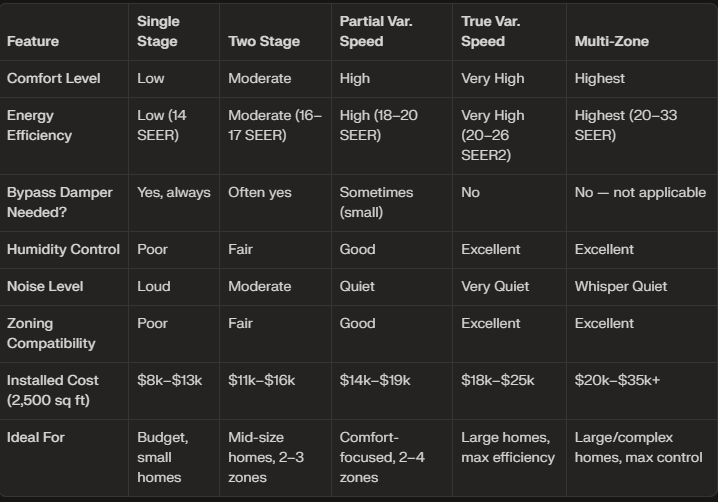
If you're in a larger home (2,500+ sq ft, multi-story, or with rooms that have very different heating/cooling needs), investing in true variable speed or multi-zone is the smartest long-term play. The upfront cost is higher, but:
Energy savings of 30–50% over single-stage systems compound every month
You eliminate the engineering band-aids (bypass dampers, dump zones) that cause problems down the road
Comfort is genuinely transformative — no more hot upstairs bedrooms, no more thermostat wars
Modern variable speed and multi-zone systems are designed to last 15–20 years
For homes where ductwork is already in great shape, a true variable speed central system with zoning delivers incredible results. For homes where ductwork is problematic, aging, or nonexistent — or where you want the absolute pinnacle of room-by-room control — multi-zone mini-split/VRF is the ultimate answer.
The key takeaway: don't zone a system that can't handle it. Match the zoning strategy to the equipment, and the equipment to the home. That's how you get real comfort, real efficiency, and a real return on your investment.