
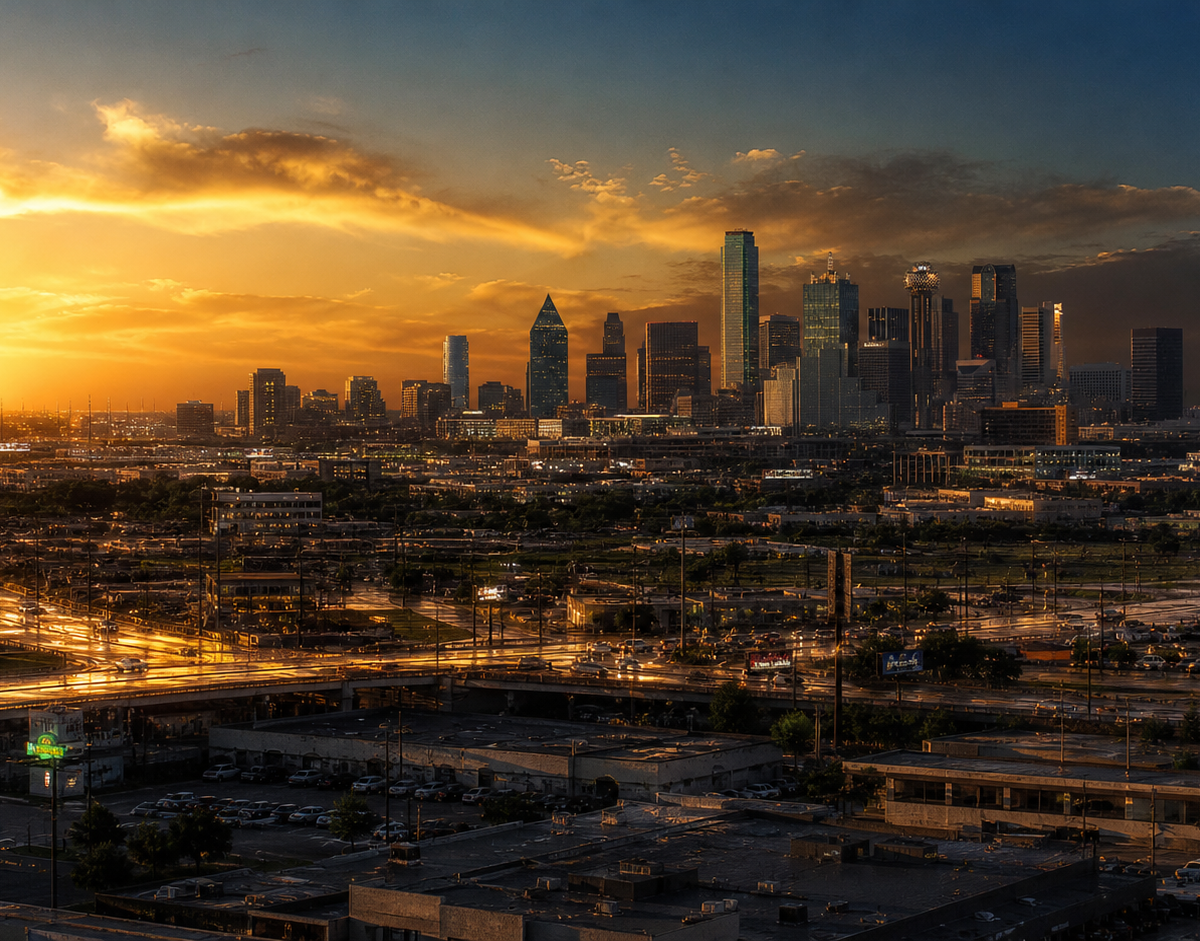
North Texas dew points are climbing — and four overlapping forces (urban heat islands, 54% more reservoir surface area, a warmer Gulf, and suburban irrigation) are reshaping what HVAC systems must handle in DFW homes and businesses.
The Moment That Changed the Conversation
On June 15, 2023, Dallas-Fort Worth residents walked outside and immediately felt something was wrong. The air was thick, suffocating, and almost impossible to breathe. What most people didn't know was that they were living inside a weather record: DFW had just tied its all-time dew point of 80°F — a level so saturating that it had been reached only five times since official record-keeping began in 1947. It wasn't just hot. It was the kind of wet heat that makes even a 95-degree day feel closer to 105.[1]
That single day was a headline. But the story underneath it has been building quietly for 30 years — and it has everything to do with how North Texas has transformed itself: millions of acres of new open water, a city that has paved over its own green space at a staggering rate, a Gulf of Mexico that is running warmer than it has in recorded history, and a climate system where the traditional relief valve — the dry western air that once cut through DFW's summer humidity — is showing up less and less often.
This is the story of why DFW's air is getting stickier. It matters for every home and business in the metroplex. And it matters especially for your HVAC system, which is fighting a moisture battle that the equipment in most DFW buildings was never designed to win.
Understanding Dew Point: The Number That Actually Matters
Before going further, it's worth explaining why dew point is the right metric to track — not relative humidity. Relative humidity is a ratio: how much moisture is in the air compared to the maximum possible at that temperature. A 60% relative humidity reading means something very different at 50°F than at 95°F. Dew point, by contrast, is an absolute measure of actual moisture in the air. It does not change with temperature.
The National Weather Service uses dew point as its preferred measure of human comfort and moisture load for exactly this reason. Their comfort scale:[1]
- ≤55°F dew point: Dry and comfortable
- 55–65°F dew point: Getting sticky; more muggy
- ≥65°F dew point: A lot of moisture in the air; oppressive
DFW's 30-year average July dew point is 70.9°F according to NWS normals — meaning the entire month of July sits, on average, well above "oppressive" and hovering near the threshold of truly dangerous heat stress. When you wake up on a typical August morning in Dallas and the air already feels like a wet blanket at 7 a.m., dew points of 73–76°F are the reason. The temperature has barely warmed yet, but the moisture content of the air is already at near-maximum.[2][3]
The broader context from NWS climate records shows that DFW's average dew point runs at 70.1°F in June, 70.9°F in July, and 70.2°F in August. Annual average dew point across all months is 54.4°F — but it's the summer months that drive real-world discomfort and real-world HVAC performance. And those summer dew points have been climbing.[2]
Why Dallas Is Getting Hotter — and More Humid — Faster Than Almost Any City in America
The Urban Heat Island: Dallas's Self-Made Climate Crisis
To understand DFW's humidity trajectory, you first have to understand what is happening at the temperature level, because heat and humidity are inseparable. Hot air holds dramatically more water vapor than cool air — roughly twice as much at 95°F versus 75°F. When you raise the urban temperature baseline, you create an atmosphere that can absorb and retain more moisture.
The 2017 Dallas Urban Heat Island Management Study, commissioned by the Texas Trees Foundation and conducted by Dr. Brian Stone of Georgia Tech's School of City and Regional Planning, made a finding that should have stopped Dallas in its tracks: Dallas is heating up faster than every major city in the United States except Louisville and Phoenix. Not hotter in absolute terms than Houston or Phoenix — but warming faster, at a rate that reflects aggressive urban expansion without proportional investment in cooling strategies.[4][5][6]
The mechanism is straightforward: Dallas has more than 35% impervious surface — rooftops, parking lots, highways, driveways, big-box store aprons — that absorb solar energy during the day and radiate it back as heat at night. The Georgia Tech study found that urban areas in Dallas can be up to 15°F warmer than rural surroundings with trees and open space. A 2024 follow-up study by the City of Dallas and NOAA, using volunteers who traversed nine routes at three different times of day, confirmed that there is now a 10-degree temperature differential between the hottest and coolest parts of the city in the evening hours. The hottest zones — Oak Lawn, Deep Ellum, the Medical District, West Dallas, Bishop Arts — are concentrated in areas with little vegetation, dense pavement, and dense building stock.[7][8][5][4]
By 2025, Dallas's Phase II Heat Island Study identified 12 degrees as the spread between the city's hottest urbanized spots and cooler areas. In the hottest sections of Dallas, the Texas Trees study found an average high of 101°F and average low of nearly 80°F across five full months of the year. An overnight low of 80°F means the air never gets a chance to dry out. Buildings never get the overnight moisture recovery that a cooler night would provide. HVAC systems run continuously without relief.[8][4]
Dr. Stone's report included a statement that should be pinned to every contractor's wall: "Cities do not cause heat waves — they amplify them. Human activities on climate at the city/regional scale, accounting for both land surface changes and emissions of greenhouse gases, may be twice as great as the impacts of greenhouse gases alone."[5]
The connection to humidity is direct: When the UHI raises overnight lows, it prevents the atmosphere from purging moisture through overnight radiative cooling. Moisture that would have dried out in a rural environment lingers in the urban atmosphere. It soaks into porous building materials. It sits on landscaping, pavement, and unconditioned attic spaces. And when the next day's Gulf air arrives, it finds an atmosphere that never fully drained — and the cycle compounds.
The Reservoir Factor: 54% More Open Water in 25 Years
This is the piece of the humidity puzzle that almost no one talks about, and it may be the most significant local driver of rising ambient moisture in North Texas.
Water evaporates. That is not a controversial statement. What is less widely understood is the sheer scale of open water surface that North Texas has added to its landscape over the past three decades — and what that means atmospherically.
A 2009 Texas A&M University study analyzed land cover change in the DFW Metroplex between 1976 and 2001 and found the following:[9][10]
- Water area increased by 54.75%
- Vegetation decreased by 20.34%
- Urban land cover increased by 176.14%
Those numbers represent a landscape that is simultaneously hotter (more paved surface, less vegetation) and more moisture-producing (dramatically more open water). The researchers explicitly noted that increased water area "may increase atmospheric moisture" over the urban center.[9]
The Numbers Behind the Water
The Dallas area's monitored water supply reservoirs alone represent a massive evaporating surface. Reservoir levels and surface area data below were researched April 2026 — Texas reservoir capacity changes seasonally, but the regional total surface area (and the atmospheric moisture it releases) remains in the same range year-round:[11]
| Reservoir | Surface Area (acres) | Conservation Capacity (acre-ft) | Status |
|---|---|---|---|
| Lake Tawakoni | 36,787 | 871,685 | 99.2% full |
| Lake Ray Roberts | N/A (est. 29,000+) | 788,167 | 100% full |
| Lake Lewisville | N/A (est. 29,500+) | 563,228 | 100% full |
| Lake Fork | 24,572 | 606,088 | 89.2% full |
| Lavon Lake | 20,930 | 409,757 | 100% full |
| Lake Ray Hubbard | 21,048 | 439,559 | 100% full |
| Lake Grapevine | N/A (est. 7,280+) | 163,064 | 100% full |
That is just Dallas's primary supply reservoirs. The full North Texas reservoir network — including Lake Arlington, Lake Bridgeport, Eagle Mountain Lake, Cedar Creek Reservoir, Richland-Chambers Reservoir, and dozens of smaller bodies — adds hundreds of thousands of additional acres of evaporating surface.[12]
What Evaporation Actually Means at Scale
The Texas Water Development Board has calculated that total annual gross evaporation from 114 major Texas reservoirs averages 6.88 million acre-feet per year, ranging from 5.85 to 7.96 million acre-feet. That water doesn't disappear — it enters the atmosphere as water vapor. Texas A&M researchers confirmed in 2024 that accurate daily evaporation tracking is essential for water management, and developed new algorithms specifically because the existing methods were not capturing the full scope of reservoir-to-atmosphere moisture transfer.[13][14][15]
On a hot DFW summer day, the Tarrant Regional Water District alone estimates evaporation losses of 759 million gallons per day across its seven major lakes. That is 759 million gallons of water entering the North Texas atmosphere every single day as water vapor during peak summer — through evaporation from reservoir surfaces that would not have existed 40 or 50 years ago.[16]
Bois d'Arc Lake: The Newest Addition
The most recent major addition to North Texas's water landscape is Bois d'Arc Lake in Fannin County — the first major reservoir built in North Texas in nearly 30 years. Impounded beginning April 2021 and reaching full conservation pool for the first time on April 30, 2024, the reservoir spans approximately 15,371 acres at conservation pool and provides 120,000 acre-feet of firm annual yield for North Texas municipal water systems. As of late April 2026, it sits at 88.5% full — a new permanent addition to the regional evaporative budget.[17][18][19][20]
Texas has more reservoirs planned. The state is evaluating up to five new major reservoirs to meet projected DFW-area demand, with a $7 billion project currently in planning that won't deliver water until approximately 2050. Each addition adds surface area, adds evaporation, and adds atmospheric moisture to a region already dealing with unprecedented humidity levels.[21]
The Gulf of Mexico Factor: A Warmer Source, a Wetter DFW
The moisture that makes North Texas summers oppressive does not originate in the local landscape — it originates hundreds of miles south in the Gulf of Mexico, carried northward by southerly flow patterns. When Gulf moisture pushes into North Texas, it combines with local heat to produce the dew points that define a DFW summer. The question of whether those Gulf moisture pulses are getting more intense — and more frequent — is now well-answered.
The Gulf of Mexico sea surface temperature (SST) increased approximately 1.0°C (1.8°F) between 1970 and 2020, a warming rate that is twice the global ocean average. A warmer Gulf evaporates more water. More evaporation means more moisture in the Gulf air masses that push north into Texas. By late summer 2025, Gulf ocean heat content hit record highs — representing, in meteorological terms, a maximal reservoir of latent atmospheric moisture waiting to be pushed inland.[22][23]
A landmark 2024 UC Berkeley study, published in Environmental Research Letters, quantified what this means on the ground in Texas. Researcher David Romps and his team found that Texas's heat index — the "feels like" temperature that accounts for humidity — has been rising three times faster than the actual air temperature. While Texas has warmed by approximately 3°F on average since the preindustrial era, on the most extreme summer days in 2023, the effective heat stress felt by a person outdoors was 8 to 11°F higher than it would have been without climate change. Romps wrote that the heat index offers "a more accurate picture of the extent to which global warming has increased heat stress" than temperature alone.[24][25][26][27]
This is the mechanism: The temperature is rising, but it is the humidity amplification — driven by the warmer Gulf — that is making North Texas summers increasingly dangerous and uncomfortable. A 3°F temperature increase sounds manageable. An 11°F perceived increase on peak days is a different conversation entirely.
The broader statewide pattern is confirmed by a peer-reviewed study published in the Journal of Hydrology: Regional Studies (2025), which analyzed four decades (1981–2023) of Texas climate data. The study found that specific humidity trends in Texas showed a northwest-to-southeast gradient, with increases near the Gulf Coast and decreases in the Panhandle and West Texas. North Texas sits at the transitional edge of this gradient — positioned to receive increasing Gulf moisture pushes while also experiencing the temperature amplification from its urban heat island. It is not getting as much additional moisture as South Texas, but it is getting more than it used to, overlaid on a much hotter urban base.[28][29]
Climate Central's analysis of the 40-year trend (1979–2019) found that 80% of U.S. cities experienced an increase in high heat-index days — days where temperature and humidity together reached dangerous levels. Texas was among the most affected states. The trend is not slowing.[30]
The Irrigation Effect: Every Lawn Is a Humidifier
One local factor rarely discussed in humidity conversations is the role of suburban landscape irrigation. The DFW metroplex is one of the most extensively irrigated metropolitan areas in the country, with 31% of single-family residential water consumption in Texas cities going to outdoor irrigation — primarily lawn and landscape watering.[31]
When that water is applied to the lawns, trees, shrubs, and grass of DFW's sprawling suburban footprint — from The Colony and Prosper in the north to Mansfield and Cedar Hill in the south — a significant fraction does not go into the ground. It evapotranspires: it is taken up by plants and released through their leaves, or it evaporates directly from moist soil surfaces. Both processes inject water vapor directly into the local atmosphere.
A single mature oak tree can transpire up to 40,000 gallons of water per year through evapotranspiration. Multiply that across DFW's growing urban tree canopy — which the city of Dallas is actively expanding as part of its heat island mitigation strategy, targeting a 37% canopy cover by 2040 — and the regional moisture contribution becomes significant. This is not an argument against trees, which provide irreplaceable cooling benefits. It is an acknowledgment that every intervention in the urban landscape has atmospheric effects that interact with the HVAC systems inside the buildings those landscapes surround.[32][8]
The irrigation effect is particularly relevant during shoulder seasons. In May and September, when air temperatures have moderated but Gulf moisture is still active, heavy irrigation of newly planted subdivisions in Frisco, Prosper, Celina, and Forney can keep ground-level humidity elevated even on days when the regional dew point is only in the mid-60s. For buildings in those neighborhoods, the practical indoor humidity management challenge is not just the peak summer events — it is the sustained moderate-humidity shoulder season that an oversized single-stage AC system is completely unprepared to manage.
The Compounding Problem: When All Four Drivers Hit Simultaneously
The individual drivers — heat island warming, reservoir evaporation, Gulf SST increase, urban irrigation — are each meaningful on their own. But DFW's humidity problem is not driven by any one of them in isolation. It is the result of all four operating in the same direction at the same time, in a region that has grown from 3.9 million people in 1990 to over 7.6 million by the 2020 census — growth that has paved more land, demanded more reservoirs, required more irrigation, and intensified the urban heat island with every passing year.[33]
The CBS News Texas analysis of summer 2023 humidity data made this compound effect visible. Looking at all summer days from 1970 onward, NWS data shows that a maximum dew point of 77°F or higher occurred on only 7% of DFW summer days over the full period. But by mid-August 2023 alone, 12 days had already logged maximum dew points of 77°F or above — in what was simultaneously a top-10 hottest summer on record. In a normal hot, dry DFW summer, the same dry air that creates 100°F heat also keeps dew points down. In 2023, the region got both: extreme heat and extreme moisture. That combination — which Romps's UC Berkeley research identifies as a climate change signature — is what makes the new DFW humidity environment categorically different from what earlier generations experienced.[34]
The NWS records table shows what has been building over the decades. Looking at record high dew points by month at DFW:[2]
| Month | Record High Dew Point | Year Set |
|---|---|---|
| May | 80°F | 1997 |
| June | 80°F | 2023, 1997, 1994 |
| July | 80°F | 1995 |
| August | 80°F | 1977 |
| September | 78°F | 2021, 1978, 1973 |
| October | 77°F | 1954 |
| November | 73°F | 2022, 1994, 1973 |
The clustering of recent years in those record books is the real signal. September 2021 matching a 1978 record. November 2022 reaching a level not seen since the 1970s. June 2023 tying a record set almost 30 years earlier. These are not statistical noise. They are evidence of a moisture environment that has shifted upward.
What This Means for Your Home and Business — Right Now
The atmosphere DFW has built over the past 30 years — through its reservoirs, its urban form, its growth trajectory, and its relationship with an increasingly warm Gulf — is not going to reverse. The 2022 Texas State Water Plan recognizes that DFW needs additional reservoirs. The population trajectory means more impervious surface, not less. The Gulf is not cooling. The heat island will intensify before it recedes.[35]
For practical purposes, the new DFW humidity normal means:
- Average July–August dew points of 70–72°F are the baseline, not the exception[3][2]
- Shoulder seasons (April–May, September–October) now routinely deliver dew points of 65–75°F that older mechanical systems cannot adequately manage
- Peak moisture events (80°F dew points) that occurred a handful of times in 60 years of records are now happening multiple times per summer decade
- Buildings that were never designed for sustained moisture loads above 60% relative humidity are being asked to perform in an environment where outdoor moisture routinely pushes that threshold
The mechanical systems in most DFW homes and commercial buildings — the vast majority of which are single-stage, oversized, and cycle off before they ever adequately dehumidify — are fighting this environment with the wrong tools. Understanding why the air is getting stickier is the first step. Understanding what to do about it — inside your building — is where the real conversation begins.
Part 2 of this series: "What Rising Humidity Does to North Texas Homes and Buildings — From 1950s Bungalows to New Construction" — examines how this new moisture environment attacks every era of DFW housing stock and commercial buildings differently, and what the damage costs look like before and after mold sets in.
Sources include National Weather Service DFW climatological records, Texas Trees Foundation Urban Heat Island Management Study (2017), City of Dallas / NOAA Heat Island Study Phase II (2024), Texas A&M University land cover and reservoir evaporation research, NOAA Gulf of Mexico sea surface temperature data, UC Berkeley Environmental Research Letters (Romps, 2024), Texas 2036 Climate Report (2024), Water Data for Texas reservoir records, and Texas Water Development Board technical publications.
References
- North Texas Hits Record High Dew Point - Local Profile — On June 15, 2023, the Dallas-Fort Worth area experienced an unprecedented dew point level, matching ... ↩
- DFW - Normals, Means, and Extremes - National Weather Service — Average Dew Point, 40, 37.3, 40.5, 47.6, 54.7, 64.0, 70.1, 70.9, 70.2, 65.4, 56.5, 47.2, 39.4, 55.3.... ↩
- Average Dew Point Summary (°F) - PlanoWeather.com — ... average. 70.2 0.3 more than the June average. 71.5 0.4 more than the July average. 72.2 3.1 more... ↩
- Urban Heat Island Management Study - Texas Trees Foundation — What is the Urban Heat Island Effect? Cities tend to get much warmer than their surrounding rural la... ↩
- Texas Trees Foundation Announces New Dallas Urban Heat Island ... — Most notable among them: Dallas is heating up faster than every city in the country except for Phoen... ↩
- Study pinpoints Dallas' 'heat islands' - KERA News — Data collected by Dallas’ Office of Environmental Quality and Sustainability and the National Oceani... ↩
- Dallas looks to combat city's hottest spots - KERA News — New data shows parts of the city can be as much as 12 degrees hotter than other areas. Dallas offici... ↩
- The influence of the growth of the Dallas/Fort Worth (DFW ... — Land cover change between 1976 and 2001 was analyzed and it was found that water in the DFW Metrople... ↩
- The influence of the growth of the Dallas/Fort Worth (DFW) Metroplex on regional precipitation patterns — Due to the effects urbanization has on land-use and land cover change (LULC), urban areas have a maj... ↩
- Dallas Area Reservoirs - Water Data For Texas ↩
- Lakes and Reservoirs | TX Almanac — There are about 6,976 reservoirs in Texas with a normal storage capacity of 10 acre-feet or larger. ... ↩
- New Algorithm Tracks Texas Daily Reservoir Evaporation Rates — Texas A&M University researchers have developed a more accurate method for tracking reservoir evapor... ↩
- New Algorithm Tracks Texas Daily Reservoir Evaporation Rates — Texas A&M researchers have developed a more accurate method for tracking reservoir evaporation to im... ↩
- TRWD's water supply system stays in good shape despite summer ... ↩
- Bois d'Arc Lake: 88.5% full as of 2026-04-29 - Water Data For Texas — Bois d'Arc Lake: 88.5% full as of 2026-04-29 · Historical Data · Most Recent Instantaneous Water Lev... ↩
- Bois d'Arc Lake: New 26-square-mile reservoir provides water ... — Bois d'Arc Lake is the first major reservoir to be built in North Texas in nearly 30 years, a projec... ↩
- Bois d'Arc Lake (Red River Basin) - Texas Water Development Board — The Maximum Design Water Level (MDWL) for this reservoir is 550 feet in elevation. At this level the... ↩
- Texas plans $7 billion reservoir for DFW, but it's not enough - LinkedIn — The $7b reservoir will solve only ~23–28% of DFW's water problem. By the time the first one is built... ↩
- The Gulf of Mexico Is Getting Warmer | News — The data show that the Gulf of Mexico sea surface temperature (SST) increased approximately 1.0°C (1... ↩
- Ocean heat content has reached a record high in the entire Gulf ... — Gulf of Mexico SSTs (Sea Surface Temperatures) rising rapidly this month. Lots of latent heat potent... ↩
- Texas Heat Index Increases Faster Than Actual Air Temperature — Anthropogenic global warming is affecting the Texas heat index, according to a new study. Click to r... ↩
- The heat index—how hot it feels—is rising faster than temperature: Study — Texans have long endured scorching summer temperatures, so a global warming increase of about 3 degr... ↩
- In Texas, Temps Are Rising—But Heat Index Is Rising Faster | Deceleration — Texas has warmed by around 3 degrees Fahrenheit on average but on some scorching summer days last ye... ↩
- The heat index — how hot it feels — is rising faster than ... ↩
- Unveiling four decades of spatiotemporal climate trends in Texas ... ↩
- Unveiling Four Decades of Spatiotemporal Climate Trends in Texas (1981–2023) — Understanding climate variability is particularly critical in Texas, a region uniquely influenced by... ↩
- Yes, Texas summers really are hotter, more humid today than 40 ... — We are experiencing more days of oppressive temperatures and humidity than ever before, according to... ↩
- Dallas–Fort Worth metroplex — Conurbation in Texas, United States ↩
- Deep dive into record Summer humidity - Is this year an anomaly? — Scientists at NOAA have shown that the Gulf has warmed 1.8°F from 1970 to 2020. Compare the two pict... ↩
- Texas water plan relies on reservoirs vulnerable to climate change ... — The Dallas-Fort Worth region in particular is pinning its hopes on several new reservoirs — includin... ↩