
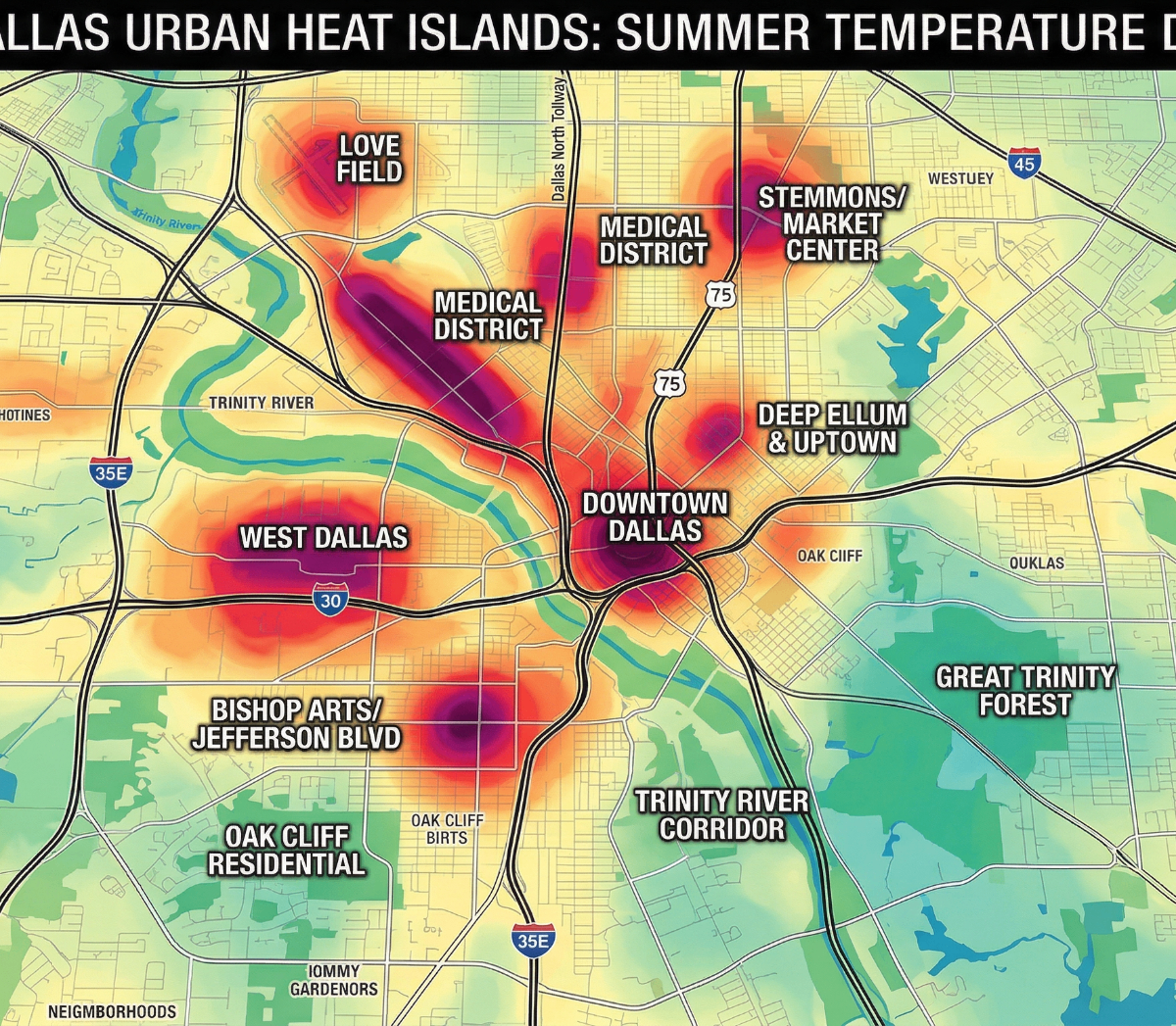
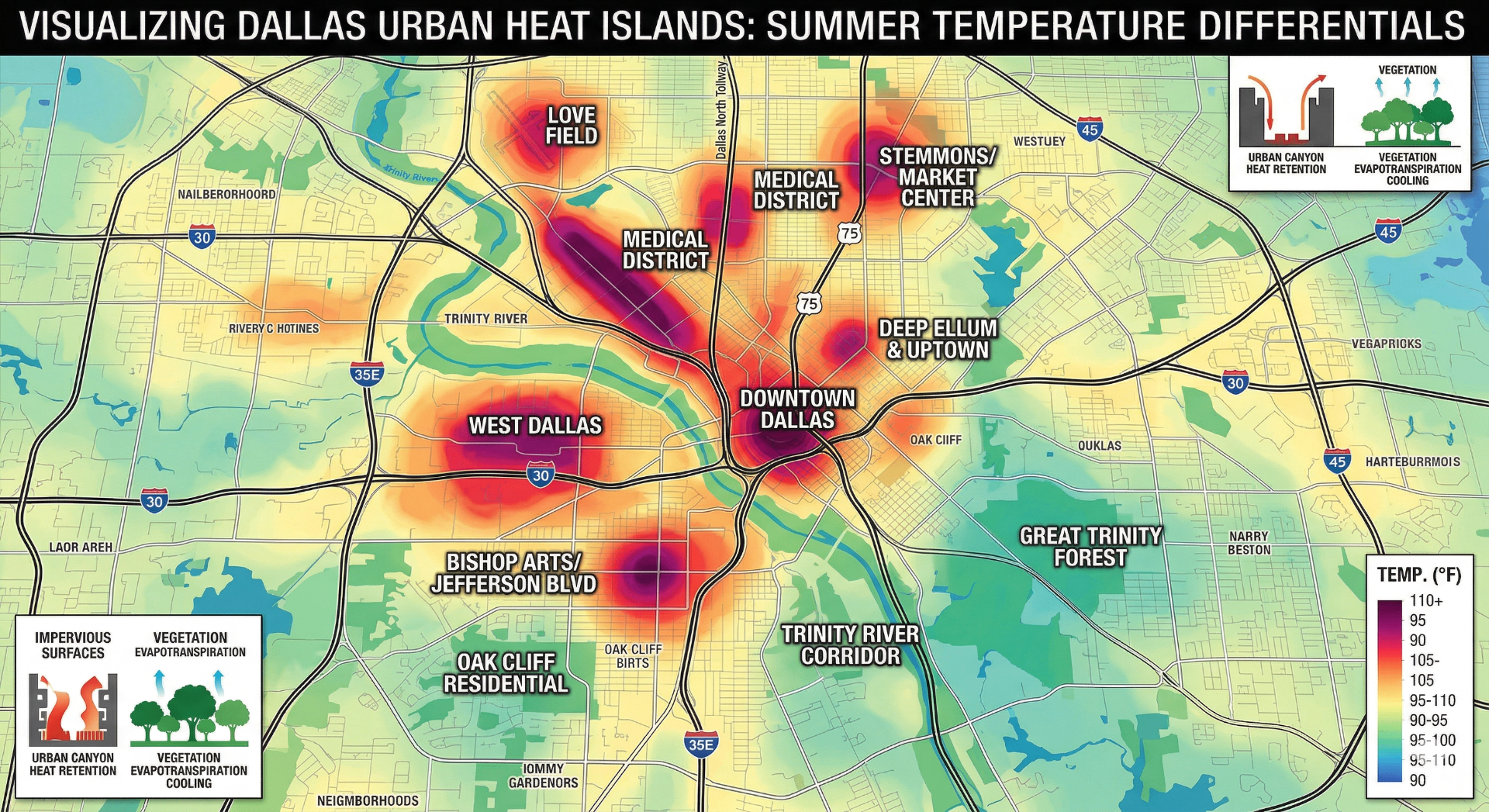
Dallas is heating up from the inside out. Scientific studies confirm that some neighborhoods can be 12 degrees hotter than greener parts of the city. This comprehensive research report examines the urban heat island effect, its impact on ERCOT and energy costs, and how inverter-based HVAC technology offers a path forward.
Dallas Urban Heat Island Effect: Energy, HVAC, and the Path to a Cooler City
A Truficient Energy Solutions Research Report
Navigate the interactive presentation above to explore key findings, then read the full research report below.
Executive Summary
Dallas is heating up from the inside out. Scientific studies conducted by the City of Dallas, NOAA, and the Texas Trees Foundation have confirmed what residents in neighborhoods like West Dallas, Bishop Arts, Downtown, and Oak Lawn already feel every summer: their streets can be 12 degrees hotter than greener parts of the city at the same moment in time. This is the urban heat island (UHI) effect — a compounding cycle where concrete and asphalt absorb solar energy all day and release it as radiant heat through the night, while thousands of air conditioning condensers churn out waste heat that further warms the outdoor air, which in turn forces those same AC units to work even harder.
The consequences extend far beyond personal discomfort. The UHI effect drives unprecedented demand on the ERCOT power grid, forces energy prices to spike during the hottest hours, increases health risks for vulnerable residents, and locks communities into a feedback loop where more cooling demand creates more outdoor heat. Dallas is heating faster than nearly every major U.S. city — second only to Phoenix. The antidote requires a three-pronged approach: urban greening, smarter building surfaces, and — critically — a fundamental shift to inverter-based, high-efficiency HVAC technology that rejects significantly less waste heat into the urban environment while consuming far less electricity.
Part I: Understanding the Urban Heat Island Effect
What Is Urban Heat Island?
The urban heat island effect describes the measurable temperature premium that densely built urban areas experience compared to surrounding rural or suburban landscapes. The phenomenon is rooted in four reinforcing mechanisms:
- Dark, impervious surfaces — concrete, asphalt, and rooftops absorb 95% of solar radiation that strikes them, storing energy that is released slowly into the nighttime air.
- Urban canyon effects — buildings block wind flow and create corridors where reflected heat concentrates and cannot dissipate.
- Loss of evapotranspiration — trees and vegetation naturally cool the air by releasing moisture. Removing them eliminates this free cooling engine.
- Anthropogenic waste heat — vehicles, industrial processes, and particularly air conditioning systems continuously discharge heat directly into the outdoor environment.
Surface temperature differences between urban and rural areas can range from 18 to 27°F during daytime, while nighttime atmospheric temperature differences typically range from 13 to 22°F. This nocturnal effect is particularly damaging because it eliminates the overnight recovery period that allows buildings and residents to shed accumulated heat.
Dallas: A City Built to Trap Heat
Dallas has developed with an unusual intensity of heat-trapping characteristics. With 35% impervious surface coverage across the city — rooftops, parking lots, highways, and concrete plazas — Dallas presents a massive solar battery that charges every sunny day and discharges heat long into the evening. Since 1990 alone, the Dallas-Fort Worth metroplex has added an astonishing 890 square miles of new impervious surface — an area larger than many entire cities. Parking lots alone cover 1,400 acres within Dallas city limits.
The Texas Trees Foundation's landmark 2017 Urban Heat Island Management Study, one of the largest urban heat assessments in U.S. history, found that the hottest areas of Dallas recorded an average high of 101°F and an average low of nearly 80°F for five full months of the year. Researchers concluded that the UHI effect plays a more significant role in Dallas's warming trends than the broader greenhouse effect alone, and that Dallas is warming faster than virtually every other major U.S. city except Phoenix.
Part II: The Dallas Heat Island Studies — What the Data Shows
Phase I: The 2023 NOAA Mapping Campaign
In August 2023, Dallas joined a coalition of 18 cities in a National Oceanic and Atmospheric Administration urban heat island mapping campaign. Approximately 70 community volunteers attached temperature and humidity sensors to their vehicles and drove nine assigned routes across roughly 100 square miles of the city on August 5, 2023, collecting over 60,000 temperature measurements across morning, afternoon, and evening periods.
The data was stark. At 3–4 p.m., the single hottest recorded spot in Dallas reached 110.1°F while the coolest area simultaneously registered 100.9°F — a 9.2-degree difference in real time. In the evening hours between 7–8 p.m., the hottest spot measured 105.6°F against a cooler area's 95.6°F. The study confirmed what climate scientists long suspected: pavement-heavy, tree-scarce districts experience a persistent thermal penalty that does not relent even as the sun goes down.
"It could be the same time in two different neighborhoods, and one could be much hotter." — Paul White II, Interim Director, Dallas Office of Environmental Quality and Sustainability
Phase II: The 2024 Expanded Study
The 2024 campaign expanded dramatically in scope. On August 10, 2024, approximately 100 volunteers mapped 250 square miles across 21 routes, partnering with the Sierra Club and Texas Trees Foundation. The expanded mapping revealed that temperature differentials had grown — with some urbanized areas measuring up to 12 degrees hotter than the city's greener zones. Dallas released the Phase II results in early 2025, briefing the Environmental Commission and generating significant media coverage from KERA News, CBS News Texas, the Dallas Observer, NBC DFW, and others.
Phase II identified nearly two dozen neighborhoods experiencing a clinically significant heat island effect. The data confirmed that developed industrial areas, dense downtown zones, and major highway corridors consistently registered the highest temperatures, while preserved natural lands in Southeast Dallas maintained relative coolness.
Part III: Neighborhood-by-Neighborhood Analysis
The Hottest Zones in Central Dallas
The following neighborhoods have been formally identified across both Phase I and Phase II studies as Dallas heat islands — areas experiencing measurably elevated temperatures due to pavement density, lack of tree canopy, highway proximity, and industrial land use:
| Neighborhood | Key Heat Factors | Environmental Justice Concerns |
|---|---|---|
| West Dallas | Heavy industrial zoning, I-35 corridor, limited green space | Yes — historical disinvestment |
| Bishop Arts / Jefferson Blvd. | Dense commercial pavement, limited canopy, low-income residents | Yes — environmental justice area |
| Downtown Dallas | Concrete canyons, rooftop heat mass, minimal vegetation | No nearby residential relief |
| Medical District | Harry Hines Blvd. corridor, parking structures, commercial density | Yes — top 3 hottest |
| Oak Lawn | Uptown-adjacent density, commercial corridors, Turtle Creek boundary | Moderate |
| Deep Ellum | Industrial-commercial mix, dark rooftops, limited trees | Moderate |
| Design District | Warehouse conversions, large paved lots, minimal shade | Moderate |
| Love Field Area | Airport tarmac, adjacent commercial pavement, I-35W exposure | Moderate |
| Stemmons / Market Center | Major freeway junction, commercial warehouse district | Moderate |
| Uptown | High-density construction, urban canyon effect | Lower income buffer, high rents |
| Glendale Park | Phase II newly identified; residential density, limited canopy | Under study |
| Ledbetter Gardens / Westmoreland Heights | Phase II expansion area; historically underinvested | Yes |
| Preston Hills / Northwest Quadrant | Phase II finding; rapid commercial expansion | Emerging |
The notable outlier in this picture is the southeastern portion of the city. Areas around the Trinity River corridor, the Great Trinity Forest, and Cedar Crest Golf Course consistently recorded the coolest temperatures in both studies. The 1995 TCU study by Dr. Ken Morgan — the first UHI study ever conducted for Dallas — found that Oak Cliff, with its tree-covered residential streets, had some of the city's coolest temperatures despite its proximity to downtown. That data point carries enormous significance for HVAC professionals: tree canopy is measurably equivalent to a free, always-on cooling system.
The Oak Cliff Paradox
Oak Cliff presents a fascinating and instructive case study in microclimatic divergence. The Bishop Arts District on Jefferson Boulevard was identified as one of the three most extreme heat island zones in Dallas, characterized by dense commercial pavement and limited canopy along the main commercial corridor. Yet blocks away, historic residential streets lined with mature live oaks and elms maintain temperatures that can be 10 degrees cooler. This is not a coincidence — it is physics. And it directly informs what Truficient recommends to homeowners in this area: in neighborhoods where the outdoor heat load is chronically elevated, standard single-stage HVAC systems are consistently undersized for actual conditions, and only inverter-variable systems with modulating capacity can compensate efficiently.
Part IV: The Energy and Grid Crisis Driven by Urban Heat
How Heat Islands Stress the ERCOT Grid
The ERCOT grid serves approximately 27 million Texas customers, and summer air conditioning demand is its defining stress test. The relationship between heat islands and grid demand is direct and quantifiable: each 1°C increase in ambient temperature raises energy demand by 0.5% to 5%, with higher-penetration AC markets like Dallas trending toward the upper end of that range. When heat islands push ambient temperatures 10–12 degrees higher than background levels, the AC load multiplier across thousands of simultaneously running systems is enormous.
The summer of 2023 was a watershed moment for Texas. ERCOT's load had never previously exceeded 80,000 megawatts before that summer — then it exceeded that threshold on 42 separate days between June 1 and August 31. The all-time peak of 85,508 MW was set on August 10, 2023, and that record still stands. Wholesale electricity prices in Dallas averaged $97/MWh for the summer of 2023, with day-ahead prices spiking to $654/MWh for individual peak hours. One megawatt can power roughly 800 homes on a normal day but as few as 250 homes during a summer heat peak — illustrating how dramatically the per-unit cooling load escalates under extreme heat.
By 2025, ERCOT demand had grown 5% year-over-year and 23% above 2021 levels, driven by a combination of population growth, data center construction, and electrification trends. Texas grid operators are increasingly relying on solar and battery storage to meet peak demand, with wind and solar now meeting 36% of ERCOT's electricity demand in 2025. But as solar output peaks midday and drops steeply in the early evening — precisely when heat island temperatures are at their maximum and residential AC demand is highest — the grid faces its most vulnerable moments exactly when heat islands are at their worst.
The Economic Toll on Dallas
The monetary cost of the Dallas urban heat island effect is substantial and well-documented:
- The additional electricity costs attributable to UHI effects in Dallas likely amount to several hundred million dollars per year.
- Widespread mitigation through cool roofs and tree planting alone could produce $40 to $50 million in annual energy savings.
- A full cool roofs deployment across Dallas has been analyzed with a benefit of $7.9 billion at a cost of $1.5 billion.
- For comparison, Baltimore's Smart Surfaces analysis found a $21 billion benefit against $1.4 billion investment — a 15:1 return.
- Dallas County Health and Human Services reported more than 1,100 heat-related illnesses in 2024 alone, with at least two deaths.
- Heat has been the number one weather-related cause of death in the United States for the last three decades.
Part V: The AC Feedback Loop — Every Condenser Makes It Worse
How Air Conditioners Amplify the Heat Island
Here is the uncomfortable truth at the heart of Dallas's cooling crisis: every air conditioner running at this moment is simultaneously making the outdoor environment hotter for every other air conditioner in the city. This is not a theoretical concern — it is a peer-reviewed phenomenon.
A landmark study by Arizona State University researchers found that waste heat from air conditioning systems running at night increased mean air temperatures by more than 1°C (almost 2°F) in some urban locations. The heat expelled at the condenser is the sum of the heat extracted from indoor spaces plus the electrical energy consumed by the compressor itself — all of which is discharged directly into the outdoor air. In a dense urban environment where thousands of condensers are running simultaneously on a 105°F afternoon, the aggregate waste heat contribution is significant and measurable.
Research published in peer-reviewed climate modeling journals has found that the AC heat feedback on urban warming can reach 20% of the magnitude of global warming projections in residential areas of hot cities. Put differently: in a city like Dallas that already runs at the hot end of the climate spectrum, AC waste heat alone can represent a meaningful fraction of observed warming trends. The feedback mechanism operates as follows:
- Heat island effect raises outdoor temperatures
- Higher outdoor temperatures increase indoor cooling loads
- More AC operation expels more waste heat outdoors
- Higher outdoor temperatures increase AC inefficiency (COP drops)
- Lower COP means more electricity consumed per BTU of cooling
- More electricity generation means more waste heat from power plants
- Return to Step 1
A scientific study modeling roof-mounted AC units at district scale found that concentrated condenser heat rejection caused a 5% increase in cooling energy needs and a 17% reduction in coefficient of performance (COP) for surrounding buildings. This is the hidden cost embedded in every low-efficiency, single-stage system installed in Dallas: it does not merely waste electricity — it actively degrades the performance of every other cooling system in the vicinity.
Why Inverter Systems Break the Cycle
Inverter-based variable-speed systems address this feedback loop in two critical ways. First, they consume dramatically less electricity per BTU of cooling delivered — which means less electricity generation is needed, which means less waste heat from power plants and grid infrastructure. Second, because inverter systems modulate their output continuously rather than cycling on at full capacity, the peak burst of heat rejection from each condenser is lower and more distributed over time, reducing the instantaneous heat load on the outdoor environment in any given block.
The U.S. Energy Information Administration has confirmed that nearly 29% of a typical home's energy bill goes to heating and cooling. Inverter-based mini-split systems can reduce that portion by 20 to 75% compared to older single-stage ducted systems, depending on the efficiency of the system being replaced. Additionally, traditional ducted systems lose up to one-third of conditioned air before it ever reaches the living space through duct leakage and thermal loss. Every BTU lost through leaky ductwork is a BTU that had to be generated at a power plant, transmitted across the grid, and discharged as condenser waste heat into the Dallas afternoon — for nothing.
Part VI: Trees, Green Space, and the Natural Cooling Infrastructure
The Science of Arboreal Cooling
Trees are the most cost-effective urban cooling technology ever invented. They provide shade that blocks direct solar gain, reduce surface temperatures of pavement and buildings through shading, and cool the surrounding air through evapotranspiration — the process by which leaves release moisture that absorbs ambient heat as it evaporates. Research published by American Forests found that establishing adequate tree cover on a city block can provide up to 10 degrees of cooling. The Texas Trees Foundation's Urban Heat Island Management Study found that heat management strategies including tree planting could deliver cooling benefits as high as 15°F in some Dallas neighborhoods.
The 1995 TCU study made a finding that remains instructive: Oak Cliff's tree-covered neighborhoods were among the coolest in all of Dallas despite their urban location. WFAA Chief Meteorologist Pete Delkus has noted that if you've ever driven through the Addison corridor — one of Dallas's densest commercial strips — "it's hard to find any grass or trees at all," contributing to a persistent heat island in that zone. The contrast with the Trinity River corridor and Great Trinity Forest areas, which consistently registered the coolest temperatures in the NOAA studies, illustrates that nature-based cooling is not merely theoretical — it is observably present in the data.
Dallas's Tree Canopy Crisis
As of 2021, Dallas's urban tree canopy covered approximately 32% of the city. The city has set a goal to reach 37% canopy coverage by 2040 through partnerships with the Texas Trees Foundation. Active projects include a linear parkway redesign along Harry Hines Boulevard in the Medical District, one of the most severely heat-impacted corridors in the city.
Trees cool their surroundings through multiple mechanisms that are additive and synergistic:
- Direct shading of pavement, rooftops, and pedestrians reduces surface temperatures
- Evapotranspiration cools the surrounding air through latent heat exchange
- Wind buffering reduces the advection of heat between urban zones
- Albedo increase — canopy replaces dark asphalt with a living, reflective surface
- Air quality improvement — trees remove particulates and ozone, which contribute to greenhouse warming at the local scale
For Dallas HVAC professionals, the practical implication is significant. A homeowner in Lakewood or in the tree-lined residential blocks of Oak Cliff may have meaningfully lower outdoor ambient temperatures — and thus a lower effective cooling load — than an identically sized home in West Dallas or the Medical District corridor. Proper Manual J load calculations must account for this microclimate reality.
Part VII: Inverter HVAC as a Climate Solution — Mitsubishi, Daikin, and Gree
Why High-Efficiency Inverter Systems Matter at Scale
The shift from single-stage, fixed-capacity AC compressors to inverter-variable systems is not merely an upgrade in homeowner comfort and energy savings — it is a meaningful contribution to reducing the urban heat island at the neighborhood scale. When viewed collectively, a neighborhood-wide transition from 14 SEER single-stage systems to 20+ SEER inverter systems reduces the aggregate electrical load on ERCOT, reduces condenser waste heat per BTU of cooling delivered, and reduces the duration and intensity of outdoor heat rejection events. The math is straightforward: a high-efficiency system consuming 30% less electricity to cool the same space generates roughly 30% less waste heat at the condenser for the same cooling output.
Mitsubishi Electric — The Gold Standard
Mitsubishi Electric pioneered ductless mini-split technology in 1959, making it the founding innovator in this category. The company's current lineup achieves efficiency ratings up to 23.1 SEER2 and 13.5 HSPF2 — the highest among the three major brands under consideration. Mitsubishi's Hyper-Heating INVERTER (H2i) technology uses patented flash injection to reroute refrigerant through the compressor at low outdoor temperatures, maintaining heating performance down to extreme cold while modulating capacity continuously rather than cycling on and off.
Key Mitsubishi advantages in the Dallas UHI context:
- Continuously variable compressor from as low as 15–30% of rated capacity up to 150–185% of rated capacity for heating, allowing the system to respond to actual load without over-cycling and excessive heat bursts
- Highest efficiency in class means the least electricity — and therefore the least indirect heat generation at the power plant and grid level — per BTU of cooling delivered
- R-454B refrigerant — ultra-low global warming potential (GWP), reducing the lifecycle environmental impact of the refrigerant itself
- 12-year residential parts warranty through Diamond contractors
- Kumo Cloud smart controls allow demand-response integration, enabling intelligent cycling during ERCOT grid peaks
Truficient Energy Solutions is a Certified Mitsubishi Diamond Contractor — one of the most recognized designations in the residential and commercial ductless HVAC space, having earned the Mitsubishi Diamond Contractor of the Year Award. This designation unlocks 12-year residential and 10-year commercial parts and compressor warranties that are unavailable through non-certified installers.
At an estimated annual cooling cost of approximately $180/year for a 23.1 SEER2 Mitsubishi system compared to approximately $250/year for a 20 SEER2 Gree system, the 10-year energy savings versus Gree amount to roughly $700, and approximately $550 versus Daikin over the same period.
Daikin — The VRF Pioneer
Daikin Industries invented Variable Refrigerant Volume (VRV/VRF) technology in 1982 — the foundational technology behind all modern variable-capacity commercial HVAC systems. Daikin's current commercial VRV IV systems achieve a COP up to 4.20 and incorporate Variable Refrigerant Temperature control that adapts automatically to building conditions and outdoor climate. The system supports up to 64 indoor units connected to a single outdoor unit, enabling complete building-wide zone control with a single condensing unit — dramatically reducing the number of outdoor condensers required, the total condenser footprint, and the aggregate waste heat discharged into the urban environment per square foot of conditioned space.
Daikin's residential lineup achieves efficiency ratings up to 20.3 SEER2 and 12.5 HSPF2, and the brand offers a 12-year parts warranty — matching Mitsubishi at the residential tier. For commercial applications in Dallas heat island zones — particularly the Medical District, Design District, and Uptown corridors — Daikin's VRV platform is a compelling solution for reducing both energy consumption and outdoor heat rejection at scale.
In the heat recovery configuration, Daikin VRF systems can simultaneously heat one zone while cooling another, transferring heat internally within the refrigerant circuit rather than rejecting it to the outdoors. In a mixed-use building with server rooms requiring cooling year-round and office spaces requiring heating in winter, this simultaneous heat recovery eliminates the waste heat that would otherwise be discharged into the outdoor environment entirely.
Gree — Value Efficiency at Scale
Gree is the world's largest manufacturer of air conditioning equipment and a major player in the residential mini-split market. Current Gree residential systems achieve efficiency ratings up to 20 SEER2 and 10.5 HSPF2, with integrated Wi-Fi controls as standard on many models. Gree's systems carry a 5–7 year parts warranty, shorter than Mitsubishi or Daikin but often offset by lower initial acquisition costs.
For Dallas residents in the heat island zones where every efficiency gain matters — particularly in Bishop Arts, West Dallas, and the Medical District neighborhoods — Gree's inverter technology still represents a dramatic improvement over the single-stage 14 SEER systems that remain common in older Dallas housing stock. Even at 20 SEER2, a Gree system will consume roughly 30% less electricity than a minimum-efficiency 14 SEER2 system for the same cooling output. In a neighborhood where hundreds of households make that switch, the aggregate reduction in condenser waste heat and grid demand is measurable.
SEER2 Side-by-Side Comparison
| Feature | Mitsubishi | Daikin | Gree |
|---|---|---|---|
| Max SEER2 | 23.1 | 20.3 | 20.0 |
| Max HSPF2 | 13.5 | 12.5 | 10.5 |
| Refrigerant | R-454B (ultra-low GWP) | R-32 | R-410A |
| Residential Warranty | 12 years (Diamond) | 12 years | 5–7 years |
| Est. Annual Cooling Cost | ~$180 | ~$235 | ~$250 |
| 10-Year vs. Gree Savings | +$700 | +$150 | Baseline |
| VRF/Commercial Platform | City Multi | VRV IV | Multi-zone |
| Smart Controls | Kumo Cloud | Daikin One+ | Gree+ app |
Part VIII: The Compounding Feedback — What Every Dallas Homeowner Needs to Understand
The Summer Peak Demand Spiral
On a hot Dallas August afternoon — say, 107°F at 3 p.m. in the Medical District or West Dallas — the following cascade is underway simultaneously:
- Every single-stage AC in the neighborhood is running at 100% capacity, as these systems have no ability to modulate
- Every condenser is discharging the maximum possible waste heat into the already-overheated outdoor air
- The rising outdoor temperature causes the condensing temperature inside each AC unit to climb, which reduces the COP — meaning each unit must consume more electricity to produce the same cooling output
- ERCOT wholesale prices are spiking, potentially to hundreds of dollars per MWh
- Power plants ramping up to meet demand are themselves generating additional waste heat
- Nighttime temperatures remain elevated because the pavement, buildings, and discharged AC heat prevent the ambient temperature from recovering — meaning tomorrow starts hotter than it should
An inverter-based system in the same environment responds fundamentally differently. Because it has already been running at partial capacity throughout the day — maintaining the indoor temperature continuously rather than allowing it to swing between cycles — it reaches the afternoon peak with less thermal debt to recover. Its variable-speed compressor can adapt its output to match the actual load rather than hammering the condenser at full blast. The result is a lower peak electricity draw per unit, a lower peak waste heat discharge per unit, and significantly lower operating costs — precisely when ERCOT prices are at their highest.
The Duct Loss Problem in Heat Island Neighborhoods
In older Dallas housing stock — which WFAA's Pete Delkus notes is abundant in many of the UHI-affected neighborhoods — traditional ducted central air systems face an additional heat island penalty. Ducts running through unconditioned attic spaces can be exposed to temperatures of 130–150°F in Dallas summer attics. Research shows that up to one-third of conditioned air can be lost through duct leakage before it reaches the living space. This means a conventional 3-ton system in a heat island neighborhood may effectively deliver only 2 tons of cooling while consuming electricity and generating condenser waste heat at the 3-ton rate.
Ductless mini-split systems eliminate this attic duct loss entirely. The refrigerant circuit runs directly from the outdoor unit to the indoor air handler with minimal thermal loss, delivering the full rated BTU output to the conditioned space. In the context of a heat island neighborhood where every BTU of cooling capacity matters and every watt of electricity consumed adds to the outdoor thermal load, this efficiency difference is not a minor specification footnote — it is a meaningful climate and comfort intervention.
Part IX: Dallas Policy Responses and What They Mean for HVAC
City-Level Actions
Dallas has begun taking measurable steps to address the UHI effect, though the pace of change will need to accelerate significantly to materially alter outcomes in the most affected neighborhoods:
- Parking reform — Dallas approved a major parking ordinance reform in 2025 eliminating most parking minimums, which could reduce the 1,400 acres of parking lots that currently contribute to the heat island effect
- Impervious surface limits — Dallas Planning and Development is proposing a code amendment that would limit impervious surface on new developments; it may go before City Council in late 2025
- Cool roofs mandate — new buildings are already required to have cool roofs that reflect rather than absorb solar radiation
- Tree canopy expansion — working with Texas Trees Foundation toward a 37% canopy goal by 2040, up from 32% in 2021
- Bond funding — $345.3 million allocated from a proposed $1.25 billion bond for parks and green space
- Weatherization programs — the city's WholeHomeDallas program connects residents with funding assistance for energy efficiency upgrades
These initiatives will produce meaningful results over decades. But they operate on a 20–40 year timeline while the thermal problem is acute and immediate every summer. For homeowners in heat island neighborhoods, the most impactful single action available to them right now is upgrading to a high-efficiency inverter HVAC system — which simultaneously reduces their electricity bill, reduces their contribution to outdoor waste heat, and reduces their dependence on an increasingly stressed grid during the hours when prices are highest.
Rebates and Incentives
Texas utility customers have access to multiple overlapping incentive programs for high-efficiency HVAC upgrades:
- Oncor Electric Delivery offers rebates of up to $1,000 for qualifying high-efficiency equipment installations
- Federal tax credits under the Inflation Reduction Act support heat pump installations for primary residences
- Manufacturer incentives from Mitsubishi, Daikin, and Gree supplement utility rebates for qualifying equipment
- The city's WholeHomeDallas weatherization program provides additional support for income-qualifying residents in the most affected neighborhoods
Part X: The Truficient Solution Framework
Engineering-First Assessment
The urban heat island effect changes the fundamental calculus of HVAC sizing in Dallas. Homes and businesses in identified heat island zones — Downtown, West Dallas, Bishop Arts, Medical District, Oak Lawn, Deep Ellum, Design District, Love Field, Stemmons/Market Center, and the expanding northwest quadrant — experience outdoor ambient temperatures that may be 10 to 12 degrees higher than what standard weather data and equipment specifications assume. Standard load calculations built on typical meteorological year (TMY) data will consistently undersize systems in these neighborhoods.
A proper engineering-based assessment for properties in Dallas heat island zones must account for:
- Actual microclimate temperature, not regional averages
- Duct system condition and attic temperature exposure
- Roof surface type and solar gain coefficient
- Tree canopy on adjacent properties and street
- Building orientation and window-to-wall ratio
- Occupancy density and internal heat gain
The Inverter Imperative for Dallas Heat Islands
In a city that is already the second-fastest warming major U.S. metro, where heat island temperatures can reach 110°F while the broader region sits at 98°F, where ERCOT demand records are broken routinely, and where the poorest neighborhoods bear the heaviest thermal burden — the case for inverter-based, variable-capacity HVAC systems is not merely an efficiency argument. It is a public health, environmental justice, and grid resilience argument.
Every high-efficiency Mitsubishi, Daikin, or Gree inverter system installed in place of a single-stage 14 SEER unit in a Dallas heat island neighborhood:
- Consumes 20–75% less electricity for the same cooling load
- Rejects proportionally less waste heat into the already-overheated outdoor environment
- Eliminates up to one-third of energy waste from duct losses in older homes
- Reduces the household's contribution to ERCOT peak demand — when grid stress is highest and prices are most extreme
- Delivers more consistent comfort because it maintains temperature continuously rather than cycling
- Provides quieter operation through modulated compressor speed
- Operates as a heat pump in winter, eliminating gas heating dependence and its associated combustion heat emissions
The urban heat island is a collective action problem — it cannot be solved by any single homeowner or business. But it can be meaningfully addressed, neighborhood by neighborhood, upgrade by upgrade, condenser by condenser. Dallas is heating faster than almost any city in America. The grid is under structural stress that will only intensify with data center growth and electrification. The communities in the hottest neighborhoods are often the communities least equipped to bear the health, comfort, and economic costs of that heat. High-efficiency inverter HVAC technology is not a luxury product — in the context of the Dallas urban heat island, it is the responsible choice.
Data sources: City of Dallas Office of Environmental Quality and Sustainability, NOAA Urban Heat Island Mapping Campaign (2023, 2024), Texas Trees Foundation Urban Heat Island Management Study (2017), Dallas Morning News, KERA News, D Magazine, Dallas Observer, Dallas Fed, ERCOT, U.S. Energy Information Administration, Arizona State University, Resources for the Future, Science Direct, Climate Central, and Truficient Energy Solutions.
References
- Dallas heat islands study reveals city's hottest neighborhoods - Some neighborhoods were found to be up to 12 degrees hotter than others. These areas are known as "h...
- Dallas looks to combat city's hottest spots - KERA News - New data shows parts of the city can be as much as 12 degrees hotter than other areas. Dallas offici...
- Urban Heat Island Management Study - Texas Trees Foundation - With rising temperatures come higher costs for energy and a threat to our energy supply. Key finding...
- Cooling the urban heat island effect | Hitachi Air Conditioning - Discover how Hitachi Air Conditioning solutions and green urban design help reduce heat island effec...
- Dallas is way too hot. The city says less pavement could help cool it ... - A new analysis found heavily urbanized areas of Dallas are 14 degrees hotter due to the heat island ...
- Excess heat from air conditioners causes higher nighttime ... - This research shows that release of waste heat raises the outdoor temperature and as a result increa...
- [PDF] Dallas Urban Heat Island - The Dallas Urban Heat Island Study examines how and where heat island effects occur in. Dallas and s...
- What is an urban heat island? And how does it affect our ... - YouTube - WFAA Chief Meteorologist Pete Delkus shows how concrete, buildings and dark roofs contribute to high...
- Dallas Summers Are Hot. In These Neighborhoods, It's Even Hotter - Urban heat islands can be up to 20 degrees hotter than parts of town with more trees and grass. (Dal...
- Study pinpoints Dallas' 'heat islands' - KERA News - Data collected by Dallas' Office of Environmental Quality and Sustainability and the National Oceani...
- Dallas study identifies heat islands 10 degrees hotter than other areas - Downtown, Uptown, Deep Ellum and West Dallas are all heat islands.
- Dallas looks to combat 'heat island' effect | NBCDFW - YouTube - Dallas hopes new climate data can help shape strategies to combat the "heat island" effect – that le...
- Urban Heat Island Study - Dallas Climate Action - The purpose of this study is to identify the hotspots in Dallas and look for equitable ways to imple...
- Dallas' Heat Island Study Reveals City's Hottest Neighborhoods, But ... - The project found that many of Dallas' urban neighborhoods experience summer temperatures 12 degrees...
- These Dallas neighborhoods are risky hot spots during extreme weather - A new urban heat study shows that some neighborhoods in Dallas can get significantly hotter than oth...
- City study finds Bishop Arts, Jefferson Blvd. suffer from heat island effect - Oak Cliff - Screenshot of study map. Residents of Oak Cliff's Bishop Arts and Jefferson Boulevard neighborhoods ...
- Map: Dallas Hottest Neighborhoods for Urban Heat Island Effect - On Aug. 10, volunteers will map temperatures across 280 square miles of Dallas to help identify urba...
- Addressing Dallas' Urban Heat Island Effect | - This heat effect can impact not only Dallas' environment, but also its quality of life by having hot...
- Keeping Cool - An American Forests Data Short - Tree Equity Score - Establishing adequate tree cover on a city block can provide up to 10 degrees of cooling. We compile...
- Urban Heat Islands 101 - Resources for the Future - One such problem is the creation of the urban heat island effect, defined as the increase in tempera...
- Record-breaking Texas summer heat tests the grid, ERCOT operations - This indicates high temperatures and resulting air conditioning demand is the primary cause of load ...
- Solar, battery capacity saved the Texas grid last summer - As ERCOT forecasts accelerated load growth due to anticipated data center construction and electrifi...
- ERCOT Yearly Peak Demand Records - ERCOT Yearly Peak Demand Records ; 2023. August 10. (current record). 85, 508 ; 2022, July 20, 80,14...
- ERCOT increasingly meets rising demand with solar, wind, and ... - EIA - From January through September 2025, demand for electric power in ERCOT increased 5% compared with t...
- What is the Economic Cost of Urban Heat in Dallas? - D Magazine - Benefit-Cost Analysis Results for Solution Scenarios Analyzed ; Solution Scenario, Benefits, Costs ;...
- Urban warming and future air-conditioning use in an Asian megacity - The impact of feedback between urban warming and air-conditioning (AC) use on temperatures in future...
- The impact of heat rejection from air conditioning systems on ... - Roof-mounted units caused a 5 % increase in cooling needs and a 17 % reduction in COP, with local te...
- What Is a Ductless Mini-Split? Inverter Technology Explained for Smarter, Cheaper Cooling - Learn how inverter mini-split systems deliver smarter, quieter cooling with up to 75% energy savings...
- [PDF] Urban Heat Island Management Study - Texas Trees Foundation - The Dallas Urban Heat Island Management Study shows the extent to which the City of Dallas is warmin...
- In Dallas, the average coverage of tree canopy sits at around 32 ... - Trees cool their surroundings by up to 10 degrees. Additionally, they help cut energy bills, clean a...
- Why is There Ice on My Mini-Split When It's Cold Outside? - Maintaining a comfortable home environment year-round is a top priority for every homeowner. Whether...
- Gree vs Daikin vs Mitsubishi: Complete Heat Pump Comparison Guide - Comparing all three major heat pump brands? Here's the complete breakdown of Gree, Daikin, and Mitsu...
- Top 10 Mitsubishi Mini-Split Heating Features - N.E.T.R., Inc.www.netrinc.com › blog › top-10-mitsubishi-mini-split-heating-features - Wondering what makes a Mitsubishi mini-split so great? Here are our 10 favorite features and how we ...
- Visualizing mini-split performance data - GreenBuildingAdvisor - I've been digging through Mitsubishi M-Series performance data for a project I'm working on. I made ...
- Decoding Mini-Split Heat Pump Costs for Homeowners in Dallas-Fort Worth - Mini-Split Heat Pump Installation Costs
As your family grows, so do your needs – especially whe...
- Mitsubishi Diamond Contractor Award - Contractor of the Year Award from Mitsubishi We couldn't be more excited and proud to win the Mitsub...
- Home - # Your Comfort, Our Assurance.
Maximize Comfort, Minimize Costs –
Your Energy-Efficient HVAC Ex...
- Commercial VRF Install | Dallas, TX - ### Project Description
Coffee Shop – Commercial Multi-Room Mini Split (VRF) Install
Most comme...
- Variable Refrigerant Flow | VRV vs VRF | VRF AC | MEA | Daikin - VRV is a technology that alternates the refrigerant volume in a system to match a building's precise...
- VRV IV - Daikin Comfort - VRV IV 's revolutionary Variable Refrigerant Temperature control automatically adapts to the unique ...
- Daikin VRF Systems: Superior Comfort for 2025 - Air On Demand - This means if one room needs cooling and another needs heating, the system can transfer heat between...
- Mitsubishi vs Fujitsu vs Daikin vs Gree - Magic Touch Mechanical - Compare Mitsubishi vs Fujitsu vs Daikin vs Gree in this 4-way shootout between 4 popular ductless mi...
- Daikin, Mitsubishi or Gree? : r/hvacadvice - Reddit - My contactor give me estimate of three brands : Mitsubishi , Daikin and Gree. Gree is the cheapest b...
- SEER2: All you need to know. - GREE Comfort - Learn all about SEER2 ratings, calculations, regional rules, and how GREE Comfort's HVAC systems mee...
- Residential Services - # RESIDENTIAL SERVICES