HVAC Service for Westmoreland Heights, Dallas
Mini-split installation, heat pump replacement, and AC repair throughout Westmoreland Heights and the West Dallas / Trinity Groves corridor. → Request a Quote or call 214-238-4349
About Westmoreland Heights
Westmoreland Heights sits in West Dallas, on the high ground rising from the Trinity River bottoms toward the I-30 corridor. The neighborhood is bounded roughly by Westmoreland Road, Singleton Boulevard, and the residential blocks running north toward the Trinity Groves redevelopment. It overlaps the 75211 and 75212 ZIP codes and shares immediate context with Trinity Groves to the east, Eagle Ford to the west, and the older West Dallas residential blocks to the south.
The defining feature of Westmoreland Heights — and what makes it different from most Dallas neighborhoods — is the housing-stock split. The area is simultaneously one of Dallas's older residential corridors and one of its most actively redeveloping. Walking blocks west from Trinity Groves, you pass through clusters of original 1940s-1960s wood-frame and brick homes (small footprints, original retrofitted ductwork, aging single-stage central systems) and into pockets of 2018-2025 new infill — three- and four-story townhomes, modern single-family rebuilds, and tight-envelope spec homes built on torn-down lot inventory. The two housing profiles sit side by side on the same block in many cases.
For HVAC, this creates two completely different replacement and service realities operating in parallel. The 1940s-1960s stock has all the conditions of inner-Dallas older housing: retrofitted ductwork, aging single-stage equipment, and architectural preservation considerations. The new infill has the conditions of every tight modern build: oversized single-stage equipment that short-cycles, no mechanical fresh-air ventilation, and moisture issues showing up at the registers. Both need solutions, but the solutions are different.
The HVAC Reality in Westmoreland Heights — Older Stock
For the original 1940s-1960s housing in Westmoreland Heights, the conditions track inner-Dallas older housing closely:
Retrofitted ductwork sized for the original equipment era. Central HVAC was retrofitted decades after construction. Flex duct runs through tight attic spaces, sized to whatever could fit through the rafters. After 30 to 50 years of attic temperatures exceeding 130°F during a Dallas summer, that ductwork has degraded — joints have separated, insulation has compressed, and conditioned air loss runs 25 to 35 percent in many homes.
Mid-life single-stage equipment. Most of these homes are running their second-generation HVAC: a 2005-2015 vintage single-stage AC paired with a gas furnace. Those systems are now in the replacement window.
Smaller floor plans, simpler load profiles. The 1,000 to 1,600 square foot homes typical of original Westmoreland Heights stock have clean cooling load profiles — three or four zones of independent ductless control covers a home cleanly when retrofit ductwork is too far gone.
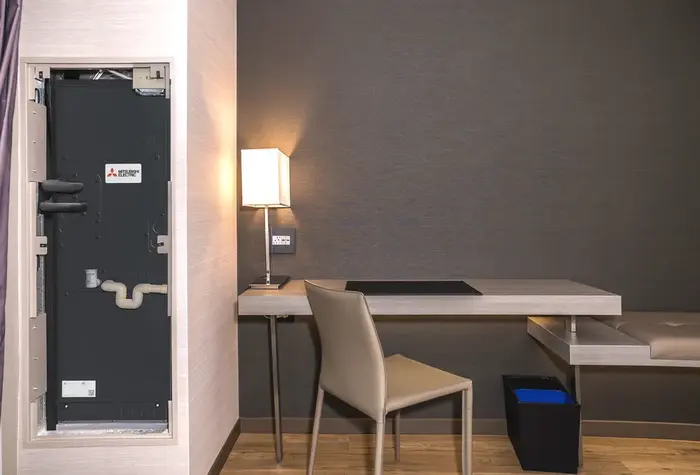
Solution path: Multi-zone ductless mini-split system or, where the existing ductwork is salvageable, an inverter-driven ducted heat pump replacement. Mitsubishi MXZ multi-zone for ductless retrofits; Mitsubishi SVZ-KP for ducted-replacement applications.
The HVAC Reality in Westmoreland Heights — New Infill
For the 2018-2025 new construction along Singleton, Sylvan, and the Trinity Groves-adjacent blocks, the HVAC conditions are different:
Oversized single-stage equipment from the wholesale-catalog spec. Many of these new builds were spec'd with rule-of-thumb tonnage — 4 tons for 3,000-3,200 square feet — without a Manual J load calculation accounting for the tight envelope. The result is short-cycling: the system blasts on, drops temperature in 8-10 minutes, shuts off, and repeats. Indoor humidity stays in the 60-65% RH range, condensation appears at supply registers, and the home feels clammy at thermostat setpoint.
No mechanical fresh-air ventilation. Tight modern envelopes don't ventilate naturally the way 1990s production homes did. New construction in Westmoreland Heights without an ERV (energy recovery ventilator) or HRV has no fresh-air strategy. Indoor pollutants — VOCs from new-construction off-gassing, CO2 buildup, cooking and bathing moisture — accumulate without any path out.
Ductwork in attic without proper air sealing. Even on new construction, attic ductwork is frequently the air-loss culprit. Manual D ductwork design plus proper sealing during install is what differentiates a system that delivers rated capacity from one that loses 20-30% to the attic.
Solution path for new infill: HVAC inspection to identify the oversizing problem, ERV installation for fresh-air ventilation, ductwork sealing or upgrade, and — in many cases — replacement of the oversized single-stage equipment with right-sized inverter equipment. See our New Build HVAC Inspection page.
What HVAC Solutions Work in Westmoreland Heights
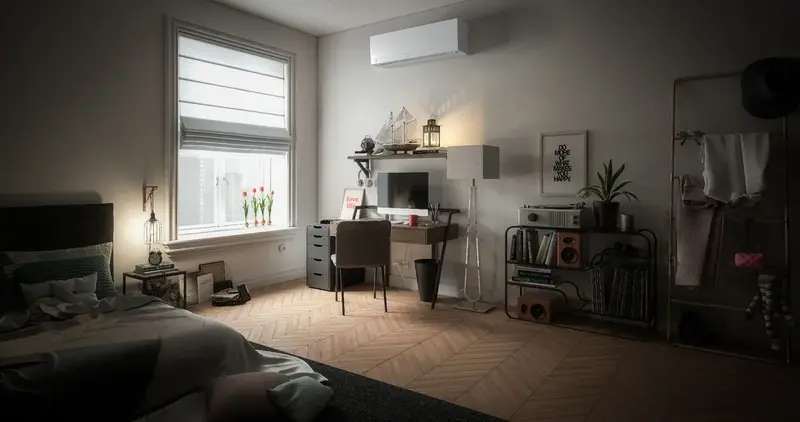
For older stock — multi-zone ductless retrofits. Mitsubishi MXZ multi-zone with two to four indoor units, replacing degraded retrofit ductwork and consolidating gas furnace + central AC into a single all-electric system.
For older stock with sound ductwork — inverter-driven ducted heat pump. Mitsubishi SVZ-KP slim-duct or P-Series ducted replacement preserves the existing distribution while delivering inverter efficiency.
For new infill with oversizing problems — system right-sizing. Manual J reload, equipment swap to right-sized inverter capacity, ERV installation, ductwork sealing.
For new infill with no fresh-air strategy — ERV/HRV retrofit. Even when the existing equipment is acceptable, mechanical fresh-air ventilation can be added as a retrofit.
For all stock — single-zone supplemental. Sun-exposed bedrooms, converted garage offices, and back additions are common candidates for single-zone Mitsubishi mini-splits adding capacity exactly where the central system can't reach.
R32 Refrigerant in Westmoreland Heights Installs
Every Mitsubishi mini-split installed today uses R32 refrigerant — a meaningful change from the R410A that filled most residential systems sold from 2010 through 2024. Under EPA AIM Act regulations effective January 1, 2025, new residential mini-split equipment can no longer be manufactured with R410A. R32 has a global warming potential of 675 — roughly 68 percent lower than R410A's 2,088 — and is a single-component refrigerant rather than a blend, which means it services cleanly without fractionation issues. For Westmoreland Heights homeowners replacing now, current installations use refrigerant the industry is moving toward.
Why Truficient for Westmoreland Heights
The split housing profile is what makes Westmoreland Heights an unusual neighborhood for HVAC service. The right answer in a 1955 wood-frame on Westmoreland Avenue is not the right answer in a 2023 spec home around the corner. We don't push the same equipment on every job — the equipment specification follows the actual building load and the actual building envelope.
Eric, Truficient's owner and the engineer behind every install, runs every Westmoreland Heights assessment personally. Manual J load calculations account for the building envelope as it actually exists — original construction with retrofit ductwork, or new construction with tight envelope and unknown original sizing. The recommendation follows from what the home actually needs.
For broader West Dallas HVAC services, see our West Dallas HVAC hub and West Dallas mini-split installation. For new construction context specifically, see Trinity Groves new construction HVAC. The 75212 ZIP page covers the broader West Dallas area. For homes south of Singleton crossing into Oak Cliff, see Oak Cliff residential HVAC.
Get HVAC Service in Westmoreland Heights
Call 214-238-4349 or request a quote online and we'll schedule a site assessment.
Truficient is a Mitsubishi Diamond Dealer. 12-year warranty on all qualifying installations. Serving Westmoreland Heights, the Trinity Groves corridor, and the broader 75211 / 75212 area.
Tools to Help You Decide
See Our Westmoreland Heights Installations
Browse photos from real mini-split and heat pump installations in Westmoreland Heights homes.
Get an Instant Estimate
Answer a few questions about your home and get a ballpark cost for your project.
Scan Your Home's Efficiency
Find out where your home is losing conditioned air and what upgrades make the most sense.