Samsung DVM S2 VRF — Dallas Commercial Installation
Samsung's flagship commercial VRF system — DVM S2 — engineered for mid-rise office, multi-tenant, and mixed-use applications in Dallas. R-454B refrigerant, heat recovery, 28+ ton capacity. Call 214-238-4349 for project consultation.
What the DVM S2 Is
Samsung's DVM S2 (Digital Variable Multi, Second Generation) is the company's commercial-tier Variable Refrigerant Flow (VRF) system, designed to compete directly with Mitsubishi CITY MULTI, Daikin VRV IV, and LG Multi V in the North American commercial market.
Key spec points:
- Capacity: 6 to 28+ tons in a single outdoor unit; modular up to 80+ tons
- Refrigerant: R-454B (A2L, low-GWP, EPA AIM Act compliant)
- Heat recovery: Simultaneous heating and cooling across zones (DVM S2 HR variant)
- Inverter compressor: Dual variable-speed scroll compressors per outdoor unit
- IEER: Up to 24+ for heat-recovery configurations
- Operating range: -13°F to 122°F outdoor (cold-climate model available to -22°F)
The DVM S2 is Samsung's response to the 2025 EPA AIM Act refrigerant transition, designed from the ground up for R-454B rather than retrofitted from R-410A platforms.
Why DVM S2 for Dallas Commercial
Dallas commercial VRF applications benefit from the DVM S2 in specific scenarios:
1. Mixed-use buildings. First-floor retail + upper-floor office + ground-floor restaurant typically need simultaneous heating in some zones and cooling in others. Heat recovery DVM S2 HR moves rejected heat from cooling zones to heating zones — recovered for free.
2. Mid-rise office (5-12 floors). DVM S2's modular outdoor units (typically rooftop) with extensive indoor unit options (cassettes, ducted concealed, wall-mounted, console) provide flexibility for varied office layouts.
3. Multi-tenant retail / strip centers. Per-tenant zoning with separate billing capability. Each tenant gets independent thermostat control without the per-unit RTU footprint.
4. Renovation / adaptive reuse. VRF refrigerant piping is small-diameter and routes through tight spaces — far easier than ductwork in historic-building renovation.
5. Schools and medical (Samsung-spec applications). Specific design specs from architects/engineers commonly call for Samsung DVM in Texas commercial projects.
DVM S2 vs Mitsubishi CITY MULTI vs Daikin VRV IV vs LG Multi V
The four major commercial VRF lines in North America. Honest comparison:
| Capability | Mitsubishi CITY MULTI | Daikin VRV IV | LG Multi V | Samsung DVM S2 | |---|---|---|---|---| | Max single outdoor capacity | 30 tons | 38 tons | 30 tons | 28+ tons | | Modular up to | 96 tons | 76 tons | 90 tons | 80+ tons | | Heat recovery | Yes (R2 / Y series) | Yes (REYQ) | Yes (Multi V 5 HR) | Yes (DVM S2 HR) | | Refrigerant | R-410A → R-454B transition | R-32 (newer) / R-410A | R-410A → R-454B | R-454B (native) | | Cold climate operation | Hyper-Heat 100% at -13°F | Excellent | Excellent | -22°F variant available | | Controls integration | kumo cloud commercial / iC4 | Daikin Touch / VRV Cloud | LG TMS | Samsung DMS / S-NET | | North American market share (commercial VRF) | #1 | #2 | #3 | Growing | | Dallas presence | Highest | High | Moderate | Growing |
Honest take: For most Dallas commercial applications, Mitsubishi CITY MULTI is the default choice driven by market share, contractor familiarity, and parts availability. The DVM S2 is a credible alternative when (a) architect/engineer specifies Samsung, (b) the project requires native R-454B equipment from day one, (c) cost is meaningfully better at quote time, or (d) the building owner has a Samsung-portfolio relationship for other equipment.
See Commercial RTU vs VRF Dallas TX for the broader equipment-selection context.
Integration with DOAS in Dallas Climate
A critical point for Dallas commercial VRF (including DVM S2): VRF doesn't include outdoor air. The indoor units recirculate space air through a refrigerant coil. ASHRAE 62.1 ventilation must come from a separate Dedicated Outdoor Air System (DOAS) — see Commercial DOAS Installation Dallas TX.
For Dallas hot-humid climate, the DOAS handles:
- Outdoor air conditioning to 50-55°F dew point
- Latent load removal (humidity)
- Energy recovery from exhaust air
- ASHRAE 62.1 ventilation rate delivery per zone
The VRF (DVM S2) handles:
- Sensible space load
- Zone-level temperature control
- Heat recovery between simultaneous-need zones
- Quiet, efficient cycling at part-load
The two pieces of equipment work together — engineered, installed, and commissioned by the same contractor where possible.
Indoor Unit Options
The DVM S2 system supports the full range of Samsung indoor units:
4-way cassettes — flush-mount ceiling installation. Common in open office, retail, and large meeting rooms.
1-way cassettes — wall-edge cassette installation. Common in narrow rooms, hallways, partial-ceiling areas.
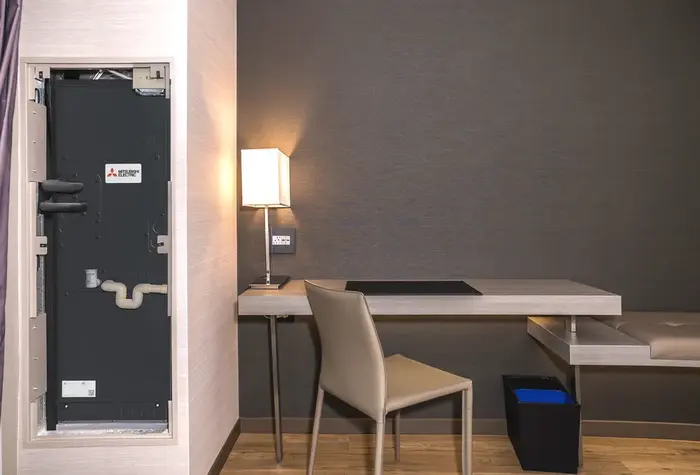
Ducted concealed — slim-profile ducted units for short-run distribution in concealed plenum. Common in office, hotel guestroom applications.
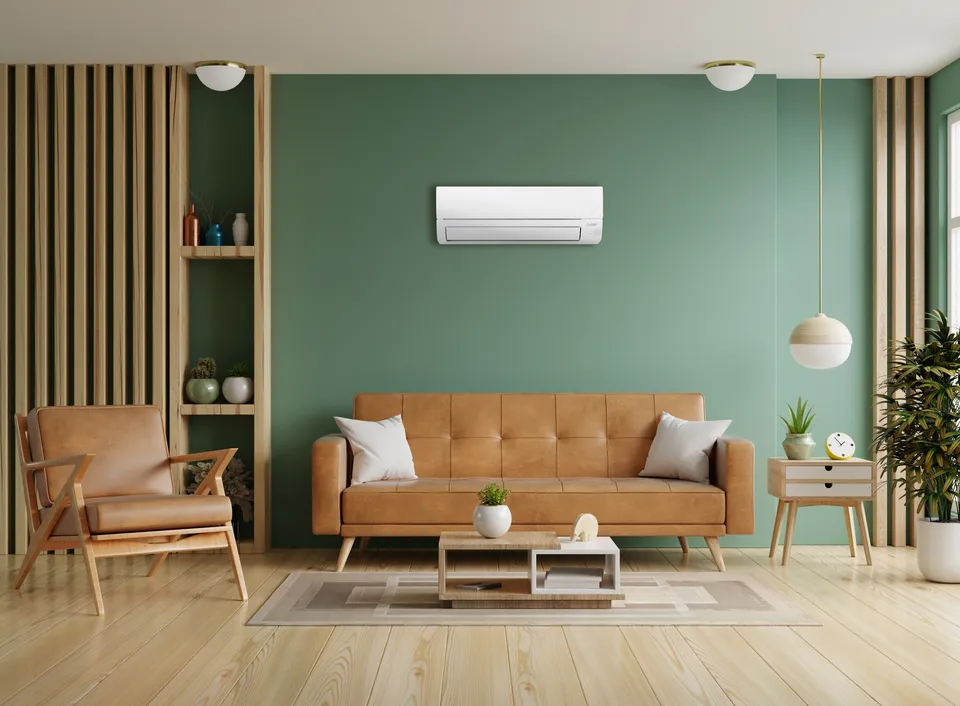
Wall-mounted — high-wall installation. Common in conference rooms, individual offices.
Console (floor-mounted) — under-window installation, similar to baseboard radiator profile. Common in renovation where ceiling access isn't available.
Ceiling-suspended — exposed ceiling unit. Common in high-ceiling industrial / retail applications.
Total indoor unit count per outdoor module: up to 64 units. Specific configurations depend on engineering capacity ratio.
Controls and Building Integration
The DVM S2 system integrates with:
Samsung DMS (Data Management Server) — building-level central control and monitoring.
Samsung S-NET Mini — small-system local control (no central server required).
BACnet / LonWorks integration — for buildings with existing building automation systems.
Web and mobile app control — Samsung BAC-NetExpress / cloud connectivity.
Tenant-level integration — per-tenant thermostat assignment, sub-metering for separate billing capability.
For projects requiring integration with existing Mitsubishi kumo cloud, Daikin VRV Cloud, or LG TMS, those are separate systems and require gateway translation — not standard practice but achievable.
R-454B Refrigerant — Why It Matters
The DVM S2 ships with R-454B refrigerant as standard. Significance:
EPA AIM Act compliance. Effective January 1, 2025, all new residential split-system and commercial VRF equipment manufactured in the US must use refrigerant with GWP below 700. R-410A (GWP 2,088) is being phased out. R-454B (GWP 466) and R-32 (GWP 675) are the two compliant options.
A2L classification. R-454B is mildly flammable (A2L). Installation requires A2L-certified technicians and equipment-specific safety protocols. Truficient is fully A2L-certified for installation and service.
Native R-454B vs retrofit. Equipment designed from the ground up for R-454B (DVM S2, Bosch Climate 5000, Daikin newest VRV IV+) performs differently than R-410A platforms with R-454B retrofitted. Native R-454B equipment is what we recommend for new installations going forward.
For broader refrigerant context, see our equipment catalogs page.
Installation Cost Framework
DVM S2 commercial installations vary widely by capacity, indoor unit count, controls scope, and DOAS integration. Rough ranges:
| Project Size | Capacity | Equipment + Install (Range) | |---|---|---| | Small commercial / strip mall | 6-10 tons | $35,000-$75,000 | | Mid-size office | 10-25 tons | $75,000-$180,000 | | Mid-rise multi-tenant | 25-60 tons | $180,000-$450,000 | | Large commercial / mixed-use | 60+ tons | $450,000+ |
These figures include outdoor units, indoor units, refrigerant piping, basic controls. They do NOT include DOAS (typically $25,000-$200,000 additional), ductwork for indoor distribution (varies widely), or major electrical service upgrade if required.
A full pre-engineered quote takes 2-4 weeks and requires detailed building information (drawings, occupancy schedule, load calculations).
When NOT to Specify DVM S2
The DVM S2 isn't the right answer for every commercial application. Skip it when:
1. Smaller projects (under 6 tons total). Standard split systems or mini-VRF (Mitsubishi M-Series, Daikin Aurora) deliver better value at this scale.
2. Pure cooling-only applications. Heat recovery is a key DVM S2 differentiator. If you don't need heat recovery, a less-expensive cooling-only VRF or even standard RTU may be more cost-effective.
3. Single-tenant pure office. Standard RTU with VAV control may be operationally simpler than VRF for a single-tenant building with consistent occupancy.
4. Specifications calling for Mitsubishi or Daikin specifically. Many Texas engineering firms have standing relationships with Mitsubishi or Daikin and will spec those for project-management reasons. DVM S2 substitution requires engineering sign-off.
For VRF brand alternatives, see Mitsubishi CITY MULTI VRF Dallas TX, Daikin VRV IV Dallas TX, and LG Multi V VRF Dallas TX.
Adjacent Pages
- Commercial RTU vs VRF Dallas TX
- Commercial DOAS Installation Dallas TX
- Mitsubishi CITY MULTI VRF Dallas TX
- Daikin VRV IV Dallas TX
- LG Multi V VRF Dallas TX
- Equipment Catalogs
Get a DVM S2 Project Consultation
Call 214-238-4349 or request a consultation.
Truficient installs and services Samsung DVM S2 commercial VRF across Dallas-Fort Worth, integrated with DOAS and properly engineered for hot-humid climate operation.
Tools to Help You Decide
See Our Dallas Metro Installations
Browse photos from real mini-split and heat pump installations in Dallas Metro homes.
Get an Instant Estimate
Answer a few questions about your home and get a ballpark cost for your project.
Scan Your Home's Efficiency
Find out where your home is losing conditioned air and what upgrades make the most sense.