The AC Feedback Loop: How Every Dallas Air Conditioner Is Making It Hotter for Every Other One
Here is something no HVAC contractor will tell you, because it's uncomfortable: every air conditioner running right now in Dallas is simultaneously making the outdoor environment hotter for every other air conditioner in the city.
This is not a theory. It's a peer-reviewed finding from Arizona State University researchers studying cities like Dallas — hot, dense, concrete-heavy metros where thousands of AC condensers run in close proximity through summer months that now stretch from May to October.
Understanding this feedback loop is the first step to understanding why the HVAC choice you make for your home or business is not just a personal decision. In a city where the urban heat island already pushes some neighborhoods to 110°F in August, every system installation is either part of the problem or part of the solution.
The 7-Step Cascade
Here is how the feedback loop operates, step by step:
Step 1 — The heat island raises outdoor temperatures. Dallas's pavement-heavy neighborhoods — Bishop Arts, West Dallas, the Medical District, Downtown — absorb solar radiation all day and release it slowly at night. NOAA's 2024 mapping confirmed these zones run up to 12°F hotter than the city's greener areas at the exact same moment.
Step 2 — Higher outdoor temperatures increase indoor cooling loads. When your outdoor ambient is 107°F instead of 95°F, your AC has to work significantly harder to maintain 72°F inside. The system's "lift" — the temperature differential it must overcome — increases with every degree of outdoor heat.
Step 3 — More AC operation expels more waste heat outdoors. An air conditioner doesn't destroy heat. It moves heat from inside to outside. The heat discharged at the condenser is the sum of the heat extracted from the indoor space plus the heat generated by the compressor motor itself. All of it goes into the outdoor air.
Step 4 — Higher outdoor temperatures reduce AC efficiency. This is where the feedback turns vicious. As outdoor air temperature rises, the refrigerant condensing temperature inside the outdoor unit rises with it. This forces the compressor to work harder to reject the same amount of heat. Engineers measure this as Coefficient of Performance (COP) degradation — a 5°F rise in outdoor temperature can meaningfully reduce how many BTUs of cooling a system delivers per watt of electricity consumed.
Step 5 — Lower COP means more electricity consumed per BTU of cooling. A system running at degraded efficiency draws more current to produce the same output. That additional current draw generates additional heat at the compressor — which must also be discharged outdoors.
Step 6 — More electricity generation means more waste heat from power plants. Power plants reject roughly twice as much heat as the electricity they produce. Every additional kilowatt-hour drawn by degraded Dallas AC systems on a 107°F afternoon represents heat discharged at distant generation facilities, plus resistive losses in the transmission lines between there and your house.
Step 7 — The cycle starts hotter the next day. A study of roof-mounted AC units at district scale found that concentrated condenser heat rejection caused a 5% increase in cooling energy needs and a 17% reduction in COP for surrounding buildings. Nighttime temperatures remain elevated because pavement and buildings retain the day's accumulated heat — including the heat from every running condenser — meaning tomorrow morning starts warmer than it should.
What Inverter Technology Changes
Standard single-stage air conditioners have one speed: full blast. When the thermostat calls for cooling, they run at 100% capacity. When the setpoint is reached, they shut off. This cycling behavior produces the worst possible interaction with the feedback loop — maximum waste heat at maximum outdoor ambient, when COP is already degraded.
Inverter-based variable-speed systems work differently. They modulate compressor speed continuously, running at partial capacity through most of the day and only ramping up when conditions demand it. This produces three measurable improvements in the feedback loop context:
Lower peak waste heat per system. Because the compressor isn't hammering at full capacity during the hottest hours, the peak burst of heat rejected to the outdoor environment is lower. Across a neighborhood, this matters.
Less electricity consumed per BTU delivered. High-efficiency inverter systems like the Mitsubishi MXZ line achieve SEER2 ratings up to 23.1 — compared to 14 SEER2 for the minimum-efficiency single-stage units common in older Dallas housing stock. That gap represents 40–65% less electricity consumed for the same cooling output.
Maintained efficiency under heat stress. Inverter compressors are engineered to continue modulating effectively at elevated outdoor temperatures. They don't hit a performance cliff the way fixed-speed systems do when outdoor temps push past 100°F.
The Dallas Numbers
- NOAA's 2023 study recorded 110.1°F in Bishop Arts at 3–4 p.m. The coolest simultaneous measurement was 100.9°F — a 9.2°F real-time gap.
- ASU research found AC waste heat raised mean nighttime temperatures by more than 1°C in urban zones.
- Research published in peer-reviewed climate journals found that AC heat feedback can represent up to 20% of global warming projections' magnitude in residential areas of hot cities.
- Dallas is warming faster than almost every major U.S. city — second only to Phoenix.
What You Can Do About It
You cannot single-handedly solve the urban heat island. But you can remove your home or business from the feedback loop with the right system choice.
Truficient specializes in engineering-based assessments for Dallas properties in identified heat island zones — areas where standard load calculations consistently undersize systems because they're built on regional averages, not the 10–12°F microclimate premium your neighborhood actually carries.
Read the full Dallas Urban Heat Island Research Report →
See how Dallas's hottest neighborhoods are affecting ERCOT →
Oncor Rebates: Getting Paid to Break the Cycle
Oncor Electric Delivery offers rebates of up to $1,000 for qualifying high-efficiency HVAC installations in its Dallas service territory. Switching from a standard 14 SEER2 system to a 20+ SEER2 inverter system is exactly the upgrade these rebates are designed to incentivize — because every household that makes that switch reduces Oncor's peak demand obligations during the worst grid days. Federal Inflation Reduction Act tax credits for heat pump installations stack on top of the Oncor rebate for qualifying primary residences. See how the incentives stack →
Get an engineering-based assessment for your home or business.
If you're in a Dallas heat island zone, your current system was almost certainly sized to regional weather data — not the 10–12°F temperature premium your neighborhood actually experiences. We assess the real microclimate load. Call 214-238-4349 or request a free assessment →
Tools to Help You Decide
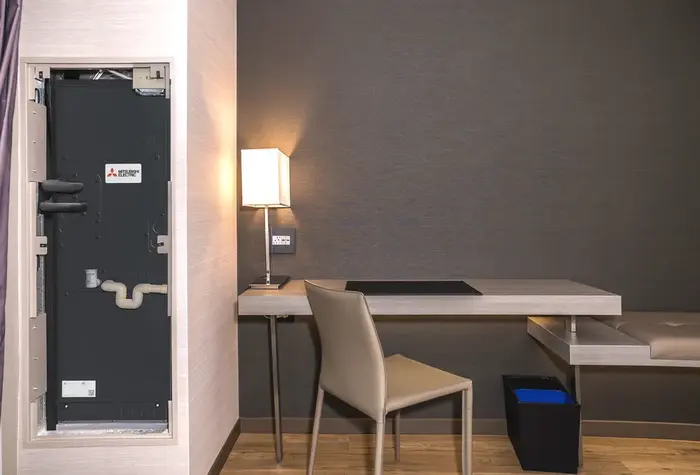
See Our Dallas UHI - AC Feedback Loop Installations
Browse photos from real mini-split and heat pump installations in Dallas UHI - AC Feedback Loop homes.
Get an Instant Estimate
Answer a few questions about your home and get a ballpark cost for your project.
Scan Your Home's Efficiency
Find out where your home is losing conditioned air and what upgrades make the most sense.