Restaurant Mini-Split Case Study — Design District, Dallas
A real Design District restaurant project: kitchen too hot, dining room cycling between 68°F and 76°F, patio unconditioned. Here's what we installed and why. Call 214-238-4349 for your project.
The Building
The project was a 4,800 square foot adaptive-reuse restaurant in a converted warehouse in the Dallas Design District — a 1960s steel-frame industrial building on the Hi Line / Slocum corridor that had been repurposed twice before becoming a full-service restaurant. The space had:
- ~2,400 sq ft of dining (high ceilings, exposed steel trusses, polished concrete floor, large storefront glazing facing west)
- ~1,400 sq ft of commercial kitchen (gas range, char broiler, fryer, two ovens, prep stations)
- ~600 sq ft of bar area between dining and kitchen
- ~400 sq ft of covered patio with overhead-door opening to the dining room
The original HVAC was a single 7.5-ton rooftop package unit installed during the previous tenant's buildout. The system fed a single trunk duct that branched to dining and kitchen, with no zoning, a single thermostat in the dining room, and no make-up air provision for the kitchen exhaust hood.
The Problems the Operator Was Living With
The owner brought us in three months after opening. The complaints were specific and consistent:
Kitchen running 92-95°F during dinner service. The exhaust hood pulled significant air out of the building during peak service. The single rooftop unit couldn't keep up with the combined load of the kitchen equipment heat and the make-up air pulled in unconditioned. Line cooks were working in conditions that violated their tolerance and approached health-code concerns.
Dining room temperature cycling 68-76°F across an evening. Single-stage system, single-thermostat control. The system hit the dining-room setpoint quickly when the room was empty, but when 80 guests showed up at 7 PM, the load doubled and the system fell behind. By 8:30 PM the dining room was at 76°F. By 10 PM it was back to 68°F when the room cleared.
Bar area always wrong. The bar sat between dining and kitchen — pulled hot air from the kitchen during service, cold air from the dining room when conditions were stable. No dedicated supply, no dedicated return.
Patio unusable in summer. The covered patio had no conditioning. With the overhead door open to dining, the patio cooled passively but cooled the dining room as a side effect.
Operating cost out of line with comparable restaurants. The 7.5-ton single-stage RTU ran continuously during service hours and frequently into the night. Monthly electric bills during summer were running 30-40% higher than what a properly sized system should produce.
The Diagnosis
The fundamental problem was that a single-zone single-stage RTU couldn't address an inherently multi-zone application:
- Kitchen had a 50,000+ BTU/hr equipment heat load and a make-up air requirement
- Dining had a variable 25,000-65,000 BTU/hr load depending on occupancy
- Bar had a fixed-schedule load tied to service hours
- Patio had zero conditioning
Additionally, the existing rooftop unit was 14 years old, R-22 refrigerant (already non-compliant for new equipment under previous EPA rules and increasingly expensive to service), and operating with marginal compressor performance.
The right solution was a multi-zone mini-split system that provided independent control by zone, paired with a dedicated kitchen exhaust make-up air unit to handle the hood requirement.
What We Installed
The system we designed and installed:
Three Mitsubishi MXZ multi-zone outdoor units (separate condensers for thermal redundancy):
- Outdoor Unit 1 — Dining Zone: Mitsubishi MXZ 48,000 BTU outdoor unit serving four indoor zones — front dining (two ceiling cassettes), rear dining (one ceiling cassette), bar (one wall-mount unit). Each zone independently controlled.
- Outdoor Unit 2 — Kitchen Zone: Mitsubishi MXZ 36,000 BTU outdoor unit serving two ceiling cassettes specifically over the cook line and prep stations, sized for the equipment heat load.
- Outdoor Unit 3 — Patio Zone: Mitsubishi MXZ 18,000 BTU outdoor unit serving two wall-mount indoor units along the patio walls, providing conditioning when the overhead door was closed.
Dedicated kitchen make-up air unit (separate from the mini-split system): A 4,000 CFM make-up air unit tied to the hood control, providing tempered fresh air to the kitchen during exhaust operation. This isolated the kitchen ventilation requirement from the cooling system.
Indoor unit selection:
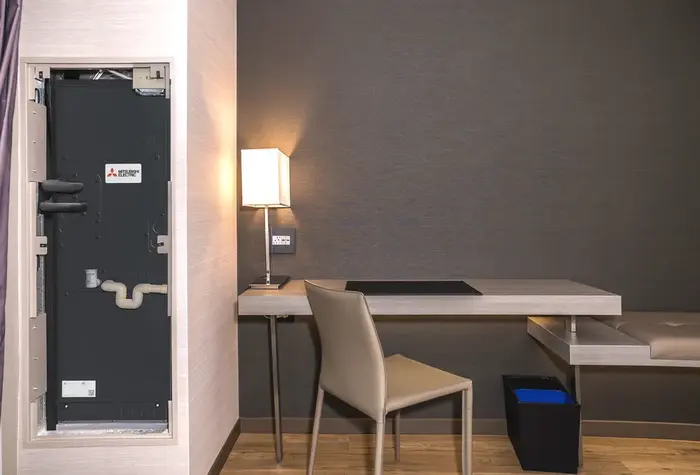
- Mitsubishi SLZ 4-way ceiling cassettes in dining and kitchen — recessed flush-mount, low-profile fit in the high-ceiling industrial space, slim cassette design that doesn't disrupt the exposed-truss aesthetic
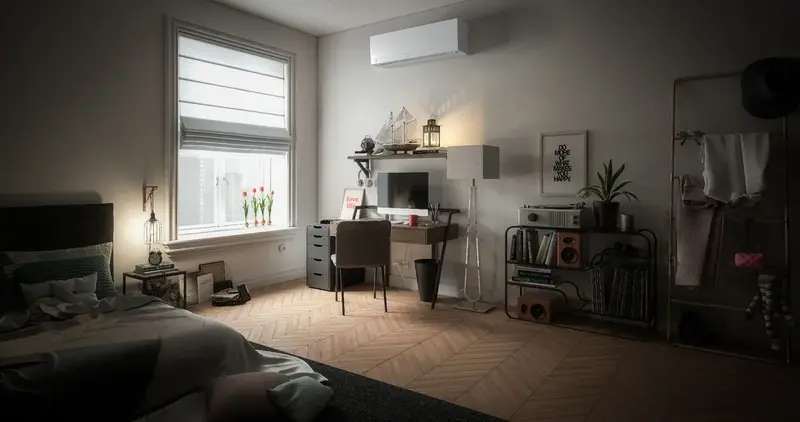
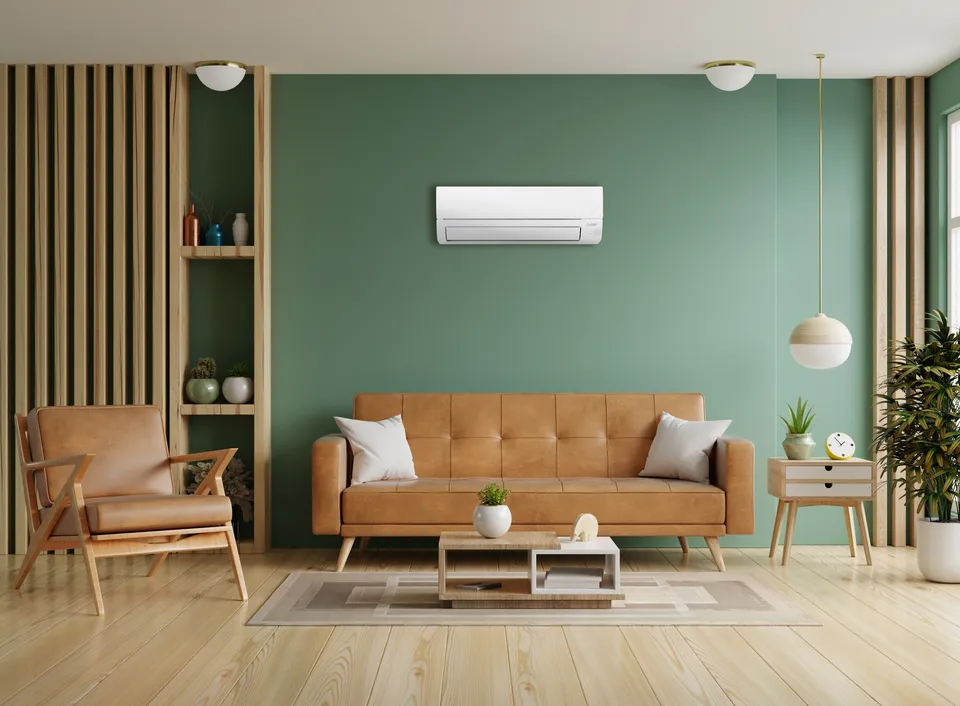
- Mitsubishi MSZ-FS wall-mount units in bar and patio — slim profile, low noise, white finish
Refrigerant: All three outdoor units use R-32 — the current EPA AIM Act compliant refrigerant, replacing the R-22 system being decommissioned.
Smart control: All three systems integrate via Mitsubishi kumo cloud, allowing the operator to monitor and control all zones from a single dashboard, set schedules per zone, and receive fault notifications.
What Changed After the Install
Three months after commissioning, the operator's actual performance:
Kitchen line temperature: 78-82°F during peak service. Drop from 92-95°F to 78-82°F during the same service-hour conditions. Line cooks reported actual workable conditions. Equipment performance also improved (refrigeration units recover faster in lower ambient).
Dining room temperature: Held within ±1.5°F of setpoint across an entire evening regardless of occupancy. The inverter-modulating equipment ramped up as the room filled and back down as guests departed, never falling behind and never overshooting.
Bar zone: Independent control eliminated the pulled-from-adjacent-zone temperature swings. Bar staff stopped complaining.
Patio: Usable as conditioned space when the overhead door was closed. Operator added 30 covers of patio seating during summer weeks and gained measurable revenue from the conditioned outdoor space.
Operating cost: Total HVAC electrical demand reduced approximately 30% versus the previous single-stage RTU. Inverter modulation across three smaller systems run only when their respective zones called for capacity, versus a single oversized RTU running continuously.
Maintenance and service profile: The new equipment is R-32 — current refrigerant, in supply for service. No more chasing R-22 refrigerant for service calls on the legacy RTU. Three smaller systems also provide thermal redundancy: a failure of one unit doesn't take the whole restaurant offline.
Why This Project Worked
Multi-zone matched a multi-zone problem. The biggest single improvement came from giving each functional area independent control. No single-thermostat HVAC can serve a restaurant with kitchen, dining, bar, and patio zones operating on different schedules and loads.
Make-up air separated from cooling. Kitchen ventilation is its own system requirement. Tying it to the cooling system (via undersized RTU pulling outside air through the building) was the original installer's mistake. A dedicated make-up air unit tied to hood control is the right architecture.
Inverter modulation matched the variable load. Restaurant loads change rapidly across an evening — empty at 5:30 PM, full at 8 PM, half-full at 10 PM. Single-stage equipment can't track that. Inverter equipment ramps continuously and matches actual demand.
Mitsubishi ceiling cassettes worked in the industrial aesthetic. The exposed-truss / polished-concrete aesthetic that defines Design District restaurants doesn't tolerate visible HVAC infrastructure. Recessed ceiling cassettes blended into the existing ceiling plane with minimal visual impact.
What This Means for Other Design District Restaurants
If you operate a restaurant or food-service business in the Design District (or in any adaptive-reuse industrial building in Dallas), the conditions are likely similar to what we faced on this project:
- High ceilings with industrial-scale interior volume
- Mixed-zone use (kitchen, dining, bar, patio, sometimes private dining)
- Original or undersized rooftop equipment from a prior tenant
- No dedicated kitchen make-up air strategy
- Comfort and operating-cost complaints
Multi-zone Mitsubishi mini-splits with separate make-up air for kitchen ventilation is a repeatable solution for this building type. Equipment specification scales with restaurant size, but the architecture is consistent.
Adjacent Pages
- Commercial Mini-Split Design District Dallas — broader Design District commercial overview
- Industrial Warehouse HVAC Design District Dallas — adaptive-reuse industrial building HVAC
- Design District HVAC Hub — neighborhood overview
- Restaurant HVAC Dallas TX — broader restaurant HVAC content
- HVAC for Builders & Developers Dallas TX — for restaurant developers and GCs
Get a Project Walk for Your Restaurant
If you operate a Dallas restaurant — Design District, Bishop Arts, Deep Ellum, Lakewood, Uptown, anywhere — and you're dealing with kitchen-too-hot, dining-room-comfort, or operating-cost issues, the conversation starts with a site walk.
Call 214-238-4349 or request a site walk.
Truficient is a Mitsubishi Diamond Dealer with light-commercial restaurant HVAC capability across Dallas.
Tools to Help You Decide
See Our Design District (Restaurant Case Study) Installations
Browse photos from real mini-split and heat pump installations in Design District (Restaurant Case Study) homes.
Get an Instant Estimate
Answer a few questions about your home and get a ballpark cost for your project.
Scan Your Home's Efficiency
Find out where your home is losing conditioned air and what upgrades make the most sense.