Commercial Mini-Split Systems for Design District Dallas Businesses
Transform your showroom or studio into a precision environment. → Request a Quote or call 214-238-4349
The Mini-Split Advantage for Showrooms, Galleries & Creative Spaces
A gallery owner on Dragon Street is not thinking about HVAC. They're thinking about foot traffic, dwell time, merchandise presentation, and customer comfort. Yet a single loud compressor cycling every 15 minutes—or worse, visible ductwork cuts in the ceiling—destroys the carefully curated ambiance of a high-end design space.
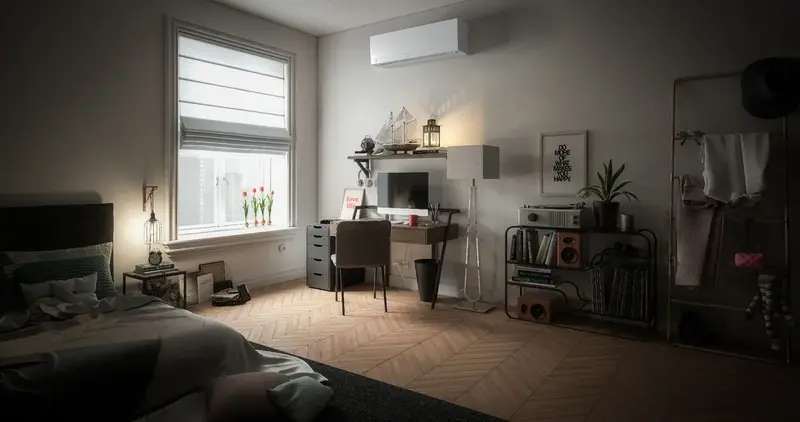
This is where commercial mini-splits solve the fundamental problem: they deliver efficient, precise climate control in a nearly invisible package. No rooftop compressor noise bleeding into the sales floor. No ceiling returns eating into sightlines. No industrial ductwork competing with gallery lighting and exposed brick. A Mitsubishi commercial mini-split system works so quietly that customers rarely know it's there.
For Design District businesses managing 2,000 to 15,000 square feet of premium commercial space, mini-splits (and their multi-zone cousin, VRF) have become the default standard. Truficient Energy has installed mini-split systems in furniture showrooms, photography studios, event spaces, and design galleries across the neighborhood. Here's why they win.
Mitsubishi SLZ Ceiling Cassettes: Invisible Conditioning for Open Showrooms
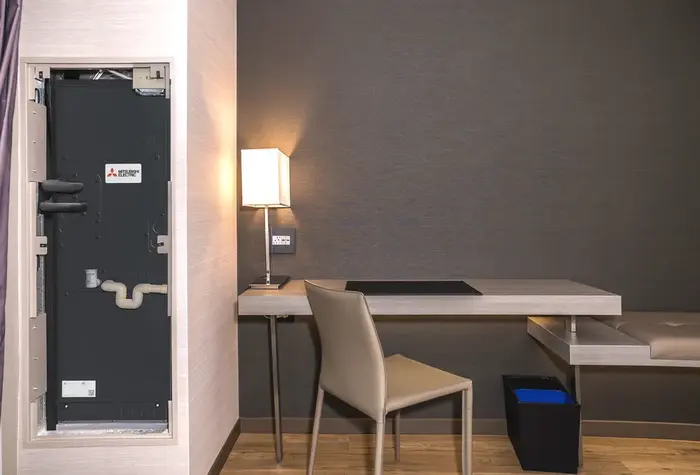
The Mitsubishi SLZ ceiling cassette unit is the workhorse of Design District commercial HVAC. These flat, square units install flush into drop ceilings (or can be exposed and aesthetically integrated into industrial spaces). The return air grille is minimal and neutral. A 5,000-square-foot showroom needs only one or two units.
Key advantages for showroom operators:
- Silent operation: 25–28 dB output (quieter than ambient conversation). Your customers hear background music and your sales pitch, not compressor noise.
- Even temperature distribution: SLZ cassettes deliver air from all four sides, preventing hot spots and cold drafts across large open layouts.
- Minimal visible footprint: The grille sits flat. The piping is hidden in the ceiling cavity. From the floor, customers see virtually nothing.
- Smart control: Wall-mounted thermostats or building management system integration allows zone-specific temperature tweaks.
A furniture showroom on Dragon Street running three SLZ cassettes can maintain 71°F across the entire sales floor while the back office stays at 68°F—independently. One outdoor compressor handles all zones. Total visible equipment: none.
VRF for Large Multi-Zone Showrooms: Scaled Efficiency
Mitsubishi City Multi VRF systems are deployed in Design District showrooms exceeding 8,000 square feet that require independent climate control across multiple zones. VRF stands for variable refrigerant flow. A single outdoor unit connects to up to 32 interior cassette or duct units, each operating independently.
VRF engineering specific to Design District:
A furniture and design showroom on Hi Line Drive occupies 12,000 square feet split across climate zones: open showroom floor (1–3 zones), climate-controlled office (zone 4), and climate-sensitive storage (zone 5). Traditional rooftop packaged units can't zone independently. Mini-splits alone would require three separate outdoor compressors—costly and visually cluttered.
VRF delivers the same capacity with one outdoor unit. The compressor modulates refrigerant flow to each interior unit based on demand. If the showroom is unoccupied and set to 74°F while the office is 70°F, the compressor throttles down. If all zones demand max cooling on a 95°F day, the compressor ramps up to full capacity. This dynamic load-matching reduces energy consumption by 30–40% versus fixed-capacity systems.
Photography Studios & Climate-Sensitive Creative Spaces
Photography studios require micro-precise temperature and humidity control. Film stock, digital sensors, prints, and chemicals are sensitive to environmental fluctuation. A 3°F swing can damage work-in-progress prints. A 5% humidity jump can corrupt medium.
Truficient has installed Mitsubishi mini-split and VRF systems in photography studios across the Design District (particularly around Motor Street and Slocum Street corridors). These systems maintain ±2°F temperature consistency and 40–50% humidity bands without fluctuation.
Why mini-splits beat alternatives:
- Ductwork noise: Traditional rooftop units and central returns generate ductwork rumble that bleeds into studio recording/media rooms.
- Humidity control: Mini-splits allow independent dehumidification cycles. A single zone can run 45% humidity while the rest of the building runs 50%.
- Energy efficiency: Precision zoning means you're not cooling an empty darkroom 24/7. The studio only conditions occupied space.
Aesthetics Matter: Exposed Industrial Spaces & Design Integration
Design District converted warehouse buildings often feature exposed ceilings, industrial beams, and zero tolerance for "HVAC infrastructure" visual clutter. This is the neighborhood's defining character. Traditional rooftop packaged units and visible ductwork break the aesthetic.
Mitsubishi mini-split systems can be mounted and installed to enhance rather than interrupt this aesthetic:
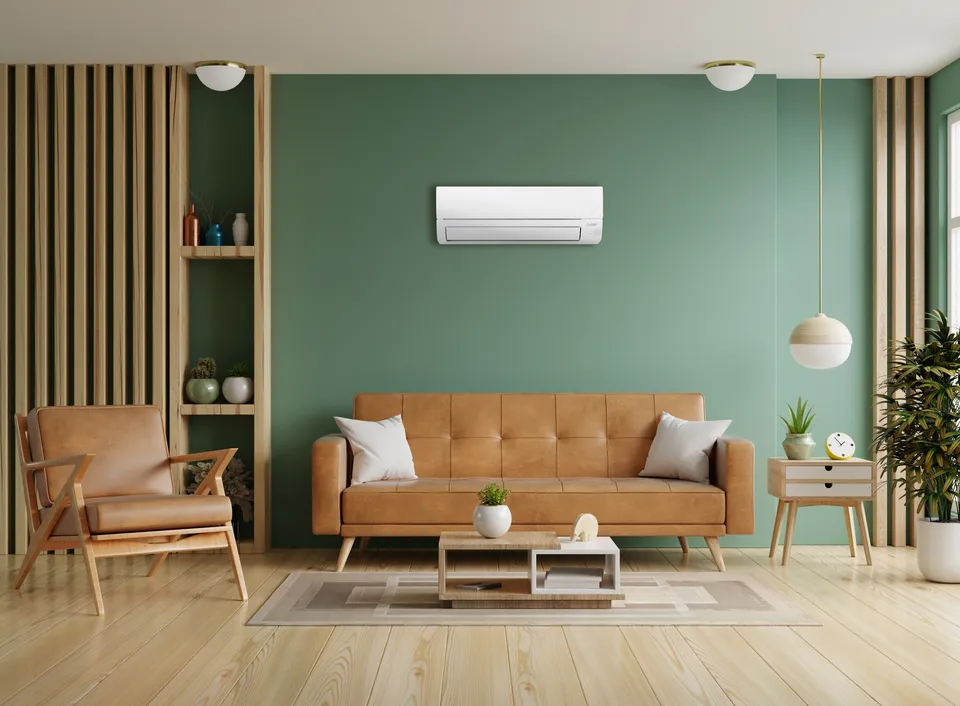
- Wall-mounted interior units can be positioned to align with architectural lines and exist as intentional design elements (matte black, white, or brushed silver finishes).
- Ceiling cassettes sit flush and blend into drop ceiling grids or industrial ceiling cavities.
- Minimal external piping: All refrigerant lines run inside walls or ceiling cavities. Only a 1-inch line pair is externally visible between the outdoor and indoor units.
Event spaces in the Design District (particularly around Slocum and Dragon corridor mixed-use buildings) use mini-splits precisely because they must transition from raw industrial to climate-controlled retail/event space without sacrificing the raw aesthetic.
Service & Maintenance: Year-Round Support for Design District Businesses
Installing a Mitsubishi commercial mini-split is the beginning, not the end. These systems require preventive maintenance every 6–12 months to maintain peak efficiency and warranty coverage.
Truficient provides maintenance contracts for Design District commercial HVAC systems:
- Filter replacement and inspection (every 3–6 months)
- Refrigerant level checks (annually)
- Compressor health monitoring (annually)
- Condenser coil cleaning (seasonally)
- Thermostat calibration (annually)
A neglected mini-split system loses 3–5% annual efficiency. Over five years, a showroom paying $1,500 to install a system might waste $3,000 in additional energy costs through deferred maintenance. Truficient's maintenance contracts cost $450–600 annually and typically save $2,000+ in energy over the system lifetime.
Oncor approves most Design District applications within 5–7 days.
Truficient: Design District's Mitsubishi Commercial HVAC Partner
The Design District's commercial character depends on systems that work invisibly. Mitsubishi commercial mini-split and VRF systems from Truficient Energy are built for this neighborhood's unique constraints: no visible equipment, no noise, no ductwork, precision zoning, and aesthetic integration.
Explore the broader Design District HVAC ecosystem or learn more about Mitsubishi mini-split technology and efficiency across Dallas.
Ready to specify a commercial mini-split system for your Design District business? Request a quote or call 214-238-4349 for immediate assessment and design consultation.
Tools to Help You Decide
See Our Design District Installations
Browse photos from real mini-split and heat pump installations in Design District homes.
Get an Instant Estimate
Answer a few questions about your home and get a ballpark cost for your project.
Scan Your Home's Efficiency
Find out where your home is losing conditioned air and what upgrades make the most sense.