Ductless HVAC for Lakewood and White Rock Lake, Dallas
Historic home, addition, or whole-home system? Let's solve it. → Request a Quote or call 214-238-4349
What Lakewood HVAC Projects Actually Look Like
Lakewood is not a uniform neighborhood in terms of housing stock or HVAC challenge. The residential streets between Gaston Avenue and White Rock Lake range from 1920s Tudor Revival estates on Lakewood Boulevard and Tokalon Drive — properties with original plaster walls, limestone exterior detailing, and attic spaces that were never designed to house mechanical equipment — to mid-century ranches on the quieter streets closer to Garland Road, to infill construction and substantial additions that have been added to historic footprints over the past thirty years.
The common thread is that the existing HVAC infrastructure in Lakewood homes is rarely adequate for the whole building. The original structure may have a functional central system. The addition — a primary suite wing, a family room expansion, a new sunroom — either doesn't connect to it, can't connect to it without destructive construction through finished original spaces, or would overload a system that was already sized to its limit.
Truficient's active Lakewood projects right now reflect this pattern directly. Several of them are addition-specific installations where the primary home's central system stays in place and a dedicated ductless unit conditions the new space. The most common indoor unit choice in these projects isn't a standard wall-mount — it's the Mitsubishi MLZ one-way ceiling cassette, and understanding why requires understanding what that unit actually does.
The Mitsubishi MLZ One-Way Ceiling Cassette: Why It Fits Lakewood Additions
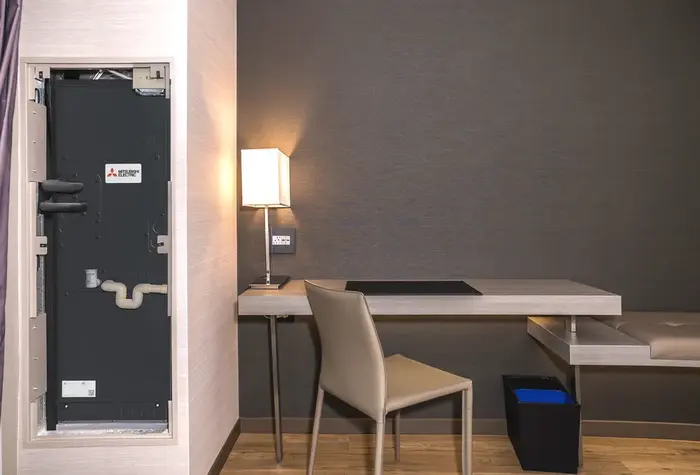
The Mitsubishi MLZ series is a slim ceiling cassette that mounts within the ceiling cavity and discharges conditioned air in a single direction — one way, as the name implies, rather than the four-way distribution of a standard cassette. The unit body is compact: significantly shallower than a conventional ceiling unit, which means it fits into ceiling constructions where a deeper unit wouldn't. It's designed for low-ceiling spaces, additions with tight plenum depth, or any application where a wall-mount unit doesn't fit the architecture but a full four-way cassette won't physically install.
For a Lakewood addition — a primary suite wing on the back of a 1935 Tudor, a family room addition over a new pier-and-beam foundation section, a sunroom framed into the rear of a masonry cottage — the MLZ addresses a specific combination of constraints simultaneously.
Ceiling depth. Addition spaces in Lakewood homes often have ceiling constructions that don't offer the plenum depth that a four-way cassette requires. The MLZ's slim profile installs in ceiling cavities with as little as 10 inches of available depth above the finished ceiling surface, which is achievable in most addition framing conditions without special modification.
Directional airflow. In a rectangular addition — a primary suite bedroom wing, a family room that extends off the back of the house — conditioning the space from one direction is often more appropriate than distributing air from all four sides. The MLZ's directional discharge can be oriented to push conditioned air along the length of the room, reaching the far end of the space rather than distributing air that decays before it crosses the room.
Architectural discretion. From below, the MLZ presents a narrow, rectangular grille flush with the ceiling surface. In a Lakewood addition with original-style trim and finish work — a Tudor-influenced primary suite that matches the architectural character of the main house — a low-profile ceiling grille reads better than a wall-mount unit on the primary wall surface.
Independent operation. Each MLZ unit is a fully independent zone. The addition runs at whatever temperature its occupants set, regardless of what the main house's central system is doing. No shared thermostat conflicts, no duct runs crossing from the original structure into the new footprint.
Current Lakewood Installation Scenarios
The following represents the range of Lakewood projects Truficient is currently working through — each one using ductless equipment to condition a space that the main home's HVAC system can't or shouldn't reach.
Primary suite additions. The classic Lakewood project: a Tudor or Colonial Revival home where the original bedrooms are modest in size and the owners have added a full primary suite on the back or side of the lot. The addition has its own framing, its own roof section, and a finished ceiling that connects to the original plaster interior with a transition detail. The MLZ installs in the new ceiling cavity above the primary bedroom, positioned to direct conditioned air across the room toward the exterior wall. A second MLZ or a wall-mount unit handles the addition's bathroom and closet if the layout calls for it.
Family room and sunroom expansions. A family room or sunroom addition in Lakewood frequently involves significant glazing — south-facing glass in a sunroom addition creates a substantial solar gain that the main system, which is already running at or near its capacity for the original footprint, can't absorb. A dedicated MLZ or single-zone wall-mount handles the addition's solar load independently without affecting the rest of the house's conditioning.
Full ductless retrofits on historic structures. For Lakewood properties where the existing central system is at end of life — aging R410A equipment, multiple previous repairs, a compressor that's drawing high amperage and running hot — the replacement path is sometimes a whole-home multi-zone ductless system rather than a like-for-like central replacement. This is particularly relevant for multi-story Lakewood homes where temperature stratification between floors is a persistent problem. A multi-zone system with independent handlers on each floor eliminates the stratification problem by conditioning each floor to its own setpoint rather than averaging the whole building on one thermostat.
Why Ductless Preserves What Makes a Lakewood Home Worth Owning
Lakewood's residential character — the reason property values on Lakewood Boulevard and Tokalon Drive are what they are — rests on architectural integrity. Plaster ceilings, original millwork, masonry construction details, and finished interior surfaces that have been maintained or carefully restored over decades.
Conventional duct system work in these structures is inherently destructive. Running a duct chase from the original house into an addition requires opening walls or ceilings to create the passage. Adding supply registers to rooms that weren't originally served means cutting into plaster surfaces. The contractor who is willing to do this work quickly tends to do it with a Sawzall and a can of spray foam, and the result shows in the finished product.
Ductless installation in a Lakewood historic home requires one small exterior penetration per indoor unit — typically through the addition's exterior wall, away from primary street-facing elevations, at a location chosen to minimize visual impact. The refrigerant and condensate lines run inside the wall cavity or in a line-hide cover that can be painted to match the exterior. Nothing in the original structure is cut, opened, or disturbed.
For Lakewood homeowners who have invested in careful restoration work, this is not a minor point. The HVAC decision is a preservation decision as much as a comfort decision.
Thermal Performance at White Rock Lake
Lakewood's proximity to White Rock Lake creates a specific thermal profile worth understanding. The lake moderates overnight temperatures slightly, but the combination of masonry construction and high thermal mass means Lakewood homes hold heat in their walls well into the evening. The streets closest to the park also experience higher humidity levels during summer — ground-level moisture from the lake and surrounding vegetation adds to the interior humidity load that HVAC equipment has to manage.
Mitsubishi's inverter compressors modulate continuously rather than cycling on and off at fixed capacity. In a masonry Lakewood home or addition with high thermal mass and gradual heat release overnight, this means the system maintains setpoint with less temperature swing and removes moisture from the air more consistently — because it runs longer at lower capacity rather than cycling through on-off intervals that don't dehumidify effectively.
For Lakewood additions where the new framing section connects to original masonry walls, the thermal mass differential between the old and new construction is something Truficient accounts for in system sizing. The addition may reach temperature quickly while the masonry original warms more slowly — or vice versa, depending on orientation and solar exposure.
Serving Lakewood and White Rock Lake
Truficient serves the full Lakewood residential area — Lakewood Boulevard and Lakeshore Drive, Tokalon Drive and Peavy Road, the residential blocks between Gaston Avenue and the park, and the White Rock Lake neighborhood east toward Garland Road. Primary service ZIP: 75214.
For homes in the adjacent Lower Greenville and M Streets area, see our Lower Greenville mini-split and ADU installation page. For the Lake Highlands area to the north, our Lake Highlands AC repair page covers repair and replacement for that neighborhood's mid-century housing stock.
Schedule a Lakewood Walkthrough
Every Lakewood project starts with a site visit. The specific ceiling construction of the addition, the outdoor unit placement options that preserve the property's visual character, and the indoor unit selection that fits the architecture can't be determined remotely.
Call 214-238-4349 to schedule a walkthrough, or request a quote online and we'll confirm a time.
Truficient is a Mitsubishi Diamond Dealer serving Lakewood, White Rock Lake, and East Dallas.
Tools to Help You Decide
See Our Lakewood Installations
Browse photos from real mini-split and heat pump installations in Lakewood homes.
Get an Instant Estimate
Answer a few questions about your home and get a ballpark cost for your project.
Scan Your Home's Efficiency
Find out where your home is losing conditioned air and what upgrades make the most sense.