Mini-Split Installation in Lower Greenville and the M Streets, Dallas
Bungalow, addition, or ADU — we've done it on your block. → Request a Quote or call 214-238-4349
The M Streets Ductwork Problem
The residential avenues east and west of Greenville Avenue — Matilda, Mercedes, Monticello, McMillan, Morningside — were platted and built between 1915 and 1940. These bungalows, Tudor cottages, and Colonial Revival homes predate residential central air conditioning by a generation. When AC retrofits happened in the 1950s and 1960s, contractors improvised duct routes through attic spaces that weren't designed for them: narrow flex duct over original plaster ceilings, supply registers cut into closets, entire back rooms left off the system because there was no clean path to reach them.
The result is a consistent pattern in M Streets homes today: the front rooms cool adequately, the back bedroom and any addition run four to ten degrees warmer than the rest of the house, and the garage or carriage house out back has never been part of the system at all.
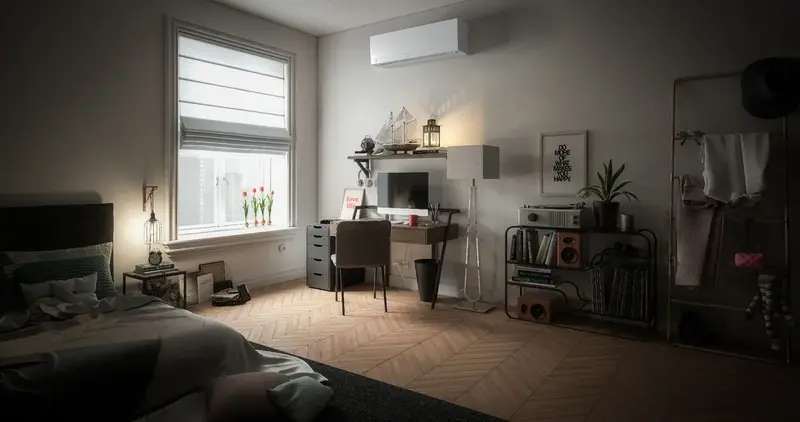
A Mitsubishi ductless mini-split addresses each of these situations without touching the existing duct infrastructure. One small exterior penetration. A refrigerant line set the diameter of a garden hose. An indoor handler positioned where the space actually needs it. No plaster demo. No ceiling cuts. No duct work.
What makes Lower Greenville and the M Streets different from other East Dallas neighborhoods is the breadth of HVAC projects that come with the renovation activity here — not just one problem room in a bungalow, but the full range: garage conversions, ground-up ADUs, primary suite additions, and whole-home ductless retrofits. Truficient has worked through all of these project types in this neighborhood. The following sections cover what each involves.
Garage Conversions: Conditioning Attached and Detached Garages for Living Use
The single-car and two-car garages on M Streets lots — including detached carriage houses on the alleys and attached garages that were never finished — are among the most active conversion projects in Lower Greenville. These spaces become home gyms, home offices, short-term rental units, art studios, and music rooms. In almost every case, the existing structure has no HVAC infrastructure whatsoever.
A garage conversion mini-split installation is one of the cleaner and faster projects Truficient does. The outdoor unit mounts to the exterior of the structure — on the rear wall, on a bracket off the eave, or on a ground pad in the alley — and the refrigerant line set runs inside to a wall-mount or ceiling-mount indoor handler. The space is operational with its own dedicated system, entirely independent of the main house.
What varies from one garage conversion to the next in Lower Greenville is the existing electrical service situation. A detached carriage house on the alley may have a subpanel with available capacity; a finished attached garage may need a dedicated circuit run from the main house panel. Truficient assesses the electrical situation during the initial walkthrough so there are no surprises at installation. The electrical work is part of the project, not a separate coordination problem.
Garage conversions in this area also vary in their insulation condition. An uninsulated masonry carriage house from the 1930s has a very different thermal profile than a framed garage addition with existing drywall. The system sizing depends on it — an undersized unit in a poorly insulated space will run continuously and underperform; an oversized unit will short-cycle and fail to dehumidify properly. Truficient sizes every garage conversion installation based on the actual insulation condition of the space, not a rule of thumb.
Ground-Up ADUs: HVAC as Part of the Build From the Start
Several M Streets property owners in the past few years have gone beyond converting existing structures and built new accessory dwelling units from the foundation up — typically on the rear portion of a deep lot behind a bungalow, replacing a demolished garage or filling previously unused yard space. These ground-up ADU projects represent the cleanest mini-split installation scenario because HVAC is part of the design from the start rather than a retrofit.
For a new-construction ADU on an M Streets lot, Truficient typically recommends a single-zone Mitsubishi wall-mount unit for studios and one-bedroom layouts in the 400–650 square foot range, and a two-zone system for ADUs with separate bedroom and living areas or loft configurations where temperature stratification between levels is a concern. Because the ADU structure is new, there's often an opportunity to specify a higher level of insulation in the walls and ceiling than the main house has — which meaningfully reduces the required system size and operating cost.
Ground-up ADU projects also present the opportunity to locate the outdoor unit in the most practical position before any finished landscaping or screening goes in. Alley-side placement, integrated into a fence or utility area, is the common outcome for M Streets ADUs and keeps the unit out of the main yard while maintaining service access.
One consistent issue in Lower Greenville ADU projects: the city of Dallas permitting requirements for new residential structures require properly permitted HVAC installations with inspections, and the system needs to be sized and documented appropriately for the certificate of occupancy. Truficient pulls permits for all ADU installations and coordinates the inspection process with the general contractor.
Primary Suite and Room Additions: Conditioning the Space That Wasn't There Before
The most common addition project in the M Streets is a primary suite expansion or a kitchen-and-family-room addition across the back of the lot — taking a 1,000-square-foot bungalow and pushing it to 1,600 or 1,800 square feet. The existing central system was sized for the original footprint. The addition isn't part of it, either because the existing system can't carry the extra load, because running duct to the addition would require destructive construction through finished original spaces, or because the addition's floor plan doesn't lend itself to duct routing.
A mini-split for this type of addition is a supplemental system, not a replacement for the main house HVAC. The addition gets its own outdoor unit — or is added as a zone on a multi-zone system if the outdoor unit has available capacity — and its own indoor handler. The main house's existing system continues to serve the original footprint. The two systems run independently.
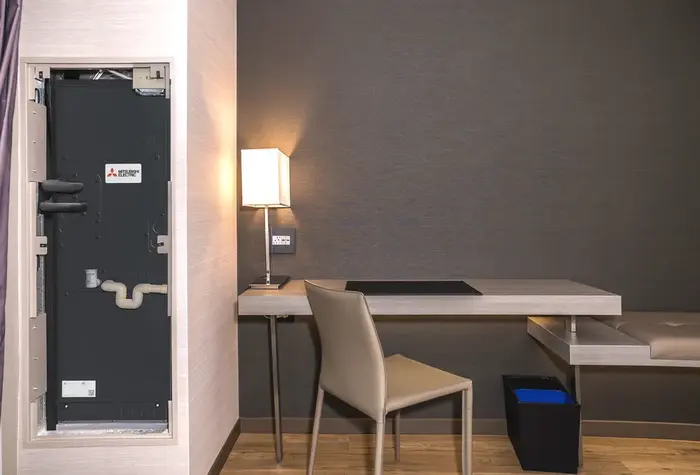
For M Streets additions that involve high ceilings or open-plan living areas, Truficient evaluates whether a wall-mount unit, a ceiling cassette, or a concealed ducted unit fits the space better. A family room addition with 12-foot ceilings and a large expanse of south-facing glass benefits from a ceiling cassette that distributes conditioned air across the space from above, rather than a wall-mount directing airflow across one portion of the room. The unit selection is part of the installation design, not a default choice.
Whole-Home Ductless Retrofits: When the Original System Is Done
For M Streets bungalows where the existing central system has reached the end of its practical life — or where the original duct infrastructure is so compromised that repairing or extending it isn't economically rational — a whole-home ductless replacement using a multi-zone Mitsubishi system is the option worth considering.
This approach replaces the central system entirely with a multi-zone outdoor unit connected to independent indoor handlers in each zone of the house. Each zone operates independently. The front living area and the back bedrooms run at different temperatures if the occupants want them to. A zone that's unoccupied can be set back without affecting the rest of the house.
For a 1,200-square-foot M Streets bungalow, a typical whole-home ductless retrofit uses a two- or three-zone outdoor unit with wall-mount handlers in the main living zone, the primary bedroom, and either a secondary bedroom or the addition. The existing duct system is decommissioned in place — no demolition required — and the outdoor compressor from the original system is removed and disposed of.
For ADU installations specifically, the federal Inflation Reduction Act's residential energy credit (Section 25C) covers qualifying heat pump and mini-split equipment at up to 30% of installation cost, subject to annual caps. ADUs on a property with a primary residence owner-occupant typically qualify. A ground-up ADU that's treated as a new residential structure may have different credit eligibility than a conversion — something worth confirming with a tax professional using the specifics of the project.
Serving Lower Greenville and the M Streets
Truficient serves the full Lower Greenville corridor — the M Streets blocks from Ross Avenue north to Mockingbird Lane, the streets east toward Skillman Avenue, and the Belmont Avenue and Vanderbilt Avenue transition areas near the Greenville Avenue commercial strip. Primary service ZIP: 75206.
For the adjacent Lakewood and White Rock Lake neighborhood, our Lakewood ductless HVAC page covers that area's historic addition and whole-home scenarios. For Uptown and Oak Lawn to the west, see our Uptown multi-zone installation page.
Request a Quote
Whether it's a back bedroom that never cooled properly, a garage you're finishing into a home office, a ground-up ADU going through permitting, or a whole-home system that's done — call or request a quote and we'll schedule a walkthrough.
Call 214-238-4349 or request a quote online.
Truficient is a Mitsubishi Diamond Dealer serving Lower Greenville, the M Streets, and East Dallas.
Tools to Help You Decide
See Our Lower Greenville Installations
Browse photos from real mini-split and heat pump installations in Lower Greenville homes.
Get an Instant Estimate
Answer a few questions about your home and get a ballpark cost for your project.
Scan Your Home's Efficiency
Find out where your home is losing conditioned air and what upgrades make the most sense.