HVAC for Custom New Construction Homes — Dallas TX
Engineering-driven HVAC design for Dallas custom homes. Manual J load calc, right-sized inverter equipment, mechanical ventilation. Call 214-238-4349 or book a design consultation.
Why Custom Homes Need a Different HVAC Approach
Most production builders in Dallas rely on a wholesale-supply HVAC sub who specifies equipment from a catalog using rule-of-thumb tonnage — 1 ton per 800 square feet, single-stage equipment, basic flexible ductwork, no mechanical ventilation. That approach worked for 1990s-2000s production homes with leaky envelopes and lower expectations. For a custom home built to current standards, it's the wrong starting point.
If you're building a custom home in Dallas, the HVAC scope is one of the most consequential design decisions in the project. Done right, the system delivers steady comfort, low operating cost, healthy indoor air, and quiet operation for 15-20 years. Done wrong, you'll spend the first summer of occupancy fighting humidity issues, condensation at registers, comfort complaints in specific rooms, and operating costs that don't match what you expected from your "high-efficiency" home.
Truficient designs HVAC systems for custom homes the way an engineer designs a building system: starting from the actual building load, sizing equipment to that load, and selecting equipment that modulates to actual demand rather than cycling at full output. Eric — Truficient's owner — runs every custom-home design personally.
What's Different About Custom Home HVAC Today
Three things have changed in Dallas residential construction over the last 10-15 years that make HVAC design fundamentally different from the era of rule-of-thumb sizing:
Tighter envelopes. Spray foam roof decks, advanced framing, modern window assemblies, and continuous air barriers cut natural infiltration rates significantly. Cooling loads on a tight modern home are 20-40% lower than the 1990s production-home equivalent at the same square footage.
Higher expectations for comfort. Custom home buyers expect quiet operation, even temperatures across all rooms, low indoor humidity, and clean indoor air. Single-stage equipment can't deliver any of those reliably.
Mechanical ventilation is a code and IAQ requirement. Tight envelopes don't ventilate naturally. ERVs (energy recovery ventilators) or HRVs are no longer optional in tight new construction — they're the only path to healthy indoor air without giving up envelope efficiency.
For a custom home, the HVAC needs to address all three: right-sized inverter equipment, dehumidification capability, and mechanical fresh-air ventilation as a coordinated system.
What Truficient Designs Into a Custom Home HVAC Scope
Manual J load calculation. Equipment is sized to the actual building load, calculated from the floor plans, envelope construction details, window orientation and area, infiltration rate, internal gains, and Dallas climate data. Not catalog rule-of-thumb. The Manual J output is the foundation of every other decision.
Manual D ductwork design (when ducted is the right answer). For ducted systems, ductwork is sized using Manual D — the ACCA standard for residential air distribution. Properly sized ductwork delivers the system's rated capacity to the rooms that need it. Undersized or poorly-routed ductwork is the silent killer of system performance even when the equipment is correct.
Manual S equipment selection. Manual S is the ACCA standard for matching equipment to the load. We select inverter-modulating equipment that delivers the calculated capacity at design conditions and runs efficiently at the part-load conditions where the system actually spends most of its operating hours.
Mechanical ventilation strategy. ERV or HRV specification is part of the HVAC scope from day one — not a retrofit afterthought. The ventilation rate is calculated per ASHRAE 62.2 (the residential ventilation standard) based on home size and bedroom count. The ERV runs continuously at low CFM, dumps stale indoor air, brings fresh air in pre-conditioned, and recovers up to 80% of the conditioning energy in the exhaust stream.
Zone strategy. For custom homes with multiple stories, separated bedroom wings, or rooms with significantly different solar exposures, multi-zone capability is part of the design. Mitsubishi MXZ multi-zone, Daikin VRV residential, or zoned ducted systems with motorized dampers — depending on the home configuration.
Equipment specification across multiple brands. Truficient is a Mitsubishi Diamond Dealer with the 12-year Diamond warranty included on qualifying installations, and we install across the full premium residential range. For custom homes, the brand selection follows the home — Mitsubishi for most flagship custom builds, Bosch for projects where master-suite quiet operation is the priority, Daikin or LG when those brands fit the specification (or the homeowner's existing appliance ecosystem) better.
Equipment Options for Custom Homes
Mitsubishi P-Series ducted heat pumps — flagship residential ducted equipment. Inverter modulation, R-32 refrigerant, Hyper-Heat (H2i) cold-climate capability for North Texas February cold snaps without backup heat strips, 12-year Diamond Dealer warranty.
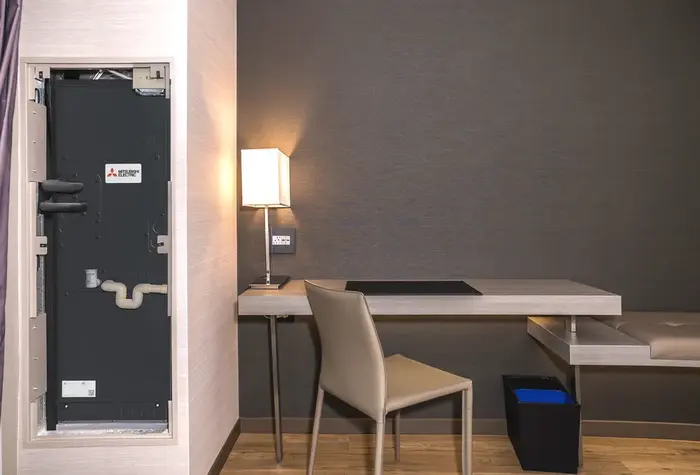
Mitsubishi SVZ-KP slim-duct heat pumps — for custom homes with limited ductwork space (constrained ceiling or attic clearance). Slim-profile air handler with full inverter performance.
Mitsubishi MXZ multi-zone ductless — for homes where ductless is the right architectural answer (open-plan layouts, addition-style configurations, ADUs). Up to 8 zones from a single outdoor unit with independent setpoint per zone.
Mitsubishi CITY MULTI VRF — for very large custom homes (5,000+ sq ft), guest houses with main house, or estate-scale projects where VRF flexibility makes sense.
Daikin Aurora and VRV — Daikin's residential and light-commercial range. Aurora multi-zone for whole-home single-family applications; VRV for estate-scale projects.
Bosch Climate 5000 — when sound floor matters in primary suites or executive offices. 20 dB(A) indoor sound is the lowest in residential mini split.
ERV / HRV systems — Panasonic, Broan, Aprilaire, and Mitsubishi ERV products integrated into the HVAC scope.
What a Custom Home HVAC Engagement Looks Like
1. Pre-design consultation. We meet with the homeowner, architect, and builder during schematic design or design development. Floor plans get reviewed, envelope strategy gets noted, target equipment tier and operating cost expectations get discussed.
2. Manual J / Manual D / Manual S package. We produce the load calculation, distribution design, equipment selection, and ventilation specification as a coordinated deliverable for the project record.
3. Equipment quote and scope. Equipment selection follows the load calc. Quote includes equipment, install labor, ERV/HRV scope, and any required electrical scope.
4. Rough-in install. Refrigerant lines, condensate routing, electrical and ventilation rough-in happen during framing/MEP rough-in phase. We coordinate with the framer and electrician.
5. Trim-out install. Indoor units, controllers, and finish work happen during trim-out, after drywall and paint.
6. Commissioning and verification. Final commissioning verifies performance per the load calc — capacity delivery zone-by-zone, ventilation rate verification, control sequence behavior. Diamond Dealer 12-year warranty applies on qualifying Mitsubishi installations.
Common Custom Home HVAC Mistakes to Avoid
Letting the wholesale-supply HVAC sub specify equipment without Manual J. This is the most consequential mistake in custom home HVAC. The result is oversized single-stage equipment in a tight envelope — the recipe for humidity issues, short-cycling, condensation at registers, and complaints from the first summer of occupancy.
Skipping the ERV or HRV "to save money." A tight new envelope without mechanical ventilation has no fresh-air strategy. Indoor pollutants accumulate. Within 12-18 months of occupancy, the homeowner is either retrofitting an ERV or living with degraded indoor air quality. Cost up front: $3,000-$5,000 installed. Cost as a retrofit: typically 2x because the ductwork has to be modified after-the-fact.
Specifying gas furnace + AC pair instead of all-electric heat pump. In Dallas, heat pump efficiency through the heating season is now meaningfully better than gas furnace economics. Heating loads have collapsed (warmer climate, tighter envelopes), and natural gas pricing has been volatile since 2021. All-electric heat pump simplifies maintenance, eliminates gas-line and combustion concerns, and is the more controllable option. More on heat pump vs gas furnace in Dallas →
Putting ductwork in unconditioned attic without proper sealing and insulation. 25-35% of conditioned air can be lost to attic spaces in poorly-sealed ductwork. Manual D design and proper sealing during install are the difference between rated capacity and delivered capacity.
No zone strategy in two-story homes. Single-thermostat HVAC in a two-story Dallas custom home produces consistent complaints — upstairs runs warmer than downstairs in summer, the opposite in winter. Multi-zone capability or two-system designs address this from the design phase.
R-32 Refrigerant in Custom Home Equipment
Under EPA AIM Act regulations effective January 1, 2025, new residential HVAC equipment can no longer be manufactured with R-410A. Mitsubishi, Daikin, LG, Hitachi, Gree, and Samsung WindFree have transitioned residential lineups to R-32 (GWP 675, single-component A2L refrigerant). Bosch uses R-454B (GWP 466). For custom home installations completing now, the equipment is R-32 or R-454B compliant from the start.
R-32 is classified A2L — mildly flammable — requiring A2L-certified installation. Truficient technicians are A2L-certified for both R-32 and R-454B systems.
Adjacent Pages
- HVAC for Builders & Developers Dallas TX — builder-side B2B services
- New Build HVAC Inspection — Tight Envelope IAQ — when the original installer didn't get it right
- Samsung Mini Split for New Construction Dallas TX — Samsung WindFree specifically for tight new-build envelopes
- Heat Pump vs Gas Furnace Dallas — heating system selection
- Mini-Split Installation Oak Cliff Dallas — for custom builds in Oak Cliff
Book a Custom Home HVAC Design Consultation
If you're building a custom home in Dallas, the HVAC scope is worth getting right at design. We'll review the floor plans, run the Manual J load calc, design the ductwork distribution, spec the equipment that actually fits the project, and quote it cleanly.
Call 214-238-4349 or book a design consultation.
Truficient is a Mitsubishi Diamond Dealer with engineering-driven HVAC design capability for Dallas custom new construction.
Tools to Help You Decide
See Our Dallas (Custom New Construction) Installations
Browse photos from real mini-split and heat pump installations in Dallas (Custom New Construction) homes.
Get an Instant Estimate
Answer a few questions about your home and get a ballpark cost for your project.
Scan Your Home's Efficiency
Find out where your home is losing conditioned air and what upgrades make the most sense.