Get a free mini-split quote for your Oak Cliff home → Request a Quote or call 214-238-4349
The Ductwork Problem That Only Oak Cliff Homeowners Fully Understand
Winnetka Heights is one of the most intact early-twentieth-century neighborhoods in all of Dallas. The homes along Edgefield, Willomet, and Montclair were built between 1910 and 1935 — original plaster walls, hardwood floors, Craftsman millwork, and not a single inch of ductwork anywhere in the structure. The same is true for large sections of Kiest Park, the older stretches along Beckley Avenue, and the bungalow blocks tucked between Jefferson Boulevard and the Trinity River greenbelt.
These homes were built before central air conditioning existed. When homeowners eventually tried to add it, the results were often compromised: flex duct crammed into undersized attic spaces, duct runs that lost a third of their conditioned air before it reached a room, or entire additions and sunrooms left unconnected to the main system. Some homes in Oak Cliff simply have no ductwork at all and have been getting by with window units for decades.
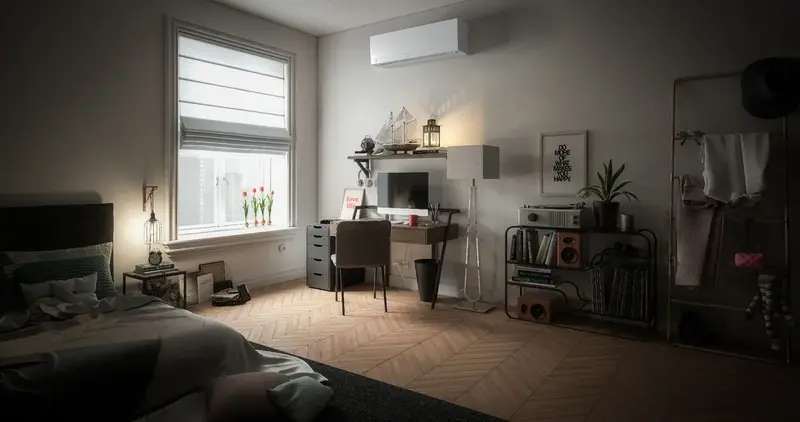
A ductless mini-split solves this problem without touching a single wall. There's no duct installation, no demolition of finished plaster or original woodwork, and no disruption to the architectural character that makes these homes worth living in. A slim indoor air handler mounts on the wall or ceiling. A compact refrigerant line set — about the diameter of a garden hose — runs through a small hole in the exterior wall to the outdoor compressor. The whole single-zone installation is typically done in a day.
Oak Cliff's New Housing Wave: Why Townhomes Need Mini-Splits Too
It's not just the century-old homes. Oak Cliff has seen a significant wave of new townhome construction over the last decade, concentrated along Jefferson Boulevard, in North Oak Cliff near the Bishop Arts District, and on infill lots throughout the 75208 and 75211 ZIP codes. These townhomes present a different set of HVAC challenges than the historic bungalows — but mini-splits often end up being the right answer here too.
Townhomes are typically tall and narrow with limited mechanical room, shared walls that make noise a real concern, and multiple floors that a single central system struggles to condition evenly. A mini-split system handles zoning naturally: the lower floor, the primary bedroom level, and the rooftop deck or bonus room can each run independently on their own schedule. You're not overcooling the ground floor to get the top floor comfortable.
The other factor is noise. Mitsubishi's indoor air handlers operate at sound levels comparable to a quiet conversation — in some cases, quieter. For a townhome with shared walls and high-end finishes, that matters in a way it doesn't for a freestanding ranch house.
What a Mini-Split Installation Involves in an Oak Cliff Home
Every Oak Cliff property presents its own access and layout considerations, so the process starts with an assessment rather than a quote from photos. That said, here's how installations typically unfold:
Assessment and equipment selection. We walk the home, assess the zones you need conditioned, identify the best placement for indoor units, and plan the line set path from indoor to outdoor equipment. For historic homes in Winnetka Heights or the Kiest Park area, we pay particular attention to exterior wall materials (stucco and brick require different core approaches than wood siding) and the visual impact of line hide covers on the home's exterior.
Single-zone vs. multi-zone. A single-zone system pairs one outdoor unit with one indoor air handler — typically the right choice for addressing one problem room or conditioning a space that's completely disconnected from the main system. A multi-zone system connects multiple indoor air handlers to one outdoor unit and can serve an entire home without any ductwork. Each zone is controlled independently, so you're only conditioning occupied spaces.
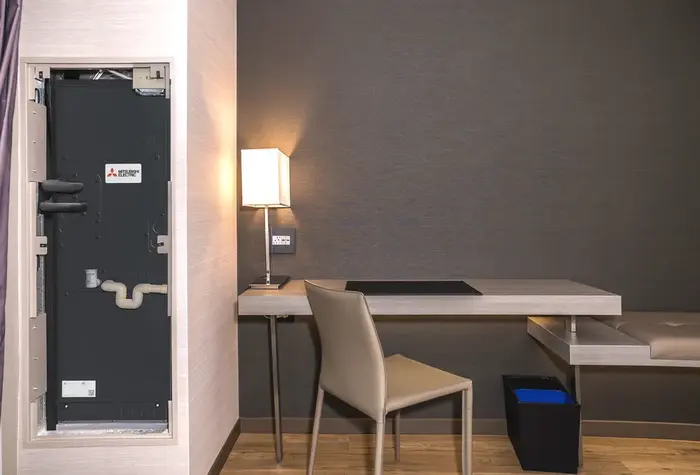
Mitsubishi M-Series and P-Series. As a Mitsubishi Diamond Dealer, Truficient installs M-Series equipment for residential applications and P-Series for spaces that need ceiling cassettes or recessed units. The inverter-driven compressors in Mitsubishi's lineup modulate output continuously rather than cycling on and off — the result is steadier temperatures, significantly quieter operation, and meaningfully lower energy consumption compared to conventional equipment.
Line set and electrical. The refrigerant tubing, wiring, and condensate drain run between units through a roughly 3-inch penetration in the exterior wall. This can be run exposed with a matching line hide cover or concealed in the wall cavity. A dedicated 240V circuit is required for each outdoor unit.
Installation day. A single-zone installation in a typical Oak Cliff home takes four to eight hours. Multi-zone systems with three or more indoor units will take longer and may require a second day depending on the layout.
Common Applications in Oak Cliff Properties
Mini-splits come up in a consistent set of scenarios across Oak Cliff's varied housing stock:
Pre-duct historic homes. The bungalows and Craftsman houses built before 1940 in Winnetka Heights, the Elmwood neighborhood, and along the Beckley corridor are the most common candidates for whole-home ductless systems. Adding traditional ductwork to these homes would require major interior demolition or compromised duct runs through attic spaces that weren't designed for them.
Problem rooms in homes that otherwise have central air. A back bedroom that bakes in summer because the duct run is too long, a converted garage that's never been connected to the main system, a sunroom addition along the Bishop Arts District corridor — these are single-zone mini-split installations that solve a specific problem without touching the rest of the home.
New Oak Cliff townhomes. As described above, multi-story townhomes benefit from the independent zone control and low noise profile of mini-split systems. Builders and buyers of new construction along Jefferson Boulevard and in North Oak Cliff are increasingly choosing ductless over traditional central systems for these reasons.
ADUs and carriage houses. Many Oak Cliff properties have secondary structures — original carriage houses behind 1920s bungalows, converted garages, backyard studios — that need their own conditioning. A single-zone mini-split is the standard solution for these spaces.
Why North Texas's Climate Makes Mini-Split Heat Pumps Especially Practical
One question homeowners ask is whether a mini-split can handle both heating and cooling in Dallas — and the answer in North Texas's climate is a clear yes. Dallas runs roughly six months of significant cooling demand. The heating season is short, and most of Oak Cliff's winter heating hours occur at outdoor temperatures in the 30s, 40s, and 50s — well within the efficient operating range of a Mitsubishi inverter heat pump system. Hard freezes are infrequent, and modern Hyper-Heat equipment is rated for temperatures far below anything Dallas typically sees.
The practical result: a heat pump mini-split handles the full year in a single all-electric system. For the long, humid Dallas cooling season specifically, the inverter compressor's ability to run at lower capacity for longer periods pulls both heat and moisture out of the air more effectively than a conventional system cycling on and off at full power.
What You Actually Save with a Mitsubishi Mini-Split in Dallas
The savings from a Mitsubishi inverter mini-split come from the equipment itself, not from an external program. Conventional systems — whether window units or older central equipment — run at fixed output: full power on, then off. Mitsubishi's inverter compressors modulate continuously, running at the lowest output needed to maintain setpoint temperature. Over a Dallas cooling season that runs six months, the difference in electricity consumption between an inverter mini-split and a conventional window unit or aging central system is significant.
Mini-splits also eliminate the duct losses that are a major hidden cost in many Oak Cliff homes. When a central duct system loses a meaningful portion of conditioned air in an unconditioned attic — which is common in older homes — the system has to work proportionally harder to meet demand. A ductless system delivers conditioned air directly into the space with no duct losses at all.
Serving Oak Cliff's Full Range of Neighborhoods
Truficient installs mini-splits throughout Oak Cliff's distinct sub-neighborhoods: Winnetka Heights, Elmwood, Kiest Park, the Bishop Arts District corridor, North Oak Cliff, West Oak Cliff, and Cockrell Hill. We serve ZIP codes 75208 and 75211 as our primary Oak Cliff territory.
For homeowners exploring all their HVAC options — not just ductless — see our Oak Cliff residential HVAC overview. If your existing system is aging and a full replacement makes more sense than adding zones, heat pump replacement in Oak Cliff covers that process in detail. We also serve the surrounding South Dallas and Oak Lawn neighborhoods.
Get a Quote for Your Oak Cliff Home
Whether you're in a 1920s Craftsman in Winnetka Heights, a 1970s ranch house near Kiest Park, or a new townhome near the Bishop Arts District, the right mini-split setup depends on your specific home, your layout, and what you're trying to fix.
Call 214-238-4349 to talk through your situation, or request a quote online and we'll schedule a site assessment.
Truficient is a Mitsubishi Diamond Dealer serving Oak Cliff and the Dallas core market.
Tools to Help You Decide
See Our Oak Cliff Installations
Browse photos from real mini-split and heat pump installations in Oak Cliff homes.
Get an Instant Estimate
Answer a few questions about your home and get a ballpark cost for your project.
Scan Your Home's Efficiency
Find out where your home is losing conditioned air and what upgrades make the most sense.