Two-Story Home HVAC Stratification — Why Upstairs Is Always Hot in Dallas
The single most common comfort complaint in Dallas two-story homes: "the upstairs is always 5 degrees warmer than the downstairs." The cause is stratification combined with single-system zoning. Variable-speed and multi-zone solutions address it. Call 214-238-4349 for a project consultation.
The Problem Stated
A typical Dallas two-story home built between 1985 and 2010 is configured with a single central HVAC system, a thermostat downstairs, and a duct system that delivers conditioned air to both floors through one zoning damper or no zoning at all. On any summer afternoon, the upstairs runs 4-8°F warmer than the downstairs. The homeowner adjusts the thermostat downward, the system overcools the downstairs to bring the upstairs into range, the downstairs becomes uncomfortably cold while the upstairs reaches an acceptable temperature, and nobody is comfortable.
The mechanical explanation has three parts:
- Solar load. The upstairs has the roof directly above it. Attic temperatures in Dallas summer reach 130-150°F. Heat transfer through ceiling insulation into upstairs spaces is the dominant heat gain component in a Dallas summer afternoon — far larger than wall conduction or window radiation. The upstairs has higher load per square foot than the downstairs simply because the upstairs is under the attic.
-
Stratification. Warm air from the downstairs migrates upward via stairwells, foyers, and any open vertical connection. The upstairs receives both its own solar load and the downstairs's stratified warm air.
-
Single-system zoning. A central HVAC system with one thermostat reads temperature at one location. When that location is downstairs, the system stops cooling once the downstairs reaches setpoint — leaving the upstairs unconditioned for the remainder of the load period.
The combination is what produces the "upstairs is always hot" complaint. None of the three causes alone is decisive; together they are.
Why Standard Fixes Don't Work
Homeowners typically try several fixes before the actual solution. Most of them produce marginal improvement:
Adjusting register dampers
Closing downstairs registers and opening upstairs registers shifts airflow but creates static pressure imbalance in the duct system. The blower works against the closed dampers, pulling more current and producing more noise. Net comfort improvement: small.
Adding a second thermostat with manual zoning
Installing a second thermostat upstairs without modifying the duct system gives the homeowner a second temperature reading but no additional control authority. The single damper system can route more air upstairs at the expense of downstairs comfort, but it can't add capacity.
Upgrading attic insulation
Improving attic R-value from R-19 to R-38 or R-50 reduces solar gain through the ceiling meaningfully. This is a genuinely effective intervention, but it doesn't address the fundamental issue: a single HVAC system can't independently condition two thermal zones with different load profiles.
Adding an attic radiant barrier
Reflects roof heat back outward, reducing attic temperature by 15-25°F. Real benefit. Doesn't solve the zoning problem.
The real fix is either (a) variable-speed equipment paired with engineered zoning, or (b) separate independent systems for upstairs and downstairs. Both are real solutions.
Solution 1: Variable-Speed + Engineered Zoning
For Dallas two-story homes with single-system HVAC and existing duct infrastructure, the right path is typically:
Step 1: Replace the single-stage outdoor compressor with a variable-speed inverter (Trane TruComfort 5TTV0X, Bosch BOVA-M20S, or equivalent).
Step 2: Replace the PSC blower air handler with a variable-speed ECM (Trane Hyperion TAM7/TEM6 or Bosch IDS air handler).
Step 3: Install or upgrade the zoning damper system — typically two zones (upstairs and downstairs) with bypass control to manage duct static pressure.
Step 4: Add a second thermostat upstairs to control the upstairs zone independently.
Step 5: Verify zoning damper sizing and bypass damper operation under both single-zone and dual-zone cooling demands.
The variable-speed equipment matters because zoning damper systems work best when the compressor can throttle capacity to match the active zone load. A single-stage compressor running at 100% capacity into a single open zone overpressurizes the duct system — the bypass damper handles the excess but creates static pressure and noise. A variable-speed compressor running at 30% capacity into a single zone matches the actual load.
For Trane-specific detail, see Trane Variable-Speed for Vaulted Ceilings Dallas. For broader variable-speed engineering, see Variable-Speed HVAC for Vaulted Ceilings.
Solution 2: Separate Independent Systems
For Dallas two-story homes where single-system zoning is impractical — typically homes with limited mechanical room space for upgraded equipment, homes with structural constraints on zoning damper installation, or homes where the homeowner specifically prefers independent system control — the right path is separate systems for upstairs and downstairs.
The typical configuration:
- Downstairs: the existing or replacement central system (typically 3-4 ton) handling the downstairs floor
- Upstairs: a separate independent system (typically 1.5-2.5 ton) handling the upstairs floor
For upstairs systems, two paths:
Ducted upstairs system (Trane, Bosch, Goodman variable-speed)
If the upstairs has existing ductwork or can accept new ductwork in attic space, a dedicated 2-ton variable-speed ducted system handles the upstairs independently. The upstairs system can run at 100% capacity during peak load (the typical 2-4 PM "upstairs is hottest" window) while the downstairs system idles. The systems operate independently with separate thermostats.
Ductless upstairs system (Mitsubishi, Bosch, Daikin mini-split)
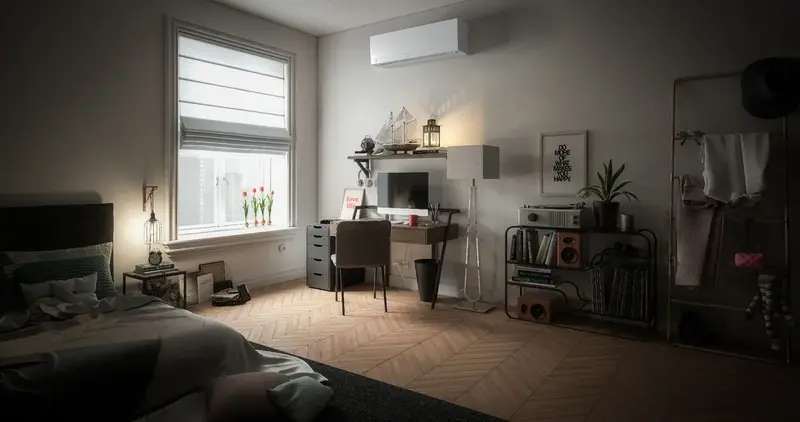
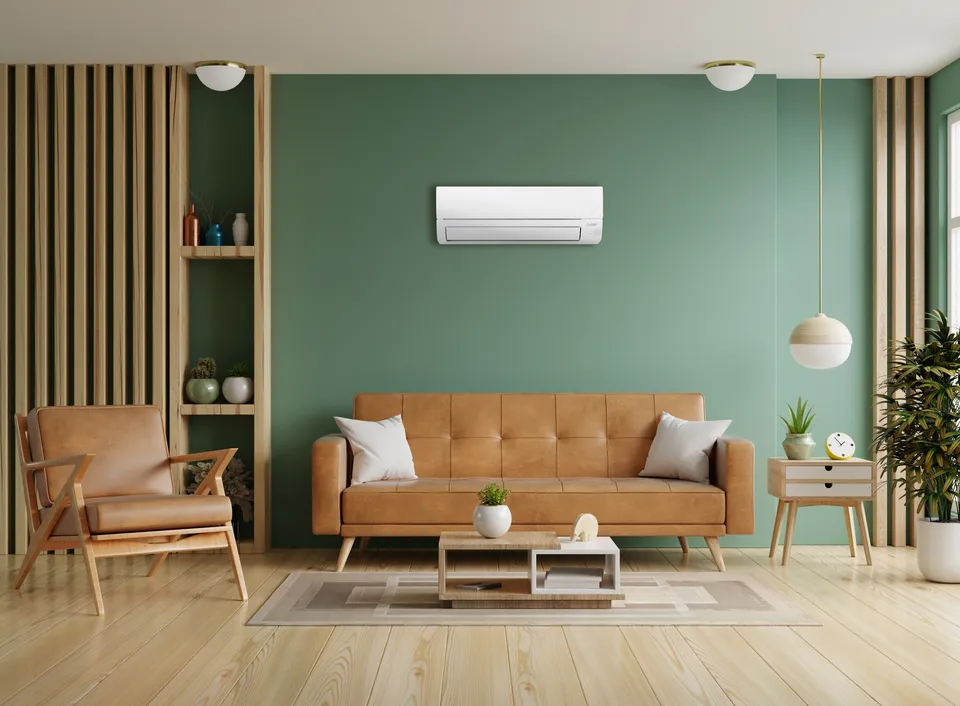
If the upstairs has no ductwork or the duct system is poor, a Mitsubishi MXZ-3C30NAHZ multi-zone or MXZ-4C36NAHZ four-zone outdoor unit handles 3-4 upstairs bedrooms with independent zone control. Each bedroom gets its own MSZ-FS or MSZ-FH wall-mount indoor unit. The downstairs retains its existing ducted system.
For Mitsubishi multi-zone detail, see Mitsubishi MXZ Multi-Zone Dallas.
Two-Story Foyer Specifically
Many Dallas two-story homes have a two-story foyer at the front entry — 18-22 foot ceiling, open balcony to the upstairs hallway. This geometry is the worst case for stratification because warm air collects at the foyer peak and flows directly through the balcony into the upstairs bedroom wing.
Targeted interventions for two-story foyers:
- High return-air register at foyer peak — pulls stratified warm air back to the air handler
- Ceiling fan in the foyer — slow continuous operation to prevent stratification at the source
- Upstairs return modification — adding return-air capacity at the top of the foyer or upstairs hallway captures warm air before it migrates to bedrooms
- Soffit at the balcony — partial soffit construction at the balcony interior reduces the open vertical area, slowing convection
These interventions don't replace the equipment-side solution, but they meaningfully improve comfort when combined with variable-speed equipment.
Right-Sizing With Manual J
Two-story Dallas homes are commonly oversized on HVAC capacity. The original installer used rule-of-thumb sizing (600 square feet per ton); the actual envelope after insulation upgrades, new windows, and storm-door installation calls for a much smaller system. Oversizing causes the same cycling pattern that produces stratification.
Manual J load calculation on the actual current envelope produces right-sized equipment. For Dallas applications, the calculation must include:
- Attic insulation R-value (current actual, not original)
- Wall insulation R-value (current actual)
- Window U-factor and SHGC (current actual — replaced windows have very different ratings than 1985 originals)
- Air sealing performance (blower door test data if available)
- Solar orientation and shading
- Internal loads (occupancy, lighting, equipment)
- Ceiling geometry (vaulted volume contribution to load)
For Dallas-specific sizing context, see HVAC Sizing Dallas.
Operating Cost Math for a Two-Story Dallas Home
For a 3,200 square foot two-story Dallas home replacing aging single-system equipment:
| Equipment Path | Install Cost | Annual Cooling Cost (est.) | 15-Year Cost | |---|---|---|---| | Single-stage 4-ton replacement (no zoning) | $11,500 | $2,000 | $30,000 | | Single-stage 4-ton + 2-zone damper system | $14,500 | $1,900 | $28,500 | | Variable-speed 4-ton (TruComfort) + 2-zone | $19,500 | $1,400 | $21,000 | | Separate systems: 3-ton downstairs + 2-ton upstairs | $22,000 | $1,500 | $22,500 | | Variable-speed downstairs + Mitsubishi upstairs | $26,500 | $1,300 | $19,500 |
Operating cost figures are estimates based on Texas residential electric rates and typical Dallas cooling-degree-days for a two-story home with typical attic insulation. The variable-speed + zoning path is usually the right answer for homes with existing high-quality ductwork; the separate-systems path is the right answer for homes where the ductwork can't support effective zoning.
Heat pump configurations qualify for federal 25C tax credit. See Federal Tax Credit Heat Pump 25C Dallas.
When to Add a Whole-House Ventilation Strategy
Some Dallas two-story homes benefit from whole-house ventilation strategies that supplement HVAC zoning:
- ERV at 200-400 CFM providing balanced fresh-air ventilation, particularly in tightly-sealed renovated homes
- Whole-house fan for shoulder-season operation (when outdoor temperature is below indoor temperature, typically October-November and March-April overnights)
- Attic exhaust fan for reducing attic temperature peaks (controversial — improperly designed attic fans can pull conditioned air from the home into the attic; correct design is required)
For ERV-specific context, see our energy-efficient neighborhood pages — Energy-Efficient HVAC Preston Hollow Dallas and Energy-Efficient HVAC University Park Dallas.
Get a Two-Story Home HVAC Consultation
Call 214-238-4349 or request a quote online.
Truficient designs HVAC solutions for Dallas two-story homes across all major neighborhoods. Engineering-driven approach starting with Manual J load calculation, identifying the right zoning or separate-systems strategy, and specifying variable-speed equipment from Trane, Bosch, or Mitsubishi catalogs.
Tools to Help You Decide
See Our Dallas Installations
Browse photos from real mini-split and heat pump installations in Dallas homes.
Get an Instant Estimate
Answer a few questions about your home and get a ballpark cost for your project.
Scan Your Home's Efficiency
Find out where your home is losing conditioned air and what upgrades make the most sense.