Commercial HVAC Installation — Dallas TX
RTU replacement, commercial mini-splits, and small-building VRF for Dallas businesses. → Request a Quote or call 214-238-4349
Commercial HVAC Installation Is a Different Job Than Residential
Commercial HVAC installation in Dallas covers a wider equipment range, more complex load conditions, and a different set of constraints than residential work. A small retail storefront in Oak Cliff, a boutique office in Deep Ellum, a restaurant in the Design District, and a light industrial building in South Dallas each have distinct installation scopes — and the right equipment for one is rarely the right equipment for another.
Truficient handles commercial HVAC installation for small and mid-size Dallas buildings: single-tenant retail, multi-tenant boutique offices, restaurants, and light commercial spaces typically in the 500 to 25,000 square foot range. That's the segment where equipment decisions actually matter, where a properly sized and specified system saves meaningful money over a fifteen-year service life, and where the wrong equipment creates a decade of maintenance calls. This page covers what a real commercial installation involves — what equipment fits which scenarios, what the process looks like, and what Dallas-specific conditions change the spec.
Packaged Rooftop Units (RTUs): The Commercial Default
The rooftop packaged unit is the dominant commercial HVAC system in Dallas for good reason. It integrates compressor, condenser, evaporator, and air handler into a single cabinet that sits on the roof and connects through a curb to the building's duct system. One unit, one service point, one roof penetration. For single-tenant buildings with flat roofs — which describes most of Dallas's commercial stock built between 1960 and the present — an RTU is usually the lowest-capital and lowest-operating-complexity path to conditioned space.
RTU sizing and specification. A commercial load calculation is not a scaled-up residential Manual J. Commercial load calcs account for occupancy loads (people generate heat), equipment loads (kitchen equipment, refrigeration, office electronics, lighting), ventilation requirements under ASHRAE 62.1 for the space's use category, solar gain on roof and walls, and schedule-based operation. The output is a design cooling tonnage and design heating capacity that drives equipment selection. Undersized RTUs cycle long and can't hold setpoint on peak days. Oversized RTUs short-cycle, dehumidify poorly, and waste capital.
Installation scope. A full RTU installation includes roof curb fabrication or reuse, crane lift and setting, refrigerant connections (on split configurations) or factory-charged drop-in (on packaged configurations), gas piping for heating (if natural gas), electrical disconnects and controls, ductwork transitions to the existing system, condensate routing, and commissioning with heat and cool performance verification. Cutting corners on any step creates reliability problems that show up in the first or second summer.
R-410A to R-454B transition. New commercial RTUs shipped in 2025 and forward use next-generation refrigerants — primarily R-454B for major manufacturers — replacing R-410A to meet EPA AIM Act requirements. For Dallas building owners planning a replacement, specifying new-refrigerant equipment now avoids R-410A supply complications on a system that will be in service into the 2040s.
Commercial Mini-Splits and Multi-Zone Ductless
Not every Dallas commercial building suits an RTU. Reasons a ductless commercial mini-split is the right call instead of a rooftop packaged unit:
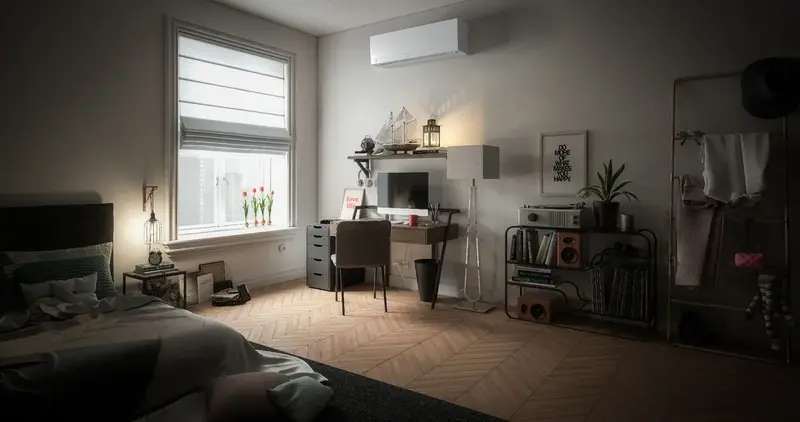
No roof access or no structural roof capacity. Many older Dallas commercial buildings — the masonry retail in The Cedars, the converted warehouse spaces in the Design District, small storefronts along Jefferson Boulevard — have roofs that weren't built to carry a rooftop unit, or landlords who won't permit roof penetration. A wall-mounted or ground-mounted outdoor unit with indoor ceiling cassettes or wall heads avoids the roof entirely.
Zoning a multi-use space. A single commercial building serving a retail front, an office back, and a storage area has three different load profiles. A single RTU conditions all three as one zone. A multi-zone ductless system gives each zone its own indoor head, its own setpoint, and its own runtime — which matches how the space is actually used.
Extending conditioning to an unconditioned area. A commercial building adds a back office, a breakroom, or a conference room that wasn't conditioned before. Rather than tear into the existing ductwork and re-engineer airflow, a single-zone mini-split conditions the new space cleanly.
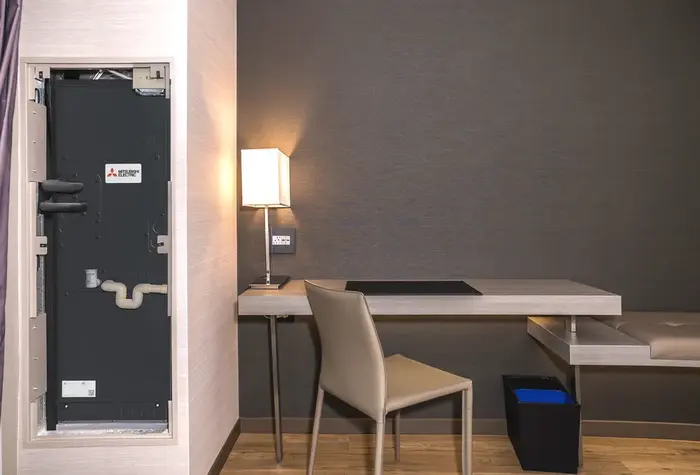
Equipment. Mitsubishi P-Series, Daikin's commercial ceiling cassette lineup, and Gree commercial equipment all serve this segment. Mitsubishi and Daikin are the premium specifications for Dallas commercial applications where warranty depth and long-term reliability matter. Gree is the value specification where budget is the controlling variable and the scope is modest — a single commercial zone, a simple deployment.
See VRF and multi-zone commercial options →
VRF for Small and Mid-Size Commercial Buildings
For Dallas commercial buildings above roughly 10,000 square feet — mixed-use buildings, multi-tenant boutique offices, small hotels, restaurants with distinct front-of-house and back-of-house thermal profiles — Variable Refrigerant Flow is frequently the right specification. VRF runs a single refrigerant loop to many indoor units across the building, modulates capacity to match actual demand, and (in heat recovery configurations) can heat one zone while cooling another from the same outdoor unit.
Truficient handles VRF installation in the small-and-mid commercial segment — buildings where the engineering scope is tractable, the payback is real, and the owner isn't paying for a 100,000-square-foot custom design. Read more on VRF systems in Dallas → or the Daikin VRV page for brand-specific information.
What Dallas Conditions Change About Commercial Installation
Extended cooling season. Dallas runs cooling load from April through October in a typical year, with peak conditions in July and August exceeding 100°F ambient for extended runs. Commercial equipment needs to be specified for sustained high-load operation, not just peak hour performance. Derating factors for ambient temperature, equipment run time, and long refrigerant line sets apply to most Dallas commercial installations.
Flat dark roofs and rooftop equipment temperature. Rooftop units on flat commercial roofs run in surface temperatures that regularly exceed 150°F during summer afternoons. This accelerates equipment aging, degrades refrigerant performance, and — for older units — eventually becomes the failure point. New installations benefit from properly specified equipment rated for the conditions; reflective roof coatings and equipment shading reduce the load on the unit and extend service life.
Freeze events. Dallas's hard freezes — 2021, 2023, 2024 — matter for commercial installations because standard heat pumps lose capacity below 15°F and older gas-heat RTUs have ignition-system failures during cold snaps. For buildings that can't tolerate heat failure during a freeze event, specifying cold-climate heat pump equipment (rated for full capacity at 5°F or below) or confirming gas-heat reliability through proper commissioning is part of a well-done installation.
Refrigerant transition timeline. 2025 and forward, all new commercial HVAC equipment ships with R-454B or comparable next-generation refrigerants. Specifying new-refrigerant equipment today means no R-410A supply exposure through the equipment's full service life.
The Installation Process
A commercial HVAC installation project with Truficient follows a predictable sequence:
- Site visit and scope assessment. Walk the building, document existing conditions, identify constraints (roof access, electrical capacity, gas availability, existing ductwork condition, equipment removal access).
- Load calculation and equipment specification. Commercial load calc based on actual space use, equipment recommendation with sizing and model justification.
- Proposal and scheduling. Fixed-scope proposal with equipment, labor, permitting, and commissioning included. Schedule set around business operations.
- Permitting. City of Dallas commercial HVAC permit for equipment replacement or new installation. Inspection coordinated at rough-in and final.
- Installation. Equipment removal, roof curb work or penetration, crane set, refrigerant and electrical connections, controls integration, ductwork transitions.
- Commissioning and verification. Startup, refrigerant charge verification, airflow measurement at grilles, heat and cool performance confirmation under load.
- Handoff. Equipment documentation, warranty registration, recommended maintenance schedule.
Get a Commercial Installation Quote
For commercial spaces that need an accurate installation quote — load calculation, equipment specification, and fixed-scope pricing — a site visit is the starting point.
Call 214-238-4349 to schedule a commercial assessment, or request one online.
Truficient installs commercial HVAC for small and mid-size buildings throughout Dallas — Downtown, Oak Cliff, Design District, Deep Ellum, Uptown, South Dallas, East Dallas, and the nearby commercial corridors. Ongoing service and preventive maintenance are available separately — see commercial HVAC maintenance in Dallas.
<section class="bach-internal-links"> <h3>Related Resources</h3> <ul><li><a href="/commercial-hvac-maintenance-dallas/">Commercial HVAC maintenance</a></li><li><a href="/vrf-systems-dallas/">VRF systems for Dallas commercial</a></li></ul> </section>Tools to Help You Decide
See Our Dallas-wide Installations
Browse photos from real mini-split and heat pump installations in Dallas-wide homes.
Get an Instant Estimate
Answer a few questions about your home and get a ballpark cost for your project.
Scan Your Home's Efficiency
Find out where your home is losing conditioned air and what upgrades make the most sense.