Commercial HVAC in the Dallas Design District
Showroom, studio, or industrial conversion? Let's talk system design. → Request a Commercial Quote or call 214-238-4349
The Design District Is Not a Standard Commercial HVAC Problem
The Dallas Design District — the creative and commercial corridor bounded by Turtle Creek Boulevard, the Stemmons Freeway, Market Center Boulevard, and the Trinity levee — is built on converted industrial structures. Former manufacturing buildings, masonry warehouses from the 1940s and 1950s, loading dock facilities repurposed as showroom floors, and brick structures with structural steel exposed above 20-foot ceiling heights. These buildings are architecturally specific, and their current tenants — furniture showrooms, interior design studios, photography and film production facilities, architecture and design firms, restaurants and bars — chose them partly because of what they look like.
HVAC in these spaces is a design problem, not just a mechanical one. Drop a conventional packaged rooftop unit into a Design District warehouse conversion and route standard galvanized duct through the exposed ceiling structure, and you've obscured the most interesting part of the building. A grid of galvanized sheet metal duct hanging below structural steel trusses doesn't look like it belongs in a showroom where a client is making a $40,000 furniture decision. It looks like a warehouse, which is what it used to be — not what it is.
Truficient approaches Design District commercial HVAC installations from the same premise that governs the rest of the tenant improvement work in these spaces: the mechanical system should fit the aesthetic, not fight it. That means specifying ducted mini-split systems with spiral duct, exposed insulated copper refrigerant lines, and equipment positioned as part of the visual language of the space rather than hidden behind dropped ceilings that would destroy the character of the building.
Ducted Mini-Splits: The System That Makes Sense Here
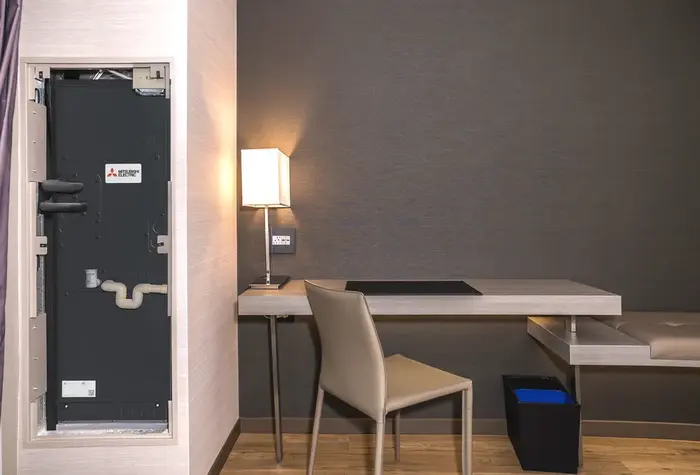
A ducted mini-split — Mitsubishi's SEZ series and comparable units — is an air handler designed to connect to a duct distribution system while operating on the same inverter compressor technology as a standard ductless mini-split. It lives in the ceiling cavity or above a mechanical chase, connects to an outdoor condensing unit via refrigerant line set, and distributes conditioned air through ductwork to multiple supply registers.
What makes ducted mini-splits appropriate for Design District spaces — and specifically superior to conventional packaged rooftop equipment — is the combination of factors that matter here.
Zoned multi-zone operation. A multi-zone ducted mini-split system connects multiple air handlers to a single outdoor condensing unit, each handler serving its own zone and operating independently. A Design District showroom with a main floor, a private client consultation area in the back, and a mezzanine office level doesn't need one system averaging the load across all three — it needs each zone conditioned on its own schedule and to its own setpoint. The outdoor unit handles all zones simultaneously, modulating total output to match the combined demand.
Right-sized for the load. Packaged rooftop units are typically specified in 3-ton, 5-ton, and larger increments designed for simplified commercial selection. A 2,800-square-foot Design District showroom with 18-foot ceilings doesn't fit neatly into standard commercial RTU sizing, and an oversized RTU that short-cycles is a poor fit for a space where humidity control matters — the client's furniture and textiles, the photography lighting equipment, the owner's investment in the finish-out. Mitsubishi's commercial ducted units are available in a wide range of sizes that can be matched precisely to the actual load of a specific space.
Inverter efficiency across variable occupancy. Design District businesses don't run uniform occupancy loads. A furniture showroom during a market week event is at full capacity. The same space on a Tuesday morning in February has two staff members. A packaged RTU running at full output in both conditions is inefficient and uncomfortable. An inverter system modulates to the actual load — quiet and efficient during low-occupancy periods, responsive during peak events.
Spiral Duct and the Industrial Aesthetic
The duct distribution system connected to a ducted mini-split air handler doesn't have to be hidden — and in a Design District space, hiding it behind a drop ceiling is usually the wrong choice architecturally.
Spiral round duct — the formed metal spiral that's standard in commercial mechanical engineering — reads differently than rectangular sheet metal ductwork in an exposed ceiling application. Its geometry is clean and intentional. In a Design District warehouse conversion with exposed structural steel trusses, polished concrete floors, and factory-window glazing, spiral duct hung below the structural ceiling at a consistent height and radius isn't a compromise — it's a detail that fits the industrial language of the building. The same aesthetic logic applies in production studios, in photography facilities, and in design offices where the exposed structure is the point of the space.
Truficient specifies and installs spiral duct in Design District commercial applications where the ceiling is exposed or where the tenant has chosen an industrial-authentic interior approach. The duct layout is coordinated with the structural grid and the interior design intent from the start, not bolted on after the furniture is placed.
The supply register placement in a spiral duct system — the specific locations where conditioned air enters the occupied zone — is part of the design coordination. High-ceiling industrial spaces benefit from registers positioned to direct conditioned air down into the occupied zone at floor level, rather than across the ceiling plane. Getting this right means the space is comfortable for the people in it, not just mechanically functional from an engineering standpoint.
Exposed Insulated Copper: The Refrigerant Line as a Design Detail
The refrigerant line sets connecting indoor air handlers to the outdoor condensing unit in a Mitsubishi commercial system are copper lines — supply and return, typically running 3/4-inch to 1-1/8-inch diameter depending on the system — insulated with closed-cell foam insulation to prevent condensation and energy loss.
In conventional commercial HVAC, these lines are concealed in walls, run through ceiling cavities, or hidden in mechanical chases. In a Design District space where the ceiling is open and the aesthetic is industrial, concealing them isn't always the right choice — and routing them through a finished chase adds cost and complexity without improving the space.
Exposed insulated copper refrigerant lines, run cleanly along structural members or suspended from the ceiling in a planned routing, become part of the visual detail of the space rather than something to be hidden. The insulation — typically black closed-cell pipe insulation that maintains its appearance in commercial conditions — reads as an intentional industrial element. When combined with spiral duct and the air handler positioned above the occupied zone, the result is a mechanical system that looks like it was designed for the building rather than installed in spite of it.
This approach requires more upfront design coordination than a concealed system — the line routing has to be planned with the interior layout, not improvised around finished elements — but the outcome is a space where the mechanical infrastructure is part of the finished character of the room.
The Multi-Zone Advantage in Design District Commercial Spaces
One of the consistent findings from Truficient's commercial installations in the Design District is that a multi-zone ducted mini-split system — one outdoor unit serving multiple independent indoor air handlers — often comes out ahead of a conventional multi-unit approach on all four of the measures that matter to a commercial tenant or building owner.
Installation cost. Connecting multiple zones to a single outdoor condensing unit eliminates the need for multiple rooftop RTUs, multiple electrical disconnects, and multiple sets of refrigerant line infrastructure running to individual units. In a Design District space with two or three zones, the consolidated outdoor equipment and single refrigerant circuit — even with more complex indoor distribution — frequently results in a lower total installed cost than the equivalent in separate packaged equipment. This isn't always true for every configuration, but in the 1,500- to 4,000-square-foot range common in this neighborhood, multi-zone systems are often competitive with or cheaper than the alternative.
Aesthetics. A single outdoor condensing unit on the rooftop versus three RTUs sitting in a row has an obvious visual difference when viewed from above or from neighboring structures. More importantly, the indoor distribution — a planned spiral duct layout with consistent geometry, refrigerant lines run cleanly along the structural grid — looks designed rather than accumulated. Multi-zone systems invite this kind of coordinated installation because the line routing and duct layout emanate from a single system design rather than being executed in stages by separate units.
Comfort. Multi-zone inverter systems excel in the variable-occupancy, variable-load conditions that Design District commercial spaces actually experience. The outdoor unit modulates total output continuously across all active zones simultaneously, rather than each zone cycling on and off independently. This produces steadier temperatures, more consistent humidity control, and fewer cold spots — particularly in high-ceiling spaces where temperature stratification is a real issue. When a showroom floor is at 40% capacity and the private office in the back is full, the system adjusts to both conditions in real time without overcooling one to serve the other.
Energy efficiency. Inverter technology in a multi-zone configuration captures compressor efficiency gains that single-stage commercial equipment doesn't. The compressor runs at the speed demanded by the actual combined load of the active zones — not at full output cycling to a setpoint. In a Design District space with variable occupancy throughout the day, this modulation produces meaningful reductions in energy consumption compared to fixed-capacity commercial RTU equipment running through the same conditions. Tenants who've switched from aging packaged equipment to multi-zone inverter systems in these spaces consistently report lower utility costs, particularly in shoulder seasons when the load is light and an inverter system can run at minimal output rather than cycling on and off.
Specific Design District Applications
Furniture and interiors showrooms. The primary conditioning challenge in a high-ceiling showroom is maintaining comfortable temperature at floor level — where clients are sitting and standing — without overcooling or creating perceptible airflow across the product displays. Ducted mini-splits with spiral duct routed below the structural ceiling, with registers positioned to direct conditioned air down into the occupied zone, address this directly. The system conditions the people in the space, not the air column above them.
Photography and video production studios. Production studios generate high and variable internal heat loads: banks of studio lighting, camera and grip equipment, and high-occupancy shooting days alternating with low-occupancy editing periods. An inverter system that modulates to actual load performs significantly better in this environment than fixed-capacity equipment cycling on and off around a design condition. Truficient has installed ducted mini-split systems in Design District production facilities specifically for this reason.
Architecture and interior design offices. Design offices in converted warehouse structures frequently have open-plan working areas with a mezzanine or upper-level space used for presentations or library functions. Multi-zone ducted mini-split systems with independent handlers on each level condition each space to its own occupancy pattern — the ground-floor working area and the mezzanine presentation space don't have to compromise on each other's setpoint.
Restaurant and bar spaces. The Design District's growing restaurant corridor — the Dragon Street and Oak Street blocks — includes dining rooms that need to hold comfortable temperatures despite large glass frontages and high service-period occupancy, bar areas with their own thermal load from equipment and concentrated occupancy, and kitchen environments that generate heat that must be managed separately from the front-of-house. Commercial mini-split systems with zone-specific conditioning for each area handle the thermal separation that a single RTU serving the whole footprint can't achieve.
New Build-Outs and Tenant Improvements
Design District spaces change tenants regularly, and each tenant improvement cycle is an opportunity to specify the mechanical system correctly from the start. A ducted mini-split system designed with the interior layout in mind — spiral duct routing coordinated with the lighting plan and furniture layout, refrigerant lines run cleanly along the structural grid, outdoor unit positioned on the rooftop or in the mechanical yard before the landscaping goes in — costs less and looks better than a retrofit after the space is finished.
Truficient works with Design District tenants, general contractors, and building owners at the design stage. For landlords managing multi-tenant Design District buildings, Truficient also assesses and replaces aging rooftop RTU equipment — many of which were installed in early 2000s conversion projects and are now past their practical service life.
Serving the Dallas Design District
Truficient handles commercial HVAC installation, replacement, and repair throughout the Design District — the Slocum Street and Dragon Street showroom corridors, the Turtle Creek Boulevard edge, the Market Center Boulevard commercial blocks, and the mixed-use structures approaching the Uptown and Trinity Groves boundaries. Primary service ZIP: 75207.
For commercial applications in the adjacent South Dallas commercial corridor, see our commercial HVAC South Dallas page. For residential properties in the neighboring Uptown and Oak Lawn areas, see our Uptown multi-zone mini-split page.
Request a Commercial Assessment
Design District HVAC requires a site visit. Ceiling heights, exposed structural conditions, existing mechanical infrastructure, and the tenant's interior design intent all shape system selection and equipment placement in ways that can't be determined remotely.
Call 214-238-4349 to schedule a commercial assessment, or request a quote online and we'll confirm a site visit.
Truficient is a Mitsubishi Diamond Dealer serving commercial clients in the Dallas Design District and the broader Dallas urban core.
Tools to Help You Decide
See Our Design District Installations
Browse photos from real mini-split and heat pump installations in Design District homes.
Get an Instant Estimate
Answer a few questions about your home and get a ballpark cost for your project.
Scan Your Home's Efficiency
Find out where your home is losing conditioned air and what upgrades make the most sense.