HVAC in the Dallas Design District: Cooling Warehouse Conversions in a Confirmed Heat Island
The Dallas Design District occupies a stretch of the inner loop between the Medical District and the Trinity River corridor — a zone of repurposed warehouses, showrooms, galleries, creative offices, and boutique commercial spaces that has become one of the most design-forward commercial districts in Texas. It has also been formally identified in NOAA's urban heat island mapping as a confirmed Dallas heat island zone, with conditions driven by its physical characteristics: large flat rooftops, expansive paved lots, minimal shade canopy, and the thermal mass of warehouse-scale buildings that absorb heat during the day and release it slowly through the evening.
NOAA's 2024 study found temperature differentials of up to 12°F between Dallas's hottest zones and its greener areas. The Design District's combination of impervious surface coverage and limited vegetation places it consistently on the hot end of that range.
The Warehouse Conversion HVAC Problem
Warehouse conversions present a specific set of HVAC challenges that conventional residential and light commercial systems are not designed to solve:
High ceiling heights and thermal stratification. A converted warehouse showroom with 18–24 foot ceilings accumulates heat at the ceiling level that a ducted system with ceiling supply diffusers will simply push around. The occupied zone at floor level may remain uncomfortable even as the ceiling space is overcooled, wasting energy and failing to address the actual comfort problem.
Large open floor plans with variable occupancy. A showroom that hosts a product launch event with 200 people requires dramatically different cooling than the same space during a quiet Tuesday afternoon with two staff members. A fixed-capacity single-stage system sized for peak occupancy will overcool and short-cycle for the majority of operating hours — accumulating wear and humidity problems.
Flat dark rooftops. The Design District's warehouse stock typically features flat dark rooftops with a high solar absorptivity. In a heat island zone where outdoor ambient already runs elevated, a dark flat roof over an occupied showroom is adding additional heat gain that standard load calculations underestimate.
Mini-split and VRF systems address all three problems. Multi-zone configurations allow independent conditioning of the occupied zone at floor level without wasting energy on ceiling space. Inverter compressors modulate output to match variable occupancy loads. Properly sized outdoor units are specified for the Design District's actual microclimate, not regional averages.
Spiral Duct + VRF: The Design District System That Works and Looks Right
The Design District's exposed-structure aesthetic creates a real opportunity to specify an HVAC system that performs at a commercial level while fitting the visual language of the space. Exposed spiral duct connected to ducted VRF indoor units is increasingly the Design District standard — and for good reason.
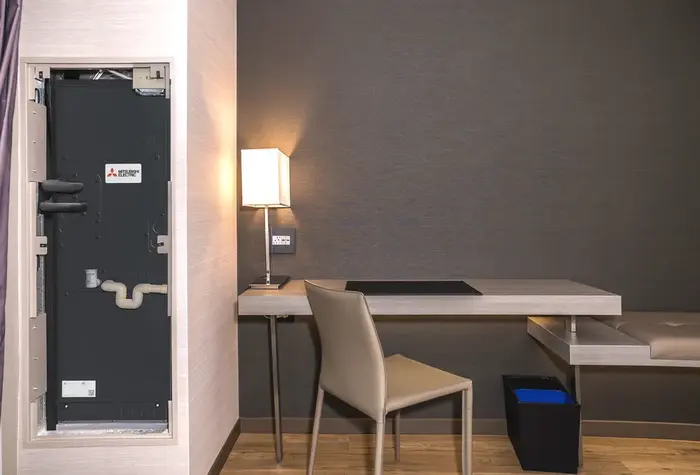
Here's the configuration in practice: a Daikin or Mitsubishi ducted VRF indoor unit (typically ceiling-concealed, low-profile) connects to a run of exposed spiral duct that distributes conditioned air through directional diffusers to each zone of the space. The spiral duct is visible — mounted at high ceiling level or along the underside of exposed structure — carrying the industrial character that Design District spaces are designed to express. The VRF system behind it delivers variable-capacity, multi-zone conditioning with an efficiency profile that a conventional RTU can't match.
Cassette combinations for multi-zone coverage. In Design District spaces with varied ceiling geometries — open showroom floors, private meeting areas, storage or office back-of-house — the ducted spiral duct system can be combined with ceiling cassette indoor units where direct zone coverage makes sense. A 4-way cassette in a dropped ceiling conference room, a 2-way or 1-way cassette in a tight corridor, and exposed spiral serving the main floor can all operate off the same VRF outdoor unit — managed as independent zones, each responding to its own load.
Different cassette styles for different spaces:
- 4-way cassette — full 360° airflow distribution; ideal for open showroom centers
- 2-way cassette — directional; good for end-of-row or corner positions
- 1-way slim cassette — minimal footprint for narrow or constrained ceiling spaces
For multi-suite Design District buildings, Daikin's VRV IV platform allows a single outdoor condensing unit to serve multiple tenants' indoor systems — replacing the rooftop unit array with a single, efficient condensing footprint and giving each tenant independent zone control.
For smaller studios and single-tenant showrooms in the 1,000–3,500 sq ft range, Mitsubishi's commercial multi-zone configurations offer the same inverter efficiency and zone control at a scale appropriate to the space.
The Heat Island Premium on Design District Energy Costs
The Design District's confirmed heat island status means that energy costs for commercial cooling are structurally higher than regional averages suggest. A showroom on Hi Line Drive running a standard rooftop unit on a 107°F July afternoon is operating at degraded coefficient of performance — consuming more electricity per BTU of cooling than the unit's nameplate rating would predict — precisely because outdoor ambient in a heat island zone exceeds the conditions the equipment was rated at.
A high-efficiency inverter system consuming 40–65% less electricity for the same cooling output reduces that structural cost premium. Combined with Oncor's commercial rebates for qualifying high-efficiency installations, the business case for an upgrade in this neighborhood is stronger than it would be in a location with typical ambient conditions.
Oncor Rebates for Design District Commercial Properties
Design District properties are in Oncor's service territory. Oncor offers rebates for qualifying commercial high-efficiency HVAC installations — confirm current rebate tiers with your installer before project close.
See Daikin VRF for Dallas commercial heat island properties →
Read the full Dallas Urban Heat Island Research Report →
See how peak ERCOT pricing affects Design District energy costs →
Tools to Help You Decide
See Our Design District Installations
Browse photos from real mini-split and heat pump installations in Design District homes.
Get an Instant Estimate
Answer a few questions about your home and get a ballpark cost for your project.
Scan Your Home's Efficiency
Find out where your home is losing conditioned air and what upgrades make the most sense.