Ductless HVAC Retrofit for Lakewood Historic Homes
Mini-split retrofit for 1920s-1940s Lakewood historic homes. Preserve plaster, hardwoods, and period details. Solve the humidity problems retrofit ductwork creates. Call 214-238-4349 or request a quote.
Why Lakewood Historic Homes Need a Different Approach
Lakewood is one of Dallas's most architecturally significant residential corridors — bounded by White Rock Lake, the Mockingbird-Greenville-Skillman corridor, and the historic East Dallas conservation districts. The defining housing stock is 1920s through 1940s construction: Tudor, Spanish Eclectic, Mediterranean Revival, Colonial Revival, Craftsman, and Prairie School homes — typically 1,800 to 4,500 square feet, almost entirely on original lots, with original architectural details intact.
These homes were not designed for central HVAC. Original heating came from gas wall furnaces, floor furnaces, fireplaces, or in larger homes, original radiator systems. Cooling came from window units. Central air was retrofitted decades after construction — and the retrofit decisions made 30-60 years ago are now showing their age in two specific ways:
1. The retrofit ductwork is failing. Whatever ductwork was added during 1960s-1990s renovations is degraded. Joints have separated, insulation has compressed, conditioned air loss runs 25-35% in many homes. The system's rated capacity exceeds what reaches the living space significantly.
2. The ductwork is creating humidity problems. Lakewood's older homes have ductwork running through unconditioned attic spaces where summer temperatures exceed 130°F. Return ductwork pulls hot humid attic air directly into the system in many cases. The result is a system fighting humidity it shouldn't be encountering — and an indoor environment that runs 60-65% RH despite the AC running for hours.
3. Replacement-grade ductwork would compromise the architecture. Re-running ductwork through original plaster walls, dropping new soffits, or cutting chases through original finishes is unacceptable to most Lakewood homeowners. The architecture is the reason they bought the home.
The right answer for Lakewood historic homes — particularly homes where existing ductwork is degraded beyond economic repair — is a multi-zone Mitsubishi ductless retrofit that replaces the failing system entirely without disturbing the original architecture.
The Humidity Connection — Why Ductless Beats Ducted in Lakewood
Dallas indoor humidity is a bigger problem in 2026 than it was when many Lakewood retrofitted ductwork systems were originally installed. Outdoor dew points have risen measurably across the DFW metro over the past two decades. We covered the science in Why DFW's Air Is Getting Stickier and the comprehensive DFW Humidity Hub.
For Lakewood historic homes specifically, ductless mini-splits address the humidity problem in three distinct ways:
Inverter modulation runs continuously at part-load. Mitsubishi mini-split compressors modulate output continuously rather than cycling on and off at full capacity. The system runs at 30-100% capacity matching the actual load in real time — which means continuous dehumidification. Single-stage equipment cycles too quickly to dehumidify; inverter equipment doesn't.
No attic ductwork = no attic humidity gain. Ductless systems have no ductwork in unconditioned attic. The refrigerant line set, condensate drain, and control wiring run through small wall penetrations. There's no attic-to-living-space humidity migration through return air or supply ducts. The cooling system is only conditioning indoor air, not fighting outdoor-equivalent attic air.
Indoor unit coils sized for the actual zone. Each ductless indoor unit is sized for its specific room. The coil temperature, the runtime, and the moisture removal all match the actual zone load. Centralized ducted systems oversize for the largest zone and under-perform on smaller zones; multi-zone ductless gets each zone right individually.
For a Lakewood homeowner with chronic indoor humidity complaints — sticky air, mildew in closets, condensation at registers — multi-zone Mitsubishi ductless typically resolves the problem within the first week of operation.
What a Lakewood Historic Home Retrofit Looks Like
Multi-zone whole-home configuration. For most Lakewood homes, a Mitsubishi MXZ multi-zone outdoor unit serves four to six indoor zones. A typical configuration in a 2,800 square foot two-story Lakewood Tudor:
- One zone for the front living and dining rooms
- One zone for the kitchen and breakfast area
- One zone for the upstairs primary bedroom
- One zone for the upstairs secondary bedrooms (single unit serving the bedroom hallway)
- One optional zone for an upstairs bonus room or finished attic
- One optional zone for a finished basement or lower-level family room
Indoor unit selection for historic interiors. The indoor unit catalog includes options that fit different architectural contexts:
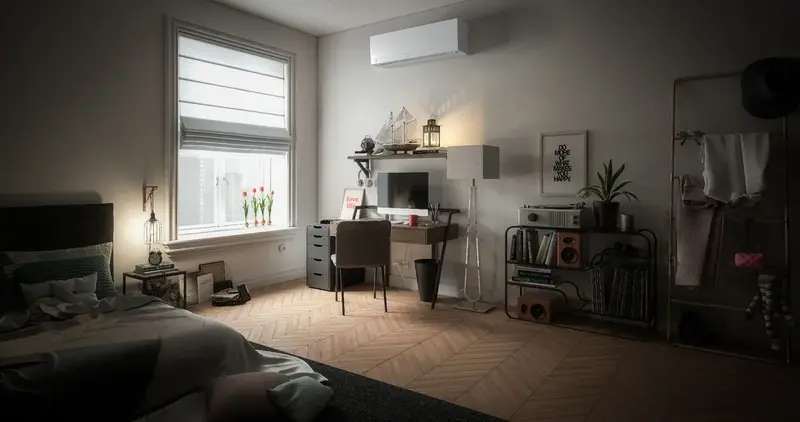
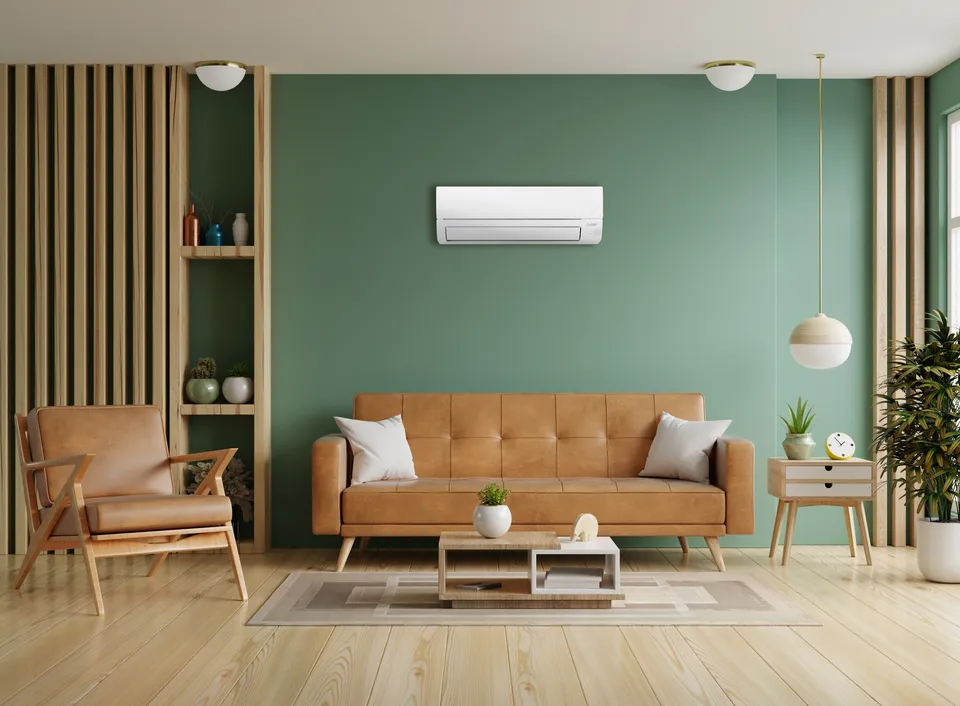
- Mitsubishi MSZ-FS wall-mount — slim profile, white finish, 19 dB(A) whisper mode. Default for most rooms — integrates cleanly with period interiors when mounted at appropriate height (~7 feet).
- Mitsubishi SLZ ceiling cassette — recessed flush-mount in the ceiling. For renovated rooms with adequate ceiling clearance (modern kitchen, master suite renovation, etc.), this option avoids visible wall-mount equipment entirely.
- Mitsubishi MFZ floor-mount — for rooms with high windows or limited wall space. Floor-mount units sit at the base of the wall and integrate well in rooms where wall-mount positioning is constrained.
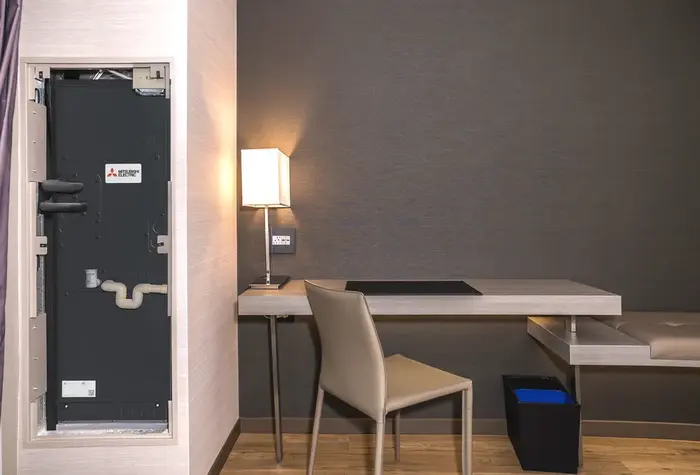
- Mitsubishi SVZ-KP slim-duct concealed — for renovated zones where existing ductwork is in good condition or where short concealed ductwork can be added without architectural compromise. Provides ducted aesthetic with inverter performance.
Architectural preservation. Refrigerant line sets, condensate drains, and control wiring route through small wall penetrations (the size of a quarter). We route line sets through wall cavities, behind built-ins, along exterior trim lines, or through attic chases to minimize visual impact in original architecture. No plaster modifications. No dropped soffits. No ductwork chases.
Outdoor unit placement. Lakewood lots typically allow side-yard placement screened by existing landscaping. The outdoor unit is roughly the size of a small refrigerator and runs at 53-58 dB(A) outdoors — quieter than typical conversation.
What R-32 Refrigerant Means for Lakewood Retrofits
Every Mitsubishi mini-split installed today uses R-32 refrigerant — the EPA AIM Act compliant refrigerant for residential equipment manufactured after January 1, 2025. R-32 has a global warming potential of 675, roughly 68 percent lower than R-410A's 2,088. As a single-component refrigerant, it services cleanly without fractionation issues. For Lakewood homeowners replacing now, current installations use refrigerant the industry is moving toward, not away from.
R-32 is classified A2L — mildly flammable — requiring A2L-certified installation. Truficient technicians are A2L-certified for R-32 systems.
What Decommissioning the Original System Looks Like
For Lakewood homes where the existing central system is being decommissioned as part of the ductless retrofit:
- Indoor air handler and outdoor condenser removed. Both pieces of legacy equipment removed from the home.
- Existing ductwork capped at the air handler closet. We don't typically rip out existing ductwork — we cap it cleanly at the air handler location to preserve the option to use it later if needed (rare but occasionally relevant). The capped ductwork becomes inert.
- Existing 240V circuit reused. The dedicated electrical circuit serving the previous compressor is typically the right size for the new outdoor unit. No panel upgrade required in most cases.
- Gas furnace decommissioning. For homes consolidating heating and cooling to all-electric, the gas furnace is decommissioned and the gas line capped at the furnace location.
The transition from old central system to new multi-zone ductless is typically a 2-3 day project depending on zone count and home complexity.
Comparable Brand Options for Historic Home Retrofits
While Mitsubishi is the most-specified premium residential mini-split for Lakewood retrofits, comparable equipment exists across other brands:
- Daikin Aurora Multi-Zone — comparable performance and warranty. Daikin Mini Split for Historic Homes Dallas →
- Bosch Climate 5000 — quietest indoor sound floor (20 dB(A)) for primary suites where acoustics matter
- LG Multi F MAX LGRED° — for homes building out smart-home integrations via ThinQ ecosystem
For most Lakewood historic-home retrofits, Mitsubishi Diamond Dealer installation with the 12-year compressor and parts warranty is the default specification. Brand alternatives are available when specific characteristics (Bosch sound, LG ThinQ smart-home, Daikin brand preference) drive the decision.
A Real Example — Bishop Arts Case Study
For a real before-and-after on the same retrofit pattern in a Bishop Arts 1925 Craftsman bungalow — including specific equipment selection, before/after humidity readings, and operating cost change — see our Bishop Arts ductless retrofit case study. The Lakewood housing pattern tracks closely.
Adjacent Pages
- Mini-Split Installation Lakewood Dallas — broader Lakewood mini-split context
- Bishop Arts Ductless Retrofit Case Study — real before/after numbers
- Daikin Mini Split for Historic Homes Dallas — alternative brand for historic applications
- DFW Humidity Hub — comprehensive humidity resource
- High Humidity Home Dallas TX HVAC Fix — humidity symptom diagnostic
Get a Quote for Your Lakewood Historic Home
If your Lakewood historic home has retrofit ductwork that's losing 25-35% of its conditioned air, indoor humidity that runs high despite the AC operating, or a central system at end of life, a multi-zone Mitsubishi ductless retrofit is the path that solves the mechanical problems without compromising the architecture.
Call 214-238-4349 to walk through your home, or request a quote online.
Truficient is a Mitsubishi Diamond Dealer specializing in historic home ductless retrofits across Lakewood, Bishop Arts, M Streets, Junius Heights, and the broader East Dallas / Oak Cliff historic corridor.
Tools to Help You Decide
See Our Lakewood Installations
Browse photos from real mini-split and heat pump installations in Lakewood homes.
Get an Instant Estimate
Answer a few questions about your home and get a ballpark cost for your project.
Scan Your Home's Efficiency
Find out where your home is losing conditioned air and what upgrades make the most sense.