Mini-Split Installation in Lakewood, Dallas
Whole-home cooling and heating for Lakewood historic homes without disturbing original architecture. → Request a Quote or call 214-238-4349
Why Mini-Splits Are the Right Answer for Lakewood
Lakewood is one of the most architecturally significant residential neighborhoods in Dallas — bounded by White Rock Lake to the east, Mockingbird Lane to the north, and the Mockingbird-Greenville-Skillman corridor framing the rest. The 75214 ZIP covers the core area: Lakewood proper, Hollywood Heights, the streetcar-era streets along Abrams Road and East Side Avenue, and the broader corridor into the M Streets and Lower Greenville.
The defining housing stock is 1920s through 1940s construction — Tudor, Spanish Eclectic, Mediterranean Revival, Colonial Revival, Craftsman bungalow, and Prairie School homes — almost entirely on original lots, with original architectural details intact. Lakewood homes are typically 1,800 to 4,500 square feet, single- or two-story, with original hardwood floors, plaster walls, leaded glass windows in formal rooms, period millwork, original tile in kitchens and baths, and the architectural pedigree that has kept the neighborhood one of the most desirable residential markets in Dallas for nearly a century.
For HVAC, the Lakewood housing reality drives the equipment choice. Most homes have:
Pre-HVAC original construction. Lakewood homes were built before central air conditioning was standard. Heating was originally provided by gas wall furnaces, floor furnaces, fireplaces, and in some larger homes, original radiator systems. Cooling came from window units or attic fans. Central HVAC was retrofitted decades after construction, with significant compromise to architectural elements during the retrofit.
Compromised retrofit ductwork. Whatever ductwork was added during 1960s-1990s renovations is now 30-60 years old. Most has degraded — joints have separated, insulation has compressed, and conditioned air loss runs 25-35 percent in many homes. The system's rated capacity exceeds what reaches the living space significantly.
Architectural details that constrain new ductwork. Original hardwood floors, plaster walls with crown moulding, leaded glass windows, period millwork, original built-ins — these elements define why owners bought in Lakewood. Any HVAC solution that requires cutting chases through plaster, dropping soffits to hide new ductwork, or modifying original architectural elements is a non-starter for most owners.
Multi-story load profiles. Many Lakewood homes are two-story Tudor or Colonial Revival floor plans with formal first-floor rooms and bedroom wings on the second floor. Single-thermostat HVAC consistently produces upstairs-vs-downstairs temperature differential complaints — upstairs runs warmer than downstairs in summer, opposite in winter.
A multi-zone Mitsubishi mini-split system addresses all of these conditions simultaneously — replacement-grade equipment, no architectural disruption, independent zone control for multi-story floor plans.
What a Mini-Split Installation Looks Like in Lakewood
Multi-zone whole-home configuration for typical Lakewood floor plans. For most Lakewood homes, a Mitsubishi MXZ multi-zone outdoor unit serves four to six indoor zones. A typical configuration in a 2,800 square foot two-story Tudor:
- One zone for the front living and dining rooms
- One zone for the kitchen and breakfast area
- One zone for the upstairs primary bedroom
- One zone for the upstairs secondary bedrooms (single unit serving the bedroom hallway)
- One optional zone for an upstairs bonus room or finished attic
- One optional zone for a finished basement or lower-level family room
Each zone runs on its own schedule and its own setpoint. The bedrooms run cooler at night. The formal rooms run at comfort during occupied hours and a setback when empty.
Outdoor unit placement. Lakewood lots are typically 7,000-10,000 square feet with mature canopy and architectural landscaping. Outdoor unit placement is planned for setback clearance, neighbor consideration, and aesthetic compatibility — most installations use a side-yard or rear concrete pad screened by existing landscaping or a small custom screen. The unit is roughly the size of a small refrigerator and runs at 53 to 58 dB(A) outdoors — quieter than conversation.
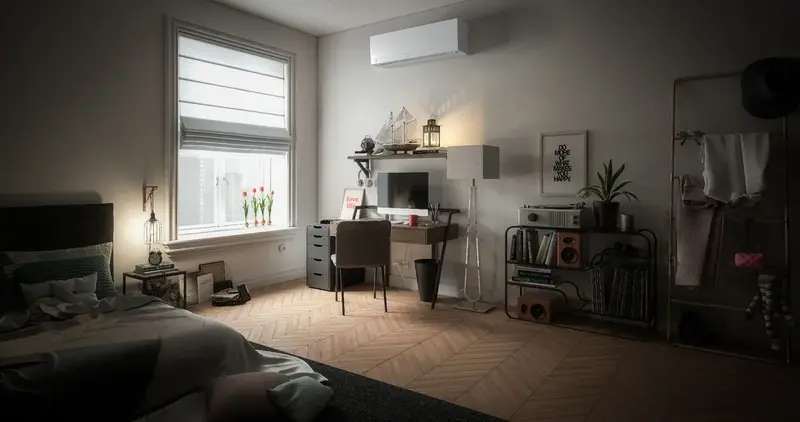
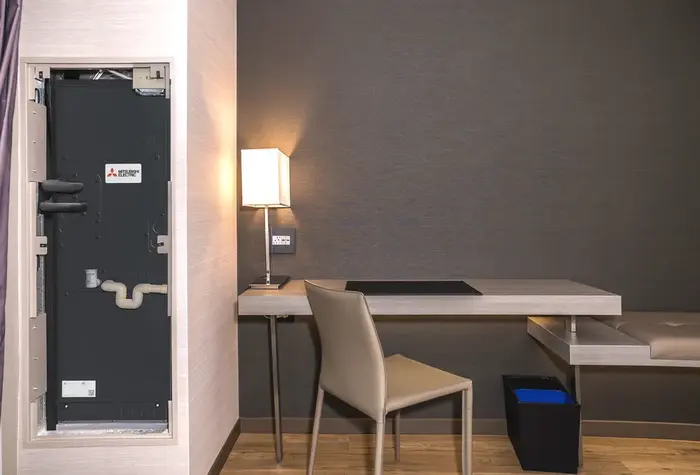
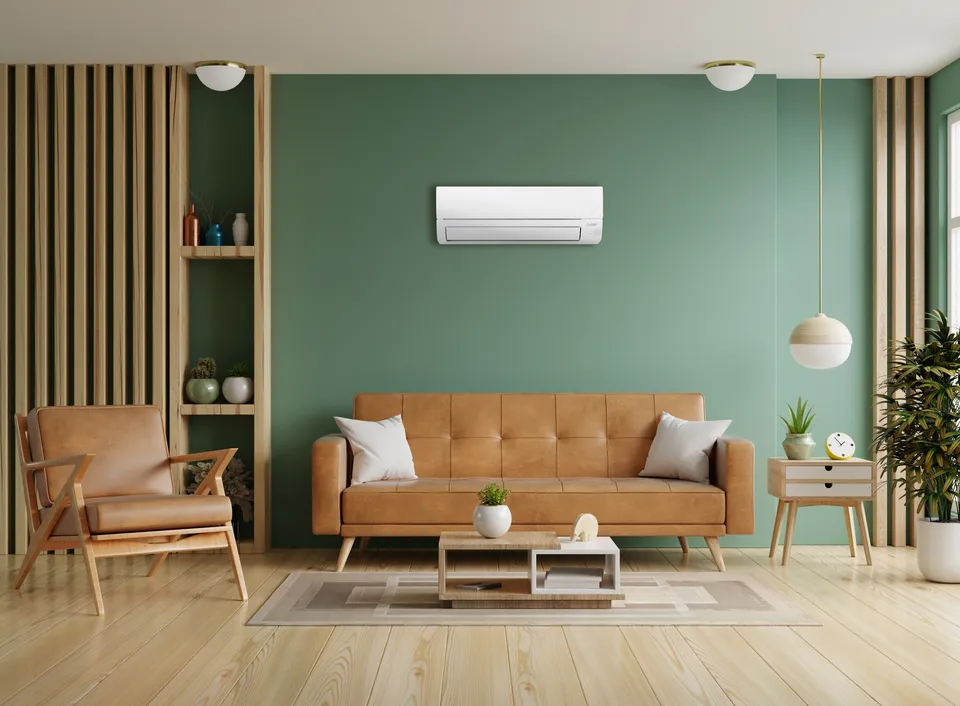
Indoor unit mounting. Wall-mounted MSZ-FS units are the most common choice for Lakewood — slim profile, white finish, low noise (as quiet as 19 dB(A) on the indoor side). For homes where wall-mount aesthetics don't fit a particular room, ceiling cassettes (SLZ) or floor-mount units (MFZ) are alternatives. Indoor unit selection follows the room's architecture.
Line set routing. The refrigerant line set, condensate drain, and control wiring run from the outdoor unit to each indoor unit through small wall penetrations. We route line sets through wall cavities, behind built-ins, along exterior trim lines, or through attic chases to minimize visual impact.
Mitsubishi's R-32 Refrigerant
Every Mitsubishi mini-split installed today uses R-32 refrigerant. Under EPA AIM Act regulations effective January 1, 2025, new residential mini-split equipment can no longer be manufactured with R-410A. R-32 has a global warming potential of 675 — roughly 68 percent lower than R-410A's 2,088. As a single-component refrigerant rather than a blend, it services cleanly without fractionation when small leaks develop. For Lakewood homeowners replacing now, current installations use refrigerant the industry is moving toward.
R-32 is classified A2L — mildly flammable — requiring A2L-certified installation. Truficient technicians are A2L-certified for R-32 systems.
One System for Heating and Cooling
Every Mitsubishi mini-split is a heat pump — it handles both heating and cooling without a separate furnace. For Lakewood homeowners currently running a gas wall furnace, floor furnace, or aging gas furnace alongside a central AC system, a multi-zone mini-split consolidates everything into a single all-electric system.
In this climate, the tradeoff works cleanly. Dallas winters are short and mild — average January high temperatures in the mid-50s, and genuinely cold nights below 25°F are rare in most years. Mitsubishi's Hyper-Heat (H2i) outdoor units are rated for full heating capacity down to 5°F and continued operation to -13°F — well below anything Lakewood typically sees. Removing the gas furnace simplifies maintenance, eliminates gas-line and combustion concerns, and consolidates the heating load to electricity.
Why Inverter Modulation Matters in Lakewood
The single-stage central systems that fill most older Lakewood homes today run at full capacity when the thermostat calls and shut off when it doesn't. Cycling at full capacity is the least efficient operating profile available. The compressor draws maximum current at every startup, and the system doesn't run long enough to dehumidify properly. Indoor humidity stays high (60-65% RH) during the cooling season even when the thermostat reads correctly — the home feels clammy.
Mitsubishi mini-splits use inverter-driven compressors that modulate output continuously, matching actual load in real time. The system runs at exactly the capacity required — sometimes 30 percent of rated output, sometimes 100 percent. The practical result in a Lakewood home is steady indoor temperatures, real humidity control, and electricity consumption proportional to how hard the system is actually working.
What the Installation Day Looks Like
Assessment. We walk the home, evaluate the existing systems and ductwork condition, run a Manual J load calculation, identify zone configurations based on the home's actual layout and occupancy patterns, plan indoor unit and line set locations, and confirm the electrical panel has available capacity for the dedicated 240V circuit.
Day of installation. A four-zone whole-home Lakewood installation is typically two days. A six-zone configuration is two and a half to three days. The bulk of the work is line-set routing.
Testing and walkthrough. Before leaving, we confirm heating and cooling performance on each zone, verify condensate drainage, and walk through controller operation including the Mitsubishi kumo cloud app for remote control.
Warranty. Mitsubishi Diamond Dealer installation includes the 12-year parts and compressor warranty.
Serving Lakewood and the Broader 75214 Area
Truficient serves Lakewood and the surrounding 75214 corridor, including the M Streets, Hollywood Heights, and the broader East Dallas historic district. We also serve the adjacent Lower Greenville and Old East Dallas historic neighborhoods.
For homes with the original 1920s-1940s bungalow profile, see our dedicated HVAC for 1940s Oak Cliff bungalows page (the architectural patterns translate). For broader Oak Cliff residential offerings, see Oak Cliff residential HVAC and Oak Cliff mini-split installation.
Get a Quote for Your Lakewood Home
If your Lakewood home has rooms that are never at the right temperature, retrofit ductwork that's losing 25 to 35 percent of its conditioned air, or a central system at end of life, a multi-zone mini-split is likely the most efficient path forward — and the path that preserves your home's original character.
Call 214-238-4349 to talk through your situation, or request a quote online.
Truficient is a Mitsubishi Diamond Dealer serving Lakewood and the broader historic East Dallas area.
Tools to Help You Decide
See Our Lakewood Installations
Browse photos from real mini-split and heat pump installations in Lakewood homes.
Get an Instant Estimate
Answer a few questions about your home and get a ballpark cost for your project.
Scan Your Home's Efficiency
Find out where your home is losing conditioned air and what upgrades make the most sense.