HVAC in the Dallas Medical District: One of the Three Hottest Zones in the City
When NOAA researchers analyzed the results of their 2023 and 2024 urban heat island mapping campaigns across more than 250 square miles of Dallas, the Medical District along Harry Hines Boulevard ranked among the three most extreme heat island zones in the city. That designation is not a footnote — it means this corridor consistently recorded temperatures 10–12°F above the city's cooler areas at the same hour.
For the property owners, facility managers, and business tenants operating in the Medical District, this is not abstract environmental data. It is the thermal environment your HVAC system is fighting against every summer day — and increasingly, year-round.
Why the Medical District Runs So Hot
The Medical District's heat island profile is driven by a specific combination of land use and infrastructure that is unusually concentrated:
Harry Hines Boulevard corridor. One of Dallas's most heavily trafficked commercial arterials, Harry Hines presents miles of dark pavement, commercial rooftops, gas stations, and surface parking with minimal tree canopy interruption. The road surface and adjacent parking lots absorb solar radiation through the day and become radiant heat sources in the late afternoon.
Parking structures and surface lots. The Medical District is served by an unusually dense network of parking infrastructure — both above-grade structures and surface lots. Multi-story parking garages present large dark surfaces on multiple vertical and horizontal planes, absorbing and reradiating heat in ways that surface parking alone does not.
Hospital campus infrastructure. The major hospital campuses in the Medical District generate significant anthropogenic heat through their own operations — generator exhaust, rooftop mechanical equipment, emergency generator testing, and the aggregate HVAC load of large, continuously occupied medical facilities.
Near-zero residential tree canopy. Unlike the residential neighborhoods of Oak Cliff or Lakewood a few miles away, the Medical District has almost no residential street tree canopy in its commercial core. The Texas Trees Foundation has specifically targeted Harry Hines Boulevard for a linear parkway redesign as part of Dallas's heat island mitigation efforts — a recognition that this corridor is among the worst in the city.
Commercial HVAC in a Top-Three Heat Island Zone
The Medical District's commercial building stock includes large hospital campuses (which manage their own facilities), but also a substantial inventory of smaller commercial properties — medical office buildings, outpatient clinics, imaging centers, surgical suites, dental offices, and ancillary retail.
These smaller commercial properties are often cooling with aging conventional systems that were never sized for the heat island conditions the Medical District carries. The practical result is the same as in any heat island zone: systems that run at sustained full capacity during afternoon peaks, fail to maintain comfortable indoor conditions on the hottest days, and accumulate wear from operating in conditions that exceed their design specifications.
Daikin VRF is particularly well-suited to the mixed-use commercial profile of Medical District properties. A single Daikin VRV IV outdoor unit can serve up to 64 indoor air handlers — allowing a multi-suite medical office building to replace several aging rooftop units with a single condensing unit, dramatically reducing the outdoor heat rejection footprint in a zone that is already thermally compromised.
The heat recovery configuration is especially relevant here: Medical District buildings that need year-round cooling in server rooms and imaging equipment areas while also needing heating in patient waiting areas during winter can transfer heat internally rather than rejecting it outdoors — eliminating that portion of the building's contribution to the urban heat load entirely.
Multi-zone cassette configurations for medical commercial spaces. Medical office buildings and outpatient clinics have complex internal zone requirements: waiting rooms with variable patient occupancy, exam rooms with specific temperature consistency requirements, nurse stations and admin areas, and server/IT closets that need continuous year-round cooling. A VRF system with mixed indoor unit types handles this in a way that a single RTU serving the whole floor cannot:
- Ducted indoor units connected to spiral or conventional ductwork for waiting rooms and large open areas
- Ceiling cassettes in individual exam rooms and offices for direct zone control
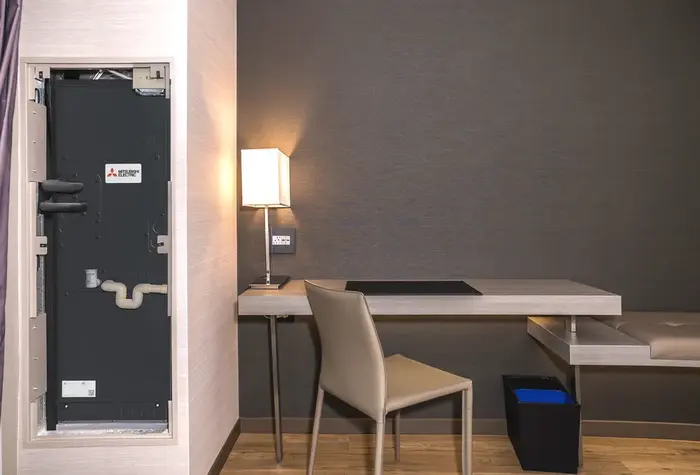
- Slim duct or concealed units for server closets and imaging equipment rooms
- Heat recovery loop across all zones — waste heat from cooling the server room in January is transferred to warm the patient waiting area
Residential Properties Adjacent to the Medical District
The residential neighborhoods immediately adjacent to the Medical District — including parts of Love Field and the northwest Oak Lawn corridor — carry the thermal spillover from the district's commercial core. Properties on blocks that back up to commercial parking lots or border the Harry Hines corridor experience elevated ambient conditions that extend beyond the commercial zone itself.
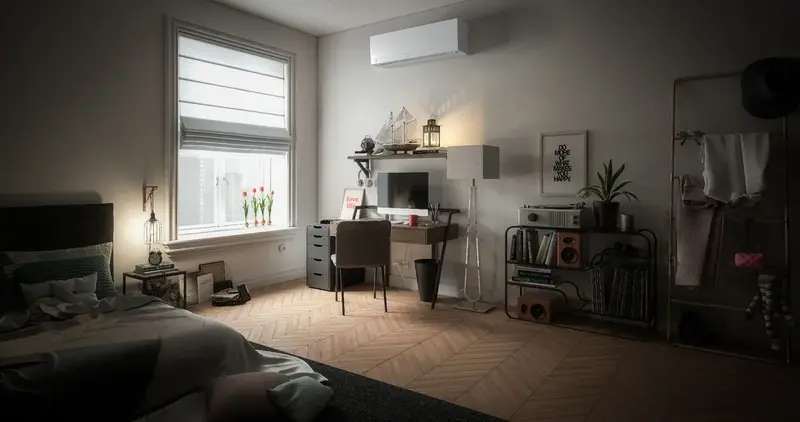
For these residential properties, Mitsubishi's inverter mini-split systems offer the combination of high-ambient performance (rated to 115°F outdoor cooling operation) and precision zone control that dense adjacent commercial heat load demands. The 23.1 SEER2 top-of-line efficiency means the system consumes dramatically less electricity at the moment when the Medical District's heat island conditions are at their worst — the 3–7 p.m. window when ERCOT wholesale prices also spike.
Oncor Rebates in the Medical District
The Medical District is in Oncor Electric Delivery's service territory. Oncor offers rebates of up to $1,000 for qualifying high-efficiency commercial and residential HVAC installations.
See current Oncor and Federal incentive programs →
Read the full Dallas Urban Heat Island Research Report →
See Daikin VRF for Dallas commercial heat island properties →
Tools to Help You Decide
See Our Medical District Installations
Browse photos from real mini-split and heat pump installations in Medical District homes.
Get an Instant Estimate
Answer a few questions about your home and get a ballpark cost for your project.
Scan Your Home's Efficiency
Find out where your home is losing conditioned air and what upgrades make the most sense.