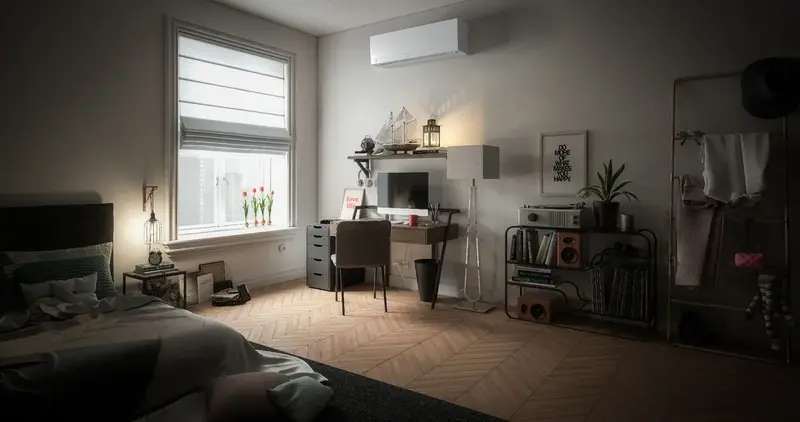
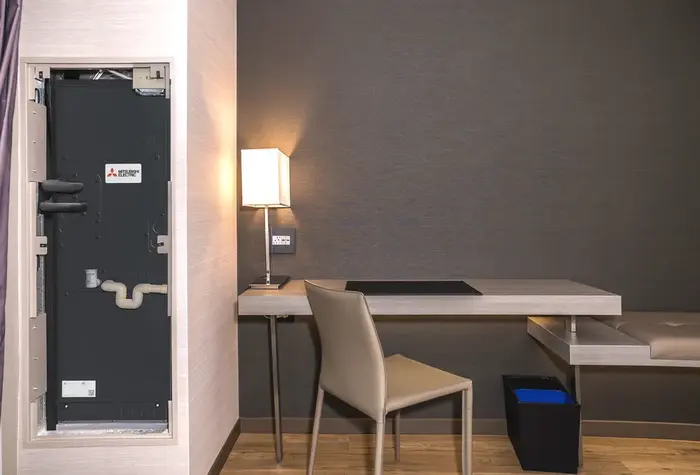
Mini-Split HVAC for Airbnb and Short-Term Rentals in Dallas
Smart controls, remote management, independent zones, and equipment durability matched to high-turnover rental use. → Request a Quote or call 214-238-4349
What Short-Term Rental Operators Actually Need From HVAC
Short-term rental properties in Dallas face a specific set of HVAC problems that traditional central systems don't solve well:
Setback between guests is a big efficiency lever. When a rental is empty between guests — typically 2 to 6 hours during the turnover cleaning window, sometimes 12 to 24 hours between bookings — running the AC at occupied setpoint is wasted energy. The operator wants the ability to set back to 80°F during vacancies and ramp down to 72°F automatically before check-in.
Remote monitoring and control matters. Property managers with multiple units need the ability to monitor HVAC status from a phone app — verifying the system is running, spotting failures before guests complain, and adjusting setpoints remotely when a guest requests a change.
Guest-tolerant controls. The thermostat should be simple enough that guests can operate it without a tutorial, but limited enough that a guest can't set it to 65°F and leave it there for three days. Lockout and minimum-setpoint features matter.
Quiet operation. Review scores suffer when HVAC equipment is noisy. A central system that was acceptable for owner occupancy may generate review complaints from guests used to quieter equipment.
Zone independence. A bedroom-only rental (guest suite within a home) needs independent control so the guest zone can be conditioned without affecting the rest of the home's climate.
Reliability and fast service. Equipment failure on a rental property is worse than failure on an owner-occupied home — lost revenue, cancelled bookings, guest refunds, and review damage. Equipment choice and service relationship matter more than the install cost alone.
Why Mini-Splits Outperform Central Systems for STRs
Mini-splits address each of these STR-specific needs in ways that central systems don't:
Built-in smart control integration. Mitsubishi Kumo Cloud (for Mitsubishi equipment) or Sensibo (aftermarket smart controller for most mini-split brands) gives operators phone-app control, scheduling, and monitoring. Setpoint changes, setback programming, and remote monitoring are standard features, not add-ons.
Per-zone operation for multi-unit rentals. A single outdoor condenser with multiple indoor units means each rental unit — or each zone within a larger rental — can operate independently. A three-unit converted property with a single outdoor MXZ-H unit has three fully independent zones that guests don't share.
Quiet indoor units. Mitsubishi wall-mounted units at 19 to 25 dB are dramatically quieter than most central systems' air handler noise. Review comments about "quiet HVAC" become common.
Inverter modulation reduces cycling noise. Central systems cycling on and off produce startup noise — a subtle compressor kick, ductwork expansion, register air rush. Inverter mini-splits modulate continuously, which eliminates the cycling noise entirely.
Faster cool-down from setback. Inverter systems can ramp from 80°F setback to 72°F occupancy setpoint in 30 to 45 minutes for a typical Dallas rental. Setback between guests is economically viable in a way it rarely is with single-stage central equipment.
Typical STR Mini-Split Configurations
Full home STR (1,500 to 3,000 sq ft, 3-4 bedrooms). Multi-zone Mitsubishi MXZ-H system, typically 4 to 6 zones — primary suite, guest bedrooms, living area, and sometimes a den or office. Each zone has independent control. Smart controller integration via Kumo Cloud for property manager monitoring.
Studio/one-bedroom STR unit in a shared building. Single-zone system with one outdoor condenser and one indoor unit. Independent from the rest of the building. Smart thermostat for remote management.
Guest suite within an owner-occupied home. Single-zone system for the guest wing, running independently from the main house HVAC. Guest zone runs at setpoint; main house remains on its normal schedule regardless of guest presence.
Backyard casita or converted ADU as STR. See our ADU mini-split page — same technical approach, STR-specific controls and scheduling.
Multi-unit converted building with 2-6 separate rentals. A VRF system (Mitsubishi City Multi or similar) serves all units from a single outdoor condenser with per-unit zoning and per-unit metering. Often the best answer for converted historic buildings or small-commercial-to-residential conversions.
Smart Controls: What's Worth Specifying
Mitsubishi Kumo Cloud. The native Mitsubishi smart control platform. Integrates with Mitsubishi mini-splits directly (no aftermarket module needed). Phone app, scheduling, remote monitoring, geofencing, and PMS (property management system) integration for property managers with multiple units. Standard specification for Mitsubishi mini-split installs in STR applications.
Sensibo Air / Sensibo Sky. Aftermarket smart controller for non-Mitsubishi mini-splits (Fujitsu, LG, Samsung, Daikin). Similar functionality to Kumo Cloud — phone app, scheduling, integrations with Google Home and Alexa.
Lockout and minimum-setpoint programming. Most smart controllers support setpoint limits — e.g., guest cannot set below 70°F or above 78°F. Prevents guest misuse while still allowing guest control within reasonable range.
Integration with STR property management systems. Guesty, Hospitable, Hostfully, and similar PMS platforms can integrate with Kumo Cloud and Sensibo for automatic setback between bookings and automatic cool-down before check-in. For operators with 3+ properties, PMS integration is a meaningful operational lever.
The Financial Case for STR Operators
The STR mini-split investment produces measurable returns beyond comfort:
Energy cost reduction through setback. A 24-hour setback between bookings at 80°F instead of 72°F saves 30 to 50 percent of that day's cooling energy. Across an annual booking schedule with typical occupancy rates, this compounds meaningfully.
Review score improvement. "Quiet HVAC," "temperature was perfect on arrival," and "easy controls" appear in Airbnb reviews for well-equipped STR properties. Review scores drive booking velocity and pricing.
Reduced emergency service costs. Inverter mini-splits have fewer failure modes than single-stage central systems. Fewer mid-stay failures means fewer refunds and fewer emergency service calls at emergency service pricing.
Higher average daily rate for premium equipment. Properties with smart climate control, zone independence, and premium HVAC can often charge 10 to 20 percent more than comparable properties with basic central systems — and command better occupancy at that price.
Warranty protection. Mitsubishi Diamond Dealer installs carry the 12-year parts and compressor warranty. For an STR property held 10+ years, this covers most expected service life without out-of-pocket repair costs.
Working With Truficient on STR Projects
Truficient works with STR operators ranging from single-property owners to multi-property portfolios. For portfolio clients, we offer:
- Consistent specification across multiple properties (same equipment, same controls, same service)
- Property-level maintenance contracts with portfolio pricing
- PMS integration support during install
- Priority service response — important when equipment fails on a bookable property
Eric, Truficient's owner, is the engineer behind every STR design. Manual J load calculations accounting for the actual occupancy and usage pattern, equipment sized to handle high-turnover duty cycles, and controls programmed for STR-specific workflows.
For related resources, see Mitsubishi mini-splits for Dallas homes, Mitsubishi Kumo Cloud smart controls, ADU mini-split installations, and mini-split for Downtown Dallas condos (common STR application).
Get an STR Mini-Split Quote
Call 214-238-4349 or request a quote online.
Truficient is a Mitsubishi Diamond Dealer. Purpose-built STR installations for Dallas, Richardson, Plano, and the broader North Texas short-term rental market.
Tools to Help You Decide
See Our Dallas Installations
Browse photos from real mini-split and heat pump installations in Dallas homes.
Get an Instant Estimate
Answer a few questions about your home and get a ballpark cost for your project.
Scan Your Home's Efficiency
Find out where your home is losing conditioned air and what upgrades make the most sense.