Mini-Split for Home Additions & ADUs — Dallas TX
For Dallas additions, ADUs, and back-of-house buildouts, a dedicated mini-split is almost always the right answer. Skip the duct extension. Call 214-238-4349 or request a quote.
The Problem with Extending Existing Ductwork to an Addition
When you build an addition onto an existing Dallas home, the standard contractor recommendation is often to "tie into the existing HVAC" — extend the supply ductwork from the existing air handler into the new space and let the central system condition it. That recommendation looks like the path of least resistance, but it's frequently the path of most disappointment.
Here's what goes wrong:
The existing system isn't sized for the additional load. A 2.5-ton system was sized for the original 1,800 square feet. Adding 400 square feet of new construction adds cooling load the original equipment doesn't have capacity for. The result is the addition that never gets to setpoint, and the original house running warmer than it used to as the system tries to cover both spaces.
Static pressure goes up when you add ductwork. The existing supply trunk was sized for the original branches. Adding new branches forces more airflow through the same trunk diameter, which raises static pressure. Higher static pressure means the existing blower works harder, the existing branches lose airflow, and the original rooms get less conditioned air than before. The whole system becomes less effective.
Long duct runs lose capacity. Running new ductwork from the existing air handler to a new back addition or ADU often involves 30-60 feet of additional duct length. Each fitting and each linear foot of duct loses pressure and capacity. By the time the air reaches the new space, it's at significantly lower velocity and capacity than what left the air handler.
Single-thermostat control creates new comfort complaints. The thermostat is in the original house. The addition has different orientation, different occupancy schedule, and likely different envelope assembly than the original. A single thermostat can't satisfy both spaces.
Ductwork through the existing roof or wall assembly is often impractical. Running supply and return between the original house and the new addition frequently means cutting through original walls, roof structure, or ceiling assemblies. The architectural and labor cost can match or exceed the cost of a dedicated mini-split system.
Why a Dedicated Mini-Split Is the Right Answer for Additions
A dedicated mini-split system serving the addition independently of the original house solves all of the problems above:
Right-sized for the actual addition load. A Mitsubishi mini-split sized to the addition's calculated Manual J load delivers the capacity the addition needs without taking anything from the original house.
No impact on the existing system. The original ductwork stays as designed. The original system stops being asked to do something it wasn't sized for. The original house stays at its original comfort level.
Independent control. The addition has its own thermostat and its own setpoint. Different occupancy patterns, different temperature preferences, different schedules — all handled.
Minimal architectural impact. A mini-split needs a small wall penetration for the line set and a 240V dedicated electrical circuit. No ducts running through original walls or roof structure.
Year-round heating and cooling from one system. The mini-split is a heat pump. It handles both heating and cooling for the addition without needing a separate furnace or supplemental heating system. For Dallas's mild winter and long cooling season, this consolidates everything into a single piece of equipment.
Common Addition Applications in Dallas
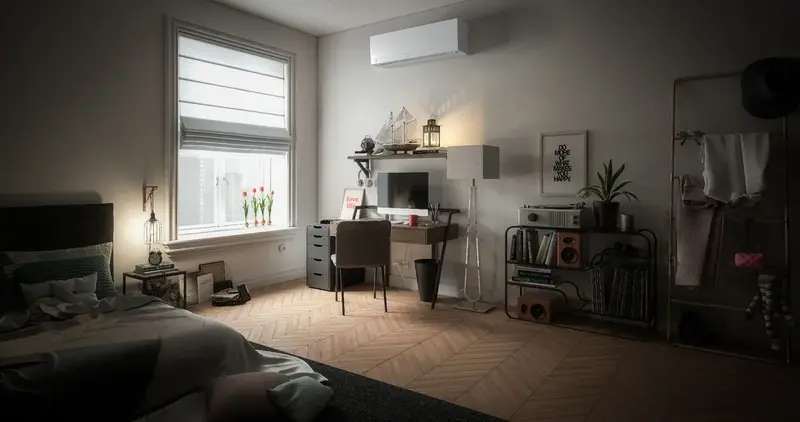
Bedroom additions and master suite additions. A 9,000-12,000 BTU single-zone Mitsubishi MSZ-FS or equivalent handles a typical 250-450 square foot bedroom addition cleanly. Whisper-quiet (19 dB(A) on whisper mode) for sleep comfort.
Back-of-house family room additions. A 12,000-18,000 BTU single-zone Mitsubishi mini-split or a small two-zone MXZ system covers most family room buildouts. The size choice tracks the actual room load — Manual J calc, not catalog rule of thumb.
Detached garage offices and ADUs. Detached structures rarely tie into the main house HVAC anyway. A dedicated single-zone or two-zone Mitsubishi system serves the garage office or ADU as its own building. 9,000 BTU for a 200-300 sq ft office; 18,000-24,000 BTU for a 600-900 sq ft ADU.
Sunroom and three-season-room conversions. Sunrooms converted to year-round conditioned space need dedicated HVAC because the envelope is typically thinner than the rest of the house. A single-zone mini-split sized to the higher-load envelope handles the conversion cleanly.
Bonus rooms over the garage. The bonus-room-above-garage problem is universal in Dallas — uninsulated below, exposed roof above, away from the central HVAC. A single-zone mini-split solves the chronic temperature complaint without modifying the central system.
Loft additions and second-story additions. Adding a second story or a loft adds significant cooling load that the existing first-story-sized system can't cover. A dedicated mini-split for the new vertical space avoids overloading the original system.
What Equipment We Use
For most Dallas addition applications, the equipment is from the Mitsubishi residential lineup:
- Mitsubishi MSZ-FS wall-mounted indoor units — slim profile, low noise, white finish, 9,000 to 24,000 BTU range
- Mitsubishi SLZ ceiling cassettes — recessed flush-mount for additions where ceiling-cassette aesthetics fit better than wall-mount
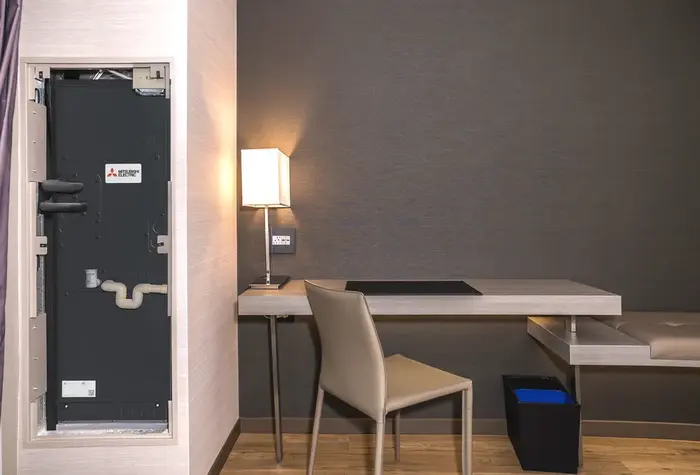
- Mitsubishi SVZ-KP slim-duct heat pumps — for additions where short-run ductwork is preferred (typically a single supply trunk with two or three diffusers)
- Mitsubishi MXZ multi-zone outdoor units — when the addition includes multiple rooms (e.g., master bedroom + master bath + closet) needing independent control
Other brand options for specific applications:
- Bosch Climate 5000 when sound floor matters (master suite addition, recording studio addition) — 20 dB(A) indoor sound
- Samsung WindFree Max Heat when draft-free air diffusion matters (sleep-sensitive primary bedroom addition)
- Daikin Aurora or LG LGRED° when those brands fit the homeowner's existing appliance ecosystem or smart-home stack
R-32 Refrigerant in Addition Equipment
Every Mitsubishi mini-split installed today uses R-32 refrigerant — the EPA AIM Act compliant refrigerant for residential equipment manufactured after January 1, 2025. R-32 has a global warming potential of 675, roughly 68 percent lower than the R-410A it replaced. For Dallas addition installations, current equipment is R-32 from the start.
R-32 is classified A2L — mildly flammable — requiring A2L-certified installation. Truficient technicians are A2L-certified for R-32 systems.
What the Installation Looks Like
Assessment. We walk the addition (during framing or after completion), evaluate the envelope, run a Manual J load calc for the addition, identify zone or single-zone configuration, plan unit and line set locations, confirm the electrical panel has available capacity for the dedicated 240V circuit.
Coordination with the GC or builder. For additions still under construction, we coordinate with the framer for line-set chase access, the electrician for the dedicated circuit, and the trim carpenter for indoor unit mount-up timing.
Installation day. A typical single-zone addition installation is four to eight hours.
Testing and walkthrough. Before leaving, we confirm cooling and heating performance, verify condensate drainage, and walk through controller operation including the Mitsubishi kumo cloud app for remote control.
Warranty. Mitsubishi Diamond Dealer installation includes the 12-year parts and compressor warranty.
When Tying Into the Existing System Actually Makes Sense
We don't push mini-splits where ducted extension is the right answer. Tying into the existing system can work when:
- The existing system has meaningful unused capacity (most don't, but some do — Manual J on the existing house tells you)
- The addition is small (under ~150 sq ft) and the load increment is minimal
- The existing ductwork has clear extension capacity (modest static pressure increase, short run distance)
- The addition has the same occupancy schedule and temperature preference as the original house
If those conditions are all true, we'll quote the duct extension. They're rarely all true together. For most Dallas additions, the dedicated mini-split is the better answer.
Adjacent Pages
- HVAC for New Construction Custom Home Dallas TX — for additions that are part of a larger custom-home project
- HVAC for Builders & Developers Dallas TX — for builder-led addition projects
- Mini-Split Installation Oak Cliff Dallas — for additions in Oak Cliff bungalows
- HVAC for 1940s Oak Cliff Bungalows — addition context for older bungalow stock
- Samsung Mini Split for New Construction Dallas TX — Samsung WindFree for tight new-construction additions
Get a Quote for Your Addition
If you're planning an addition, ADU, or back-of-house buildout in Dallas, the HVAC scope is worth getting right at design. We'll size the system for the actual addition load, coordinate with your builder, and quote it cleanly.
Call 214-238-4349 or request a quote online.
Truficient is a Mitsubishi Diamond Dealer with engineering-driven HVAC design for Dallas additions and ADUs.
Tools to Help You Decide
See Our Dallas (Additions & ADUs) Installations
Browse photos from real mini-split and heat pump installations in Dallas (Additions & ADUs) homes.
Get an Instant Estimate
Answer a few questions about your home and get a ballpark cost for your project.
Scan Your Home's Efficiency
Find out where your home is losing conditioned air and what upgrades make the most sense.