RTU vs Mini Split for Small Business — Dallas HVAC Decision Guide
The single most common HVAC decision Dallas small business owners face: replace the aging rooftop unit with another rooftop unit, or switch to ductless mini split / VRF. The right answer depends on the building, the load profile, and the operating cost horizon. Call 214-238-4349 for project-specific guidance.
The Decision In One Sentence
A rooftop packaged unit (RTU) is the right answer for Dallas small businesses with simple single-zone occupancy, existing rooftop infrastructure, and short ownership horizons. A ductless mini split or VRF system is the right answer for buildings with multi-zone load diversity, no existing ductwork, architectural sensitivity, or longer operating cost horizons. The two paths cost roughly the same to install. The operating cost differential over 10-15 years is meaningful.
What an RTU Actually Is
An RTU (Rooftop Unit) is a packaged HVAC system that contains the compressor, condenser, evaporator coil, blower, and gas heat (typically) in a single self-contained cabinet that mounts on the building's roof. Conditioned air drops from the RTU through a roof curb into the building, distributing through ductwork inside the building. Common RTU brands include Carrier, Lennox, Trane, York, Daikin, and AAON.
RTUs are the industry-default specification for most Dallas small commercial buildings under 15,000 square feet — they're simple to install, simple to service, and standard equipment for most commercial general contractors. Capacity ranges run from 3 ton (36,000 BTU) through 25 ton (300,000 BTU) on single-unit configurations.
What a Ductless Mini Split / VRF Does Differently
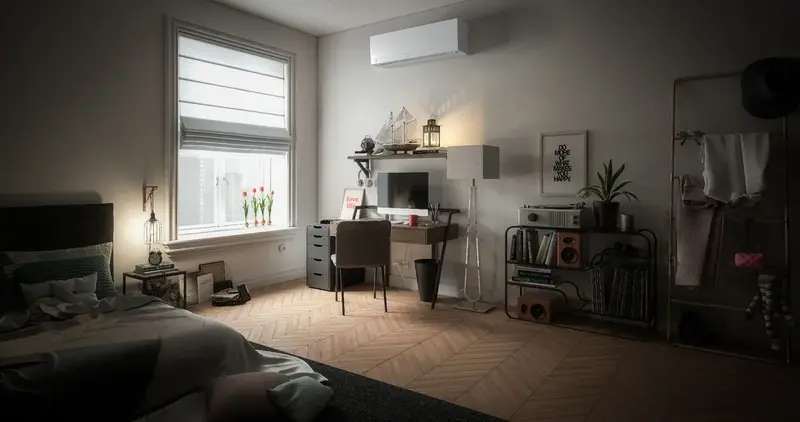
Ductless systems (residential-scale) and VRF systems (commercial-scale) decouple the cooling/heating source from the building's air-distribution method. Instead of one rooftop box cooling a duct-distributed airflow, the system has:
- An outdoor condenser unit — typically ground-mounted or on the roof, but separated from the indoor air-handling equipment
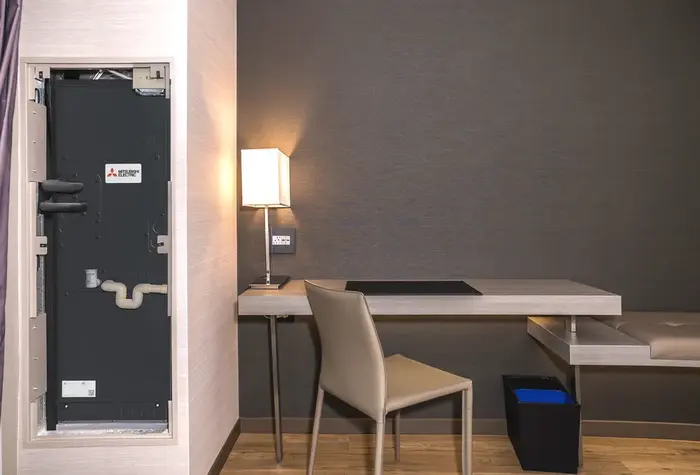
- Multiple indoor units — wall-mount, ceiling cassette, concealed-duct, or floor-mount — distributed throughout the building, each conditioning its own zone
- Linesets connecting them — refrigerant pipes running between outdoor and indoor units
The architecture means:
-
Per-zone control. Each indoor unit operates independently. The conference room can be cooled while the back office runs at minimum capacity. The retail floor cools heavily during business hours while the upstairs office stays at unoccupied setback overnight.
-
No ductwork required. For buildings that don't have existing ducted distribution (1920s warehouses, narrow storefronts, historic buildings), avoiding ductwork installation saves significant cost and preserves architectural detail.
-
Smaller equipment per zone. Instead of one 7-ton RTU sized for peak full-building load, the building runs multiple smaller indoor units that match each zone's actual load. The total capacity is similar; the matching to actual load is dramatically better.
-
Variable-speed inverter compressor. The outdoor unit modulates capacity continuously rather than cycling on and off. Operating cost reduction over single-stage RTU equipment runs 25-45% on cooling, depending on application.
Install Cost Comparison
For a typical 4,000 square foot Dallas storefront (retail, office, light commercial):
| Path | Install Cost Range | |---|---| | RTU replacement (like-for-like 10-ton) | $22,000 - $32,000 | | RTU replacement + zoning improvements | $28,000 - $40,000 | | Mini split multi-zone (4-6 indoor units, no ductwork) | $30,000 - $48,000 | | VRF heat recovery (mixed-use, 6-10 indoor units) | $48,000 - $85,000 |
RTU is the cheapest path on day one for buildings with existing ductwork that can be reused. Mini split is in similar range when the ductwork would otherwise need to be added. VRF heat recovery is the most expensive on day one but produces the lowest operating cost over time for mixed-use buildings.
Operating Cost Comparison
For the same 4,000 square foot Dallas storefront, estimated annual operating cost:
| Path | Annual Cooling Cost (est.) | 15-Year Operating Cost | |---|---|---| | Single-stage 10-ton RTU | $3,800 - $5,200 | $57,000 - $78,000 | | Variable-speed 10-ton RTU (newer technology) | $2,800 - $3,800 | $42,000 - $57,000 | | Mini split multi-zone (4-6 zones, variable-speed) | $2,200 - $3,200 | $33,000 - $48,000 | | VRF heat recovery (mixed use, simultaneous heating-cooling) | $1,800 - $2,600 | $27,000 - $39,000 |
Operating cost figures are estimates based on Texas commercial electric rates and typical Dallas cooling-degree-days. Actual results vary by occupancy schedule, envelope quality, and equipment specification.
The pattern: RTU equipment has higher operating cost per square foot than ductless multi-zone or VRF, primarily because of the single-stage on/off cycling pattern and the lack of per-zone capacity matching. Over a 15-year ownership horizon, the operating cost difference typically exceeds the install cost difference.
Where RTU Is the Right Answer
The RTU path is correct for Dallas small businesses where:
- The building already has properly-sized existing ductwork and replacement equipment can drop into the existing system
- The application is single-zone occupancy — one large open space, one consistent use, one schedule (warehouse, single-use retail with continuous hours)
- Ownership horizon is 3-7 years — the longer operating cost benefit of mini-split / VRF doesn't fully materialize
- The roof can accept the new equipment — structural review confirms RTU weight, electrical service can handle it, gas service is available if needed
- Service simplicity matters — RTU service is standard for any commercial HVAC technician; mini-split / VRF service requires brand-specific training
- The building is not architecturally sensitive — RTU is fine for utility / industrial / standard retail buildings
For Dallas RTU replacement specifically, see Commercial RTU Replacement Dallas.
Where Mini Split / VRF Is the Right Answer
The mini split or VRF path is correct for Dallas small businesses where:
- The building has no existing ductwork — Deep Ellum loft conversions, Bishop Arts storefronts, historic Design District buildings
- Multi-zone load diversity is significant — restaurant kitchen + dining + bar + office, all with different occupancy schedules
- Architectural sensitivity matters — historic preservation, design-forward retail, fine dining
- Per-zone control is operationally valuable — the back office should not run cooling overnight while the retail floor needs continuous conditioning
- Operating cost matters more than install cost — longer ownership horizon, owner-occupied building, energy-efficiency commitment
- The building has multi-tenant occupancy — mixed-use ground-floor retail with upstairs residential or office benefits dramatically from VRF heat recovery
For Bishop Arts commercial specifically, see Commercial Mini Split Bishop Arts District. For Design District small commercial, see Small Commercial HVAC Design District Dallas. For restaurants, see Restaurant HVAC Dallas TX.
Refrigerant Transition Considerations
Both RTU and mini-split / VRF equipment are transitioning from R-410A to R-454B or R-32 refrigerants under EPA AIM Act regulations. New equipment in 2026 increasingly ships with the next-generation refrigerants. For service compatibility on existing systems, R-410A continues to be available but at increasing cost.
For Dallas small businesses replacing aging R-22 equipment (any pre-2010 RTU), the refrigerant transition means the new equipment will be R-454B or R-32 regardless of brand or platform. This is an industry-wide transition, not a brand choice. See R-454B Refrigerant HVAC Dallas.
Get a Commercial HVAC Quote for Your Dallas Business
Call 214-238-4349 or request a quote online.
Truficient quotes both RTU and ductless / VRF paths for Dallas small commercial projects. Manual J load calculation, multi-brand specification, ownership-cost analysis over realistic operating horizons.
Tools to Help You Decide
See Our Dallas Installations
Browse photos from real mini-split and heat pump installations in Dallas homes.
Get an Instant Estimate
Answer a few questions about your home and get a ballpark cost for your project.
Scan Your Home's Efficiency
Find out where your home is losing conditioned air and what upgrades make the most sense.