Ready to replace your aging system? → Request an Assessment or call 214-238-4349
North Texas Has the Perfect Climate for a Heat Pump — and Most Homeowners Don't Know It
The outdated knock on heat pumps is that they don't work in cold weather. That concern made sense for older equipment in northern climates. It does not describe the situation in Oak Cliff, Dallas in 2024 or beyond.
Here's the honest climate picture for North Texas: Dallas averages around 2,400 cooling degree days per year — meaning the AC runs hard for roughly six solid months, from late April through October. The heating season is comparatively short and mild. Average January high temperatures hover in the mid-50s. Hard freezes — nights where temperatures actually drop below 25°F — occur on only a handful of days in a typical year. Even in a cold winter, the majority of Oak Cliff's heating demand happens at outdoor temperatures between 30°F and 50°F, which is squarely in the operating range where inverter heat pumps run most efficiently.
Modern Mitsubishi Hyper-Heat equipment operates effectively down to temperatures that North Texas will see only in an extreme event. For the 95-plus percent of heating hours that occur in typical Dallas winters, an inverter heat pump is not only adequate — it's the most efficient heating option available. A gas furnace in this climate is significant equipment running at full capacity for a small fraction of the year. A heat pump does both jobs in one system, running efficiently across the full cooling-dominated annual load profile.
The February 2021 winter storm changed how many Dallas homeowners think about energy reliability. One takeaway was that depending entirely on natural gas for heating carries risk when the gas supply system is under stress. An all-electric heat pump, particularly one paired with a well-insulated home, removes that dependency entirely.
The Case for Heat Pumps Is Especially Strong in Oak Cliff's Older Homes
A number of Oak Cliff's neighborhoods along Lake Cliff Park, the Stevens Park Golf Course corridor, and the older sections of West Oak Cliff have homes from the 1940s through 1970s that have been running the same gas furnace and separate AC unit for decades. That generation of equipment is at or past the end of its practical service life.
When those systems finally fail — or when repair costs start approaching replacement cost — the instinct is to replace like for like. What most homeowners don't calculate is that a gas furnace and AC combination is two separate systems: two sets of equipment, two service schedules, two points of failure. A heat pump is one system that handles both heating and cooling. When Truficient replaces a combined furnace-and-AC setup with an inverter heat pump, you're reducing equipment count, eliminating the gas line to the HVAC equipment, and upgrading to technology that runs more efficiently in this climate than what it replaced.
For the homes near the Lake Cliff Park area and along the older stretches of Edgefield and Colorado Boulevard — many of which are on larger lots with unconditioned attic space — reducing the HVAC equipment footprint and improving efficiency per system is a meaningful long-term advantage.
Why Inverter Heat Pumps Outperform Single-Stage Systems in Dallas's Long Cooling Season
Dallas doesn't have a brutal winter. It has a brutal summer. Understanding that changes how you should think about HVAC equipment.
Single-stage systems run at 100% capacity or not at all. On a 98°F August afternoon in Oak Cliff — the kind of day that's common from July through September — a single-stage system blasts on, reaches setpoint temperature quickly, and shuts off. Then it runs again. And again. That cycling behavior is inefficient, it stresses the compressor, and it doesn't dehumidify the air effectively because the system doesn't run long enough to pull moisture out before shutting off. Oak Cliff summers are humid, and a home that feels clammy even when the thermostat reads 74°F is a home with an oversized or short-cycling system.
Inverter compressors modulate their output continuously to match the actual load. On a hot day, the system runs longer at lower capacity, pulling both heat and moisture out of the air at a steady rate. The result is more consistent temperatures, better humidity control, and lower energy consumption over the course of a Dallas summer. For Oak Cliff homeowners with older homes and imperfect insulation — which describes most of the housing stock between Kiest Park and the Bishop Arts District — this steady-state operation is the biggest practical comfort improvement they can make.
Ducted or Ductless: Matching the System to the Home
Heat pump replacement takes different forms in Oak Cliff depending on the home's existing ductwork.
Oak Cliff townhomes. The wave of new townhome construction along Jefferson Boulevard and in North Oak Cliff near the Bishop Arts District has brought a different replacement context — homes with modern insulation and current energy codes, but tall and narrow layouts that challenge traditional ducted systems. Multi-zone heat pump mini-splits are often the right replacement path here, providing independent floor-by-floor zoning without the duct runs a central system would require.
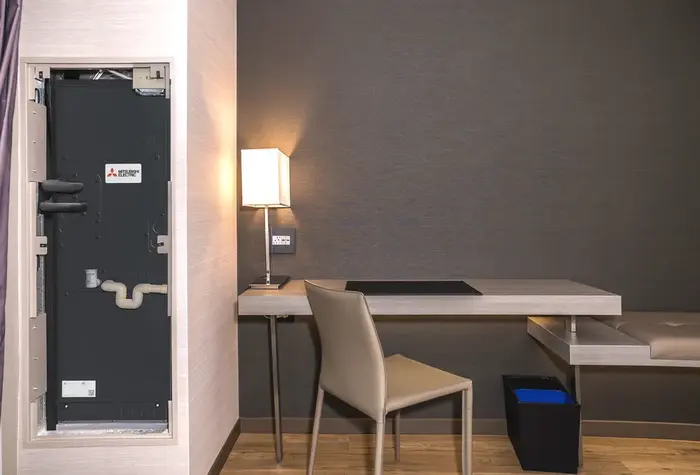
Ducted heat pump (air handler + outdoor unit). If your home has a central duct system in reasonable condition — typically homes built in the 1960s through 1990s with standard attic or closet duct runs — a ducted inverter heat pump is usually the most efficient replacement path. The outdoor heat pump unit connects to an air handler in the existing duct system. Truficient inspects the ductwork before finalizing equipment sizing to confirm the system can deliver conditioned air without excessive leakage.
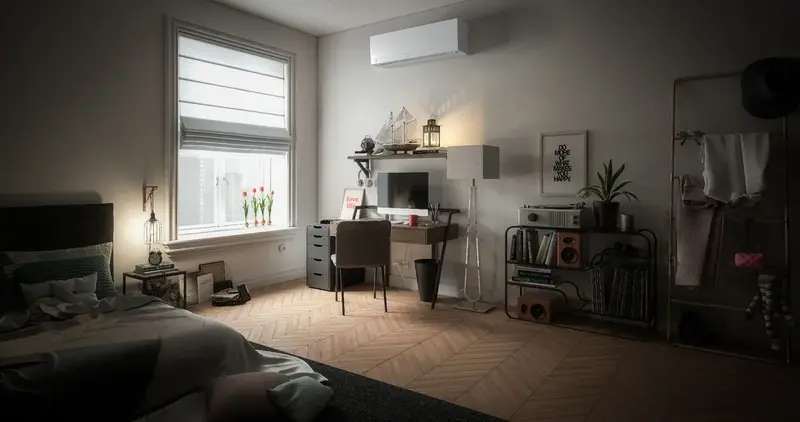
Ductless heat pump (mini-split in heat pump mode). The Craftsman bungalows along Winnetka Heights and the pre-war homes around Lake Cliff Park often have no usable ductwork. For these homes, a ductless heat pump — which is a mini-split system running in both heating and cooling modes — is the replacement path that doesn't require major structural work. The system provides year-round comfort with no ductwork and minimal installation impact on the home's interior.
Hybrid and multi-zone systems. Larger homes, homes with significant additions, or properties where part of the structure has ductwork and part doesn't sometimes benefit from a combination approach. This is worth discussing during the assessment — the right answer depends on the specific layout.
What the Replacement Process Looks Like
-
Assessment. We evaluate your current equipment, ductwork condition, electrical panel, and home layout. This determines which system type makes sense and allows for accurate equipment sizing.
-
Proposal. You receive a specific Mitsubishi equipment recommendation with line-item pricing. For Oak Cliff homes, we typically specify M-Series or Hyper-Heat equipment depending on whether the home has ductwork and the heating load profile.
-
Permits. Dallas mechanical permits are required for replacement installations. Truficient handles permitting as part of every project.
-
Installation. A ducted heat pump replacement is typically a one-day project. Ductless installations vary by the number of zones.
-
Testing and handoff. Before leaving, we verify performance in both heating and cooling modes and walk through the thermostat or controller operation.
What You Actually Save with an Inverter Heat Pump in Dallas
The other factor is eliminating gas from the equation entirely. A heat pump runs on electricity only — no gas furnace, no gas bill for heating. For homeowners who've been running a gas furnace and a separate AC unit, consolidating to a single heat pump system removes one utility variable and one set of maintenance costs permanently. The long-term cost picture is usually better than a like-for-like gas replacement, even before factoring in the efficiency gains from inverter technology.
Serving Oak Cliff and the Surrounding Dallas Core
Truficient handles heat pump replacement throughout Oak Cliff — the Lake Cliff Park corridor, the Stevens Park Golf Course area, West Oak Cliff, North Oak Cliff, Cockrell Hill, and the Bishop Arts District neighborhood — in ZIP codes 75208 and 75211.
For a broader overview of residential HVAC services in Oak Cliff, see our Oak Cliff residential HVAC overview. If your home lacks ductwork and ductless installation is the better path, the mini-split installation page covers that process in detail. We also serve homeowners in ZIP code 75208 and the adjacent Oak Lawn and South Dallas areas.
Schedule a Heat Pump Assessment
If your current system is more than 12 years old, if repair costs are approaching replacement cost, or if your home has uneven comfort or humidity problems that the current system isn't handling, an assessment is the right starting point.
Call 214-238-4349 to talk through your situation, or request an assessment online.
Truficient is a Mitsubishi Diamond Dealer serving Oak Cliff and the Dallas core market.
Tools to Help You Decide
See Our Oak Cliff Installations
Browse photos from real mini-split and heat pump installations in Oak Cliff homes.
Get an Instant Estimate
Answer a few questions about your home and get a ballpark cost for your project.
Scan Your Home's Efficiency
Find out where your home is losing conditioned air and what upgrades make the most sense.