HVAC for Oak Cliff Townhome Developers — Engineered Comfort for a Neighborhood That’s Reinventing Itself
North Oak Cliff Is Building Up. The HVAC Needs to Keep Up.
From the Bishop Arts District corridor up through Kessler and into the blocks around Jefferson Boulevard, North Oak Cliff is one of the most active infill markets in Dallas. What used to be vacant lots and teardown candidates are now 3-story attached townhomes selling in the $500K–$700K range. The buyers are professional, design-conscious, and quick to leave reviews.
They also expect a rooftop.
The rooftop deck has become a standard amenity in Oak Cliff townhomes, and for good reason — the views across the skyline, the neighborhood character, the outdoor living culture that defines this part of Dallas all make that top-floor deck a major selling feature. Buyers choose units based on it.
Which makes the most common rooftop HVAC placement a problem that starts on day one of occupancy.
The Two Problems With the Standard Spec
Problem one: comfort across three floors. Oak Cliff lots are tight. Buildings are tall and narrow — often 22 to 26 feet wide, stacked three stories — with south and west exposure baking the top level in afternoon sun. A conventional single-handler system with motorized dampers can’t resolve a 10–12 degree load differential between the top floor and the first floor. It averages. The top floor runs warm. The contractor comes out, tweaks the dampers, and the problem returns with the next heat wave. Builders in Oak Cliff who’ve gone this route know the pattern.
Problem two: a loud condenser on a rooftop people actually use. A conventional single-stage outdoor unit fires at full capacity every cycle. On a rooftop deck — where that unit is 6 to 10 feet from a conversation, a dinner table, or a speaker — it’s intrusive. It cycles on and off all evening. The rooftop the buyer was sold on becomes a place they work around rather than enjoy. In a neighborhood like Bishop Arts, where outdoor living is part of the identity, that’s a meaningful product failure.
Both problems are avoidable with the right system architecture.
What Truficient Installs in Oak Cliff Townhomes
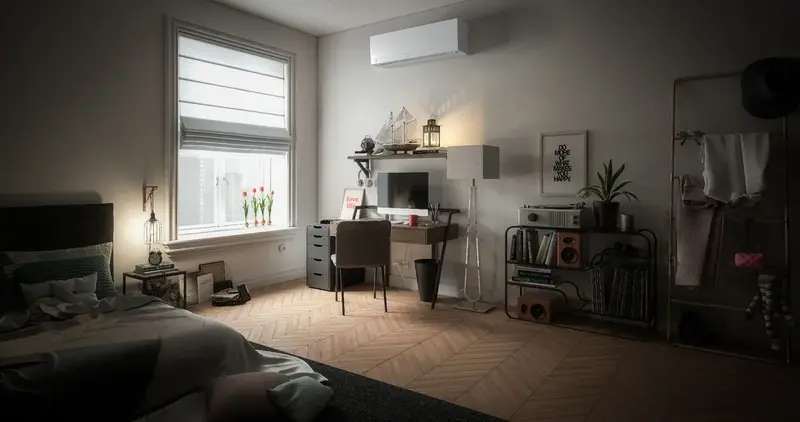
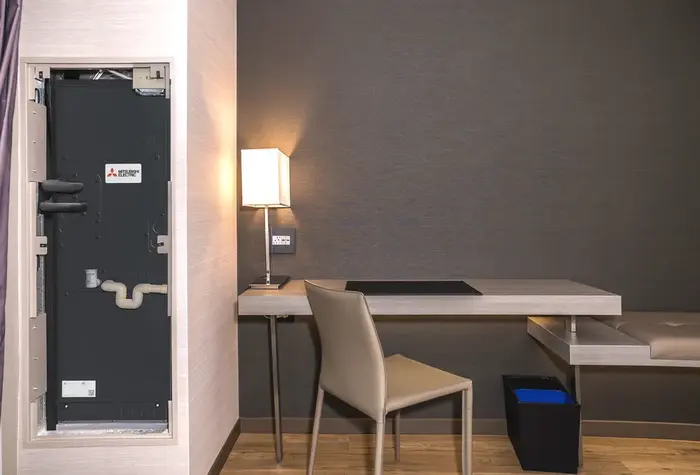
Multi-zone inverter heat pump systems place a dedicated indoor unit on each floor — ceiling-concealed ducted, wall-mounted, or ceiling cassette depending on the space. One outdoor heat pump on the roof serves all of them, but each floor operates independently on its own thermostat.
The outdoor unit is whisper-quiet. Mitsubishi and Daikin multi-zone compressors modulate their speed to match the actual load. At partial capacity — which is most of the time — these units run at sound levels that are barely perceptible in conversation. On an Oak Cliff rooftop deck on a summer evening, the outdoor unit becomes background noise rather than an interruption. That’s a detail buyers remember and mention.
Each floor handles its own load. The top floor unit addresses the afternoon solar load on its own without pulling capacity from the floors below. The first floor isn’t trying to compensate for roof heat gain — it’s only managing its own conditions. Comfort complaints drop to near zero because the system is actually designed for the building’s thermal profile.
Heat rises, and the system accounts for it. During winter months in Oak Cliff, the natural physics of the building work in the system’s favor. When the first floor calls for heat, warmth migrates upward through the building. The second floor passively benefits. The top floor — already the warmest point in the stack — often doesn’t need to run at all while the lower floors are active. The outdoor unit serves the building’s real load, not a worst-case calculation, which means higher efficiency and lower bills in the cooler months.
Modern heat pumps handle Texas winters completely. Mitsubishi multi-zone systems are rated to deliver close to full heating capacity at temperatures approaching 0°F. Oak Cliff winters rarely push below the upper 20s for more than a day or two, making this climate an ideal operating environment for heat pump technology. No gas backup needed. One system handles everything year-round.
Quiet Operation in a Dense, Walkable Neighborhood
Oak Cliff isn’t just dense — it’s a neighborhood where people are outside. Bishop Arts attracts foot traffic seven days a week. The blocks around Davis and Beckley have residents who are on their stoops, their sidewalks, their patios. Building noise matters in a way it doesn’t in suburban subdivisions.
Multi-zone inverter outdoor units don’t announce themselves. They modulate. When you’re on an Oak Cliff rooftop or sitting in the courtyard space between attached units, the difference between a traditional condenser and a Mitsubishi multi-zone unit is immediately obvious to anyone who’s experienced both.
For a developer building 8 to 12 units on a block, that quiet operation also means fewer noise complaints between units and from neighbors — a detail that matters for the project’s relationship with the surrounding community.
How We Work With Oak Cliff Builders
We work best when we’re brought in before framing is complete. At that stage we can:
- Locate indoor units to preserve ceiling heights in the living and bedroom floors buyers scrutinize most
- Design line set routing on tight lots without structural conflicts or exterior finish compromises
- Coordinate outdoor unit placement for rooftop aesthetics — equipment screens, mechanical clearances, and deck layout coexist better when HVAC is in the conversation early
- Size each floor based on real load calculations for actual solar exposure and square footage, not rules of thumb that result in oversized equipment and short-cycling
We handle installation, commissioning, and buyer orientation. You get one point of contact from design through move-in.
Let’s Talk Before You Bid
If you have an Oak Cliff townhome project in planning — a 4-unit infill row, a 12-unit community, or anything in between — we’d like to be part of the mechanical design conversation before your drawings go out.
We’ll give you an honest comparison: what a conventional system costs, what a multi-zone inverter system costs, and what the difference delivers in comfort, noise, energy performance, and buyer experience. No obligation.
Call Truficient at 972-598-9154 or send us your plans.
Truficient Energy Solutions — Mitsubishi Diamond Dealer — Specializing in multi-zone inverter systems for Dallas urban townhomes. Serving North Oak Cliff, Bishop Arts, Kessler, and surrounding neighborhoods.
Tools to Help You Decide
See Our Oak Cliff Townhomes Installations
Browse photos from real mini-split and heat pump installations in Oak Cliff Townhomes homes.
Get an Instant Estimate
Answer a few questions about your home and get a ballpark cost for your project.
Scan Your Home's Efficiency
Find out where your home is losing conditioned air and what upgrades make the most sense.