Mini-Split Installation in the Bishop Arts District, Dallas
Ready to fix your home's comfort problem? → Request a Quote or call 214-238-4349
The Ductwork Problem Built Into Every Bishop Arts Bungalow
The residential streets feeding into Bishop Avenue — Edgefield, Willomet, Montclair, and the blocks of the Winnetka Heights Historic District running north toward Fort Worth Avenue — were built predominantly between 1910 and 1945. These Craftsman bungalows, Tudor cottages, and Prairie-style homes were designed and constructed before residential air conditioning existed as a product. There was no provision for ductwork because there was nothing to duct.
When central air came to Dallas in the 1950s and 1960s, contractors found creative ways to retrofit these homes — with results that were often compromised from the start. Flex duct crammed into shallow attic spaces above original plaster ceilings, duct runs crossing hot, uninsulated attic sections and shedding cooling before the air reached a room, or entire additions along the alley side of the lot left off the central system entirely because there was no practical path. Many homes in the blocks south of Eighth Street and west of Zang Boulevard still have window units in the rooms that a duct system never reached.
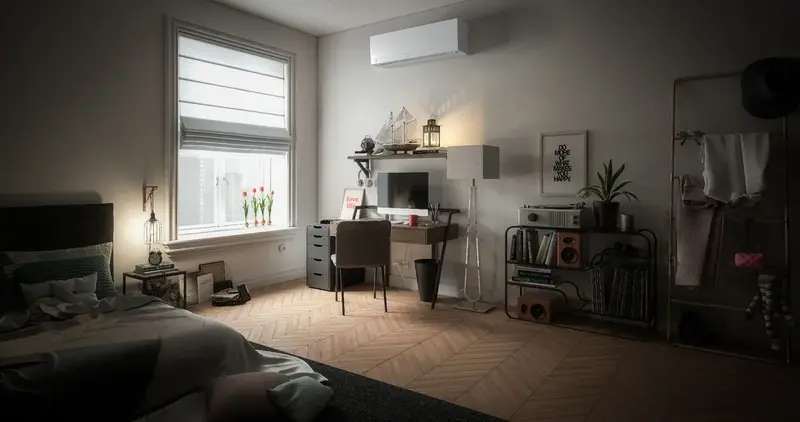
A ductless mini-split resolves this at the source. No ductwork is required. A slim indoor air handler mounts to the wall or ceiling. A refrigerant line set — roughly the diameter of a garden hose — passes through a small penetration in the exterior wall to the outdoor compressor. In a Winnetka Heights bungalow where the original plaster walls and Craftsman millwork are the point of the house, the installation leaves every surface undisturbed.
Bishop Arts' Renovation Wave and What It Means for HVAC
The Winnetka Heights Historic District and the surrounding blocks between Zang Boulevard and Hampton Avenue have become one of the most actively renovated residential corridors in Dallas. Homeowners restoring 1920s bungalows near the Kidd Springs Park corridor are spending serious money on original windows, period-appropriate millwork, and structural restoration. The HVAC question often comes last — and it's where the most damage can happen if it's handled carelessly.
A poorly planned duct installation in a plaster-wall bungalow requires opening ceilings, cutting through closets, and creating chase pathways that compromise the architectural character driving the renovation in the first place. Truficient's mini-split installations in these homes are planned specifically to avoid that damage. The line hide cover running along the exterior wall can be painted to match the trim color. Penetration locations are chosen to avoid prominent facade positions. The indoor unit placement is treated as a design decision, not an afterthought.
For homes in the formally designated Winnetka Heights Historic District, exterior modification restrictions add another layer. Truficient's installation process accounts for these requirements from the start of the assessment.
Mitsubishi's R32 Refrigerant: Why It Matters for a Bishop Arts Installation
Every Mitsubishi mini-split Truficient installs uses R32 refrigerant — a significant change from the R410A that dominated residential HVAC installations for the past two decades. Understanding the difference matters if you're making a long-term investment in your home.
R410A, the refrigerant that was standard in most residential systems installed between roughly 2010 and 2024, carries a global warming potential (GWP) of 2,088 — meaning it traps substantially more atmospheric heat than CO₂ if released. Under the EPA's AIM Act regulations that took effect in 2025, R410A can no longer be used in newly manufactured residential equipment. Any new central system or mini-split installed today uses a next-generation refrigerant.
Mitsubishi's choice is R32, which has a GWP of 675 — about 68% lower than R410A. R32 is also a single-component refrigerant rather than a blend, which means it doesn't fractionate when there's a small leak the way blended refrigerants can. It recovers and recharges cleanly. And because R32 is slightly more energy-efficient as a refrigerant fluid than R410A, the equipment that uses it tends to operate at marginally better efficiency ratings under real-world conditions.
For a Bishop Arts homeowner making a capital investment in an HVAC system that should last 15 to 20 years, installing equipment with next-generation refrigerant from the start means no legacy compatibility issues, no concerns about refrigerant availability as R410A phases out of service, and a smaller environmental footprint from day one.
Single-Zone vs. Multi-Zone: Matching the System to the House
Not every Bishop Arts installation is a whole-home project. Mini-splits come up in three consistent scenarios in this neighborhood:
The problem space. A west-facing sunporch off the back of a Kidd Springs-area bungalow that absorbs afternoon heat and has never been adequately conditioned. A carriage house converted to a studio on the alley behind a Winnetka Heights property. A third-bedroom addition that was added in the 1960s and was never connected to the original (already-marginal) central system. These are single-zone installations — one outdoor unit, one indoor air handler, problem solved without touching anything else.
The whole-home ductless system. For Bishop Arts bungalows with no functional central air, or where the existing duct system is beyond practical repair, a multi-zone system can condition the entire home from a single outdoor unit. Each indoor air handler operates independently. The main living area, the bedroom hallway, and a back addition each run on their own schedule — you're not cooling the whole house to make one room bearable.
New townhome construction. The infill townhomes along Jefferson Boulevard and the blocks between Zang and Hampton that went up in the past decade present a different case. Tall, narrow floor plans with multiple levels are thermally difficult for a single central system — heat rises, the top floor runs warmer, and the duct run from a ground-floor air handler to a third-floor bedroom is long and lossy. Multi-zone mini-splits solve this inherently: each floor gets its own handler, each controlled independently.
What the Installation Involves
Assessment. We walk the home, identify which spaces need conditioning, plan indoor unit locations and exterior line-set routing, and check the electrical panel for available capacity. For historic homes in the Winnetka Heights district, penetration location and exterior impact are part of the assessment conversation.
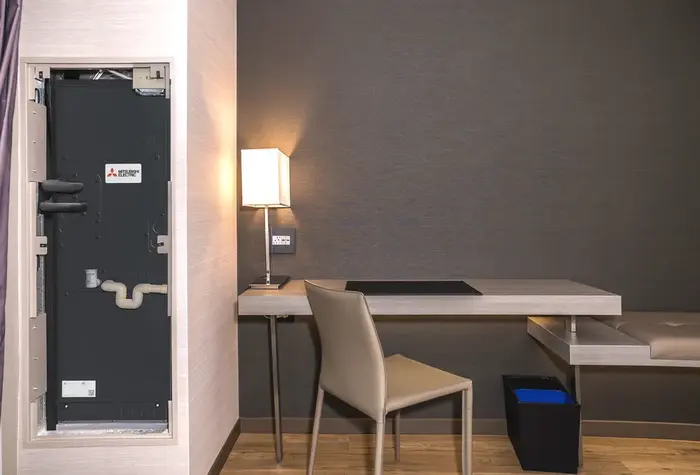
Equipment selection. As a Mitsubishi Diamond Dealer, Truficient installs M-Series wall-mount units for standard applications. For Bishop Arts homes with high original ceilings where a wall-mount unit would look out of place, ceiling-recessed cassette units (P-Series) are available — these sit flush with the ceiling and are significantly less visually prominent.
Installation day. A single-zone installation in a typical Bishop Arts bungalow takes four to eight hours. Multi-zone systems take longer, depending on zone count and line-set routing complexity.
Testing and walkthrough. Before leaving, we verify cooling and heating performance, confirm the condensate drain is clear, and walk through controller operation — including the Wi-Fi app integration if preferred over the handheld remote.
How Inverter Technology Performs Through a Dallas Summer
Bishop Arts sits in a climate that runs roughly six months of meaningful cooling demand, from late April through October, with sustained peak temperatures above 95°F through July, August, and early September. The Mitsubishi inverter compressor in every system we install modulates continuously — rather than cycling on and off at full capacity, it adjusts output to match the actual load in real time.
The practical effect in an older Bishop Arts bungalow with imperfect insulation and thermal mass from the original plaster-and-lathe construction is two things: steadier indoor temperatures without the temperature swings that come from cycling equipment, and meaningfully better humidity control because the system runs longer at lower capacity and removes moisture from the air consistently. Dallas summers are humid, and a home that's 74°F but feels clammy is a home where the HVAC system is cycling too aggressively.
Serving Bishop Arts and North Oak Cliff
Truficient installs mini-splits throughout the Bishop Arts area — the Winnetka Heights Historic District, the Kidd Springs Park corridor, the Jefferson Boulevard townhome corridor, and the adjacent blocks approaching the Methodist Dallas Medical Center campus to the north. Primary service ZIP is 75208.
For homeowners weighing a full system replacement rather than adding ductless zones, see our heat pump replacement overview for Oak Cliff. For a broader look at residential HVAC options, our Oak Cliff residential HVAC page covers the full range. We also serve the adjacent South & West Oak Cliff and Cockrell Hill neighborhoods.
Get a Quote for Your Bishop Arts Home
Whether you're in a Winnetka Heights bungalow with a room that's been on a window unit for years, a new Jefferson Boulevard townhome looking for whole-home zoning, or a renovation project where duct installation would damage what you're trying to preserve, a site assessment is the right starting point.
Call 214-238-4349 to talk through your situation, or request a quote online and we'll schedule a walkthrough.
Truficient is a Mitsubishi Diamond Dealer serving the Bishop Arts District and North Oak Cliff.
Tools to Help You Decide
See Our Bishop Arts District Installations
Browse photos from real mini-split and heat pump installations in Bishop Arts District homes.
Get an Instant Estimate
Answer a few questions about your home and get a ballpark cost for your project.
Scan Your Home's Efficiency
Find out where your home is losing conditioned air and what upgrades make the most sense.