Mini-Split Retrofit for Junius Heights Historic Bungalows
Ductless mini-split retrofit for Junius Heights historic bungalows. Preserve original 1906-1930 architecture. Solve the humidity problems that retrofit ductwork creates. Call 214-238-4349 or request a quote.
About Junius Heights
Junius Heights is one of Dallas's most architecturally significant historic districts — a turn-of-the-century neighborhood in Old East Dallas, listed on the National Register of Historic Places in 2009. The neighborhood was platted in 1906 and developed through 1930 as a streetcar suburb, with the streetcar line running down Junius Street from downtown Dallas to East Dallas. The area covers roughly 230 acres bounded by Gaston, Junius, Beacon, and Reiger Streets, primarily within the 75206 ZIP code.
The defining housing stock is consistent early-twentieth-century Craftsman bungalows, Prairie School homes, Tudor cottages, and Colonial Revivals — single-story or one-and-a-half story, typically 1,400 to 2,400 square feet, on lots 50 by 130 feet or thereabouts, with original architectural details intact: hardwood floors, plaster walls with crown moulding, leaded glass in formal rooms, period millwork, original fireplaces, and the lath-and-plaster construction characteristic of pre-1930 American residential building.
Junius Heights has been protected by Dallas conservation district zoning since the 1990s, and the architectural character has been preserved. Many homes have been substantially renovated — kitchens and baths brought current, mechanical systems updated — but the structural envelope and front-of-house formal-room details remain.
Why Junius Heights Bungalows Need Ductless
The HVAC reality for Junius Heights tracks closely with other 1906-1935 Dallas streetcar-suburb housing — Bishop Arts, M Streets, Lakewood, Elmwood — but with some specific Junius Heights characteristics:
Original construction without designed-in HVAC. Junius Heights homes were built before central air conditioning was standard. Original heating came from gas wall furnaces, floor furnaces, fireplaces, or in some larger Prairie School homes, original radiator systems. Cooling came from window units or attic fans.
Tight bungalow attic spaces. Junius Heights bungalow attics have shallow roof pitches (the architectural language of the era was low rooflines), narrow rafter spacing, and limited working clearance. Whatever ductwork was retrofitted decades ago was sized down to fit the available space — with all the capacity-loss consequences that implies. Most retrofit ductwork is now 30-50 years old and degraded.
Original lath-and-plaster walls. Junius Heights homes pre-date drywall by decades. The interior walls are original lath-and-plaster — substrate that doesn't tolerate ductwork chase modifications. New HVAC ductwork through original plaster walls means cracking, plaster repair work, and visible scarring of original architectural elements. Most owners reject this approach categorically.
Architectural protection. Junius Heights conservation district zoning includes restrictions on visible mechanical equipment and exterior modifications that affect the streetscape. Outdoor unit placement requires careful planning — typically rear or side-yard installations screened by existing landscape or custom screening.
Smaller floor plans suit ductless cleanly. A 1,500-1,800 square foot Junius Heights bungalow has a clean cooling load profile — three or four ductless zones cover the home cleanly without the architectural compromise of ductwork retrofit.
The Humidity Connection in Junius Heights
Junius Heights bungalows have a specific humidity problem that compounds with age. The retrofit ductwork running through tight attic space pulls humid attic air into the system on the return side and loses conditioned dehumidified air to the attic on the supply side. The result is a system that's effectively conditioning attic-equivalent humid air — and indoor RH that runs 60-65% during cooling season despite the AC operating.
Compounding this, Dallas indoor humidity is meaningfully worse in 2026 than it was when the original ductwork retrofits were installed. Outdoor dew points have risen across the DFW metro over the past two decades. The cooling system that handled humidity adequately in 2005 falls behind today's wetter conditions.
We covered the science behind rising DFW humidity in Why DFW's Air Is Getting Stickier (Part 1 of our humidity series), and the comprehensive DFW Humidity Hub is the master resource. For the symptom-side diagnostic and the specific equipment interventions that fix indoor humidity problems, see High Humidity Home Dallas TX HVAC Fix.
For Junius Heights specifically, multi-zone ductless mini-split retrofit addresses the humidity problem in three ways simultaneously:
Inverter modulation runs continuously at part-load = continuous dehumidification.
No attic ductwork = no attic humidity migration into the system.
Each indoor zone sized for the actual room load = per-zone dehumidification matched to per-zone needs.
What a Junius Heights Mini-Split Retrofit Looks Like
Three- to four-zone configuration for typical Junius Heights bungalows. A 1,500 square foot bungalow with living room, dining room, kitchen, two bedrooms, and a bath typically configures as:
- One zone for the front living and dining rooms (single 12,000-18,000 BTU wall-mount or ceiling cassette)
- One zone for the kitchen (single 9,000-12,000 BTU wall-mount or ceiling cassette)
- One zone for the primary bedroom (single 9,000 BTU wall-mount)
- One zone for the secondary bedroom (single 9,000 BTU wall-mount)
Larger Junius Heights homes (Prairie-style two-story homes, 2,400+ sq ft) configure with five or six zones depending on layout.
Outdoor unit placement. Junius Heights conservation district zoning requirements drive placement to side-yard or rear locations screened from the streetscape. Most installations use a side-yard concrete pad with landscape screening. The Mitsubishi MXZ multi-zone outdoor unit runs at 53-58 dB(A) outdoors — quieter than typical conversation, well within neighborhood sound ordinance requirements.
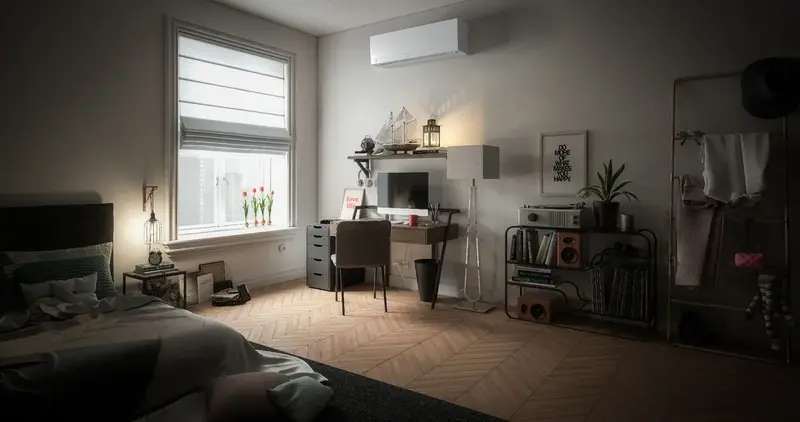
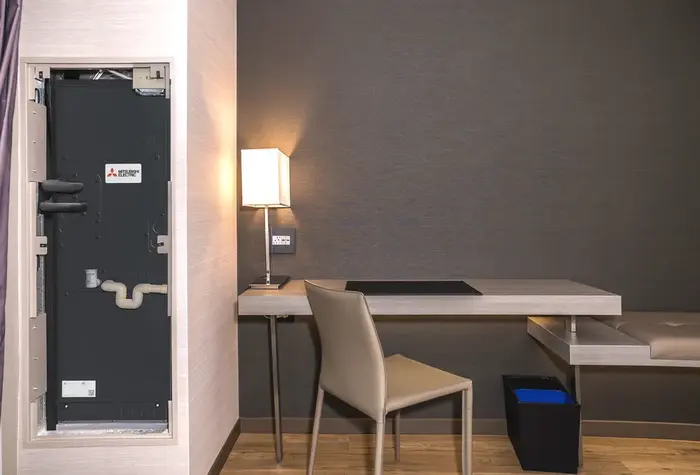
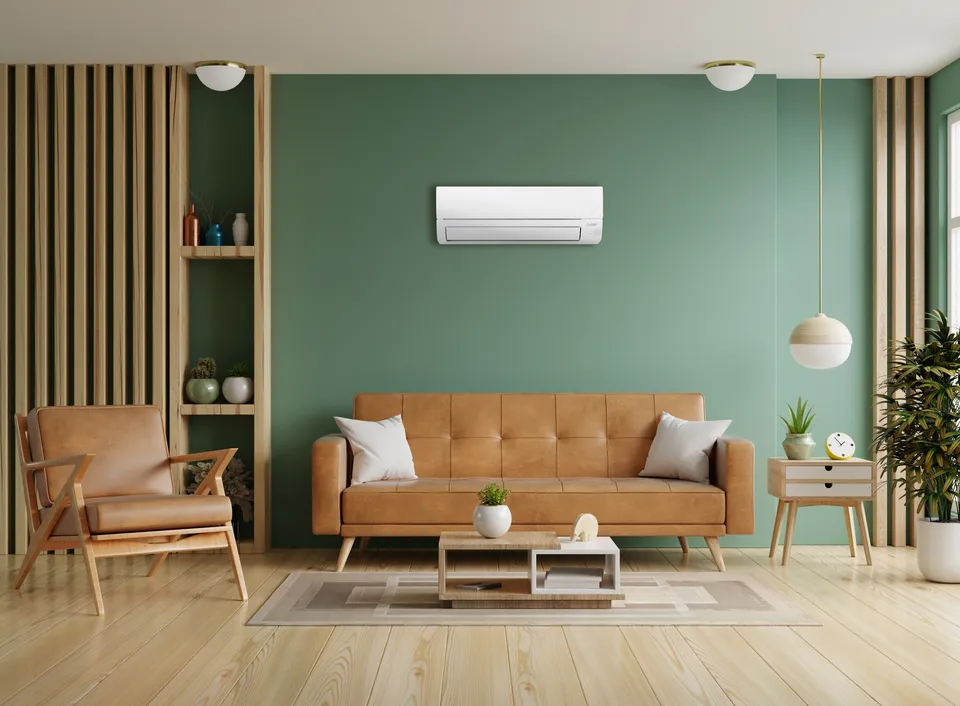
Indoor unit selection for plaster walls. Wall-mount Mitsubishi MSZ-FS units (slim profile, 19 dB(A) whisper mode, white finish) integrate cleanly with period interiors. Ceiling cassette installations are possible in renovated rooms with adequate ceiling clearance but are less common in original bungalow architecture. Floor-mount MFZ units fit well in rooms with high windows or limited wall space.
Line set routing without architectural disruption. Refrigerant line sets, condensate drains, and control wiring route through small wall penetrations (the size of a quarter). We route line sets through wall cavities, behind built-ins, along exterior trim lines, or through attic chases to minimize visual impact in original architecture. No plaster modifications required.
Decommissioning the existing central system. The original air handler and outdoor condenser are removed. Existing ductwork is capped at the air handler closet (left in place to preserve future flexibility but inert). The existing 240V circuit serving the previous compressor is typically reused for the new outdoor unit.
R-32 Refrigerant for Junius Heights Retrofits
Every Mitsubishi mini-split installed today uses R-32 refrigerant — the EPA AIM Act compliant refrigerant for residential equipment manufactured after January 1, 2025. R-32 has a global warming potential of 675, roughly 68 percent lower than R-410A's 2,088. As a single-component refrigerant, it services cleanly without fractionation issues.
R-32 is classified A2L — mildly flammable — requiring A2L-certified installation. Truficient technicians are A2L-certified for R-32 systems.
A Real Example — Bishop Arts Case Study
For a real before-and-after on the same retrofit pattern in a Bishop Arts 1925 Craftsman bungalow — including specific equipment selection, before/after humidity readings, and operating cost change — see our Bishop Arts ductless retrofit case study. The Junius Heights housing pattern tracks closely; expect similar results.
Why Truficient for Junius Heights
The HVAC for a Junius Heights historic bungalow is an architectural project as much as a mechanical project. The system design has to fit into a structure that wasn't designed for it, without compromising the elements that define the home's value.
Eric, Truficient's owner and the engineer behind every install, has worked extensively with Old East Dallas historic homeowners. Manual J load calculations account for the actual envelope of pre-1935 construction (which varies substantially home-to-home depending on whether the home has been re-insulated and re-glazed during prior renovations). Equipment specification follows the load and the architectural constraints. Outdoor unit placement is planned to comply with conservation district aesthetic requirements.
For broader Old East Dallas neighborhood context, see our Old East Dallas HVAC hub. For comparable Lakewood historic-home retrofit context, see Mini-Split Installation Lakewood Dallas. For real before-and-after on the same retrofit pattern, see the Bishop Arts case study.
Get a Quote for Your Junius Heights Bungalow
Call 214-238-4349 to walk through your home, or request a quote online.
Truficient is a Mitsubishi Diamond Dealer specializing in historic home ductless retrofits across Junius Heights, Munger Place, Swiss Avenue, and the broader Old East Dallas conservation districts.
Tools to Help You Decide
See Our Junius Heights Installations
Browse photos from real mini-split and heat pump installations in Junius Heights homes.
Get an Instant Estimate
Answer a few questions about your home and get a ballpark cost for your project.
Scan Your Home's Efficiency
Find out where your home is losing conditioned air and what upgrades make the most sense.