High Electric Bill in Summer? Here's the Dallas HVAC Diagnostic
If your Dallas summer electric bills are running $400-$700+ per month, the cause is almost always your HVAC. Here's how to figure out which intervention pays back. Call 214-238-4349 or request an assessment.
Why Dallas Summer Bills Are What They Are
Texas residential electricity rates have risen more than 40 percent over the last decade according to U.S. Energy Information Administration data. Combined with Dallas's six-month cooling season (May through October) and the rising outdoor humidity that's making cooling systems work harder, Dallas summer electric bills have climbed steadily for most homeowners.
For a 2,500 square foot Dallas home running 1990s-2000s vintage single-stage HVAC equipment, summer monthly bills in the $450-$650 range are common. Some homes run higher — $700-$900 in peak August — when the equipment is past its useful life, the ductwork is degraded, or the home has never had a Manual J load calculation done since original construction.
The bills aren't going to come down on their own. The intervention that pays back is replacement equipment — but only if the right equipment goes in. Replacing a failing single-stage system with another single-stage system gets you another 12-15 years of high bills. The replacement that pays back is inverter-modulating equipment sized to the home's actual current envelope.
What Drives a High Dallas Summer Electric Bill
Five factors compound to produce high cooling-season bills:
1. Aging single-stage AC running at degraded efficiency. A 15-year-old single-stage AC is operating at 60-75% of its rated SEER on the data plate. The compressor draws maximum current at every cycle start. The system runs more hours and uses more electricity per hour than the original spec.
2. Oversized equipment that short-cycles. Equipment was sized using rule-of-thumb tonnage when the home was built. After insulation, window, and attic upgrades during prior renovations, the actual cooling load is meaningfully smaller — but the equipment hasn't been right-sized. The system short-cycles, losing efficiency every cycle, and never running long enough to dehumidify properly. (For the humidity dimension, see High Humidity Home Dallas TX HVAC Fix.)
3. Ductwork losing 25-35% of conditioned air to the attic. After 30-50 years sitting in attic temperatures exceeding 130°F, retrofit ductwork has degraded. Joints have separated, insulation has compressed, and a meaningful portion of the system's rated capacity is being delivered to the attic instead of the conditioned space. The system has to run longer to compensate, increasing electricity consumption.
4. Multi-story home with single-thermostat HVAC. Two-story Dallas homes with single-thermostat control consistently run upstairs warmer than downstairs in summer. The system runs longer to satisfy the thermostat (located on the first floor), overcooling the downstairs to barely cool the upstairs. Multi-zone configurations or two-system designs cut runtime significantly.
5. Rising outdoor humidity. Dallas indoor humidity is a meaningful concern in 2026. Outdoor dew points have risen across the metro over the past two decades. Cooling systems are doing more latent (humidity) work than they were a decade ago, which translates to more compressor runtime per degree of cooling delivered.
What Replacement Equipment Saves on Operating Cost
The math, on a typical Dallas residential application — 2,500 sq ft home, currently running 4-ton single-stage AC + 80% efficiency gas furnace, summer monthly bills averaging $475:
| Replacement option | Estimated summer monthly bill | Annual cooling-season savings | |---|---|---| | Same single-stage replacement | $440 | ~$210 | | Variable-speed AC + same gas furnace | $360 | ~$680 | | Inverter heat pump (Mitsubishi P-Series, R-32) | $290 | ~$1,100 | | Multi-zone ductless (Mitsubishi MXZ Hyper-Heat) | $270 | ~$1,200 |
The inverter heat pump and multi-zone ductless options also eliminate gas service for heating — additional savings of $40-$80 per month in winter for homes currently paying gas standing charges plus heating fuel.
Numbers will vary based on home size, envelope, current equipment age, and operating patterns. The pattern holds: inverter-modulating replacement equipment cuts summer cooling cost meaningfully versus single-stage replacement of like-for-like equipment.
For the heat pump vs gas furnace economic case in detail, see Heat Pump vs Gas Furnace Dallas.
When Replacement Is the Right Move
The replacement-vs-repair decision depends on equipment age and condition:
Equipment under 8 years old. Repair makes sense unless major component failures (compressor, indoor coil) are involved. Continue operating with twice-annual maintenance.
Equipment 8-12 years old. Borderline. Single-component repairs are typically still economic; major component failures push toward replacement. Manual J load calculation on the home identifies whether the existing equipment is right-sized for current conditions.
Equipment 12-18 years old. Replacement is increasingly the right answer. Single-component repairs may keep the system running, but operating cost trajectory continues degrading. Major component failures should trigger replacement evaluation.
Equipment 18+ years old. Replacement is the right answer. R-22 systems (uncommon now but present in some 1990s installations) particularly should be replaced — service refrigerant is expensive and increasingly hard to source.
What an Assessment Looks Like
When you call us about high summer bills, the assessment covers:
1. Current monthly utility bills review. We look at the last 12 months of electric bills to identify the cooling-season pattern.
2. Equipment age and condition. Outdoor unit data plate, indoor unit data plate, gas furnace data plate (where applicable). Refrigerant type identifies replacement urgency.
3. Manual J load calculation. We calculate the actual current cooling load — accounting for current envelope, current insulation, current windows. Compare to the installed equipment capacity. Most Dallas homes are running oversized equipment.
4. Ductwork inspection. We measure ductwork condition, identify air leakage points, quantify ductwork loss as a percentage of system capacity.
5. Indoor humidity measurement. We measure RH in living areas. Indoor RH consistently above 55% is a tell that the equipment is short-cycling and not dehumidifying.
6. Operating cost projection. Based on the diagnostic, we project the operating cost of replacement options — like-for-like single-stage, variable-speed AC, inverter heat pump, multi-zone ductless. The numbers tell you the payback period.
The deliverable is a written recommendation with specific actions and estimated payback periods.
Equipment Options to Consider
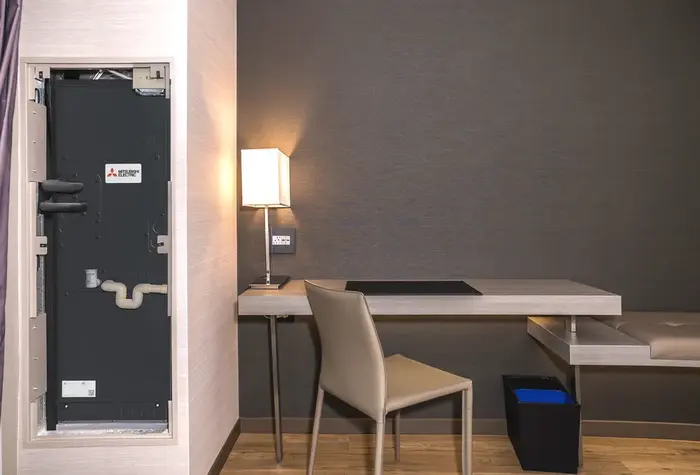
Inverter-driven ducted heat pump — Mitsubishi P-Series, SVZ-KP slim-duct. Drop-in replacement for existing ducted system. Eliminates gas furnace.
Multi-zone ductless — Mitsubishi MXZ multi-zone. Replaces the central system entirely; addresses chronic temperature differential and humidity simultaneously.
Variable-speed AC + existing furnace — for homes with newer gas furnaces with remaining useful life, replacing only the AC half with variable-speed equipment captures meaningful savings. Lower up-front cost than full heat pump conversion.
Two-system design — for larger homes, splitting the central system into two independent systems (one per floor) cuts runtime and improves comfort.
Adjacent Pages
- Heat Pump Installation Dallas TX — full service hub for heat pump replacement
- Mini-Split Installation Dallas TX — service hub for mini-split installations
- High Humidity Home HVAC Fix — humidity is often the underlying cause
- DFW Humidity Hub — comprehensive humidity context
- Heat Pump vs Gas Furnace Dallas — economic comparison
Get a High-Bill Assessment
If your summer electric bills are higher than they should be, an assessment identifies the specific intervention that pays back. We don't push replacement on equipment that has years of life remaining; we don't push repair on equipment that's beyond economic repair.
Call 214-238-4349 or request an assessment online.
Truficient is a Mitsubishi Diamond Dealer with engineering-driven HVAC diagnostics for Dallas homes.
Tools to Help You Decide
See Our Dallas (High Summer Bills) Installations
Browse photos from real mini-split and heat pump installations in Dallas (High Summer Bills) homes.
Get an Instant Estimate
Answer a few questions about your home and get a ballpark cost for your project.
Scan Your Home's Efficiency
Find out where your home is losing conditioned air and what upgrades make the most sense.