HVAC in Deep Ellum: Flanked by Heat Islands, Built on Old Warehouses
Deep Ellum occupies a stretch of east Dallas between the Downtown core and Fair Park — a neighborhood defined by its 19th and early 20th century warehouse and commercial buildings, now repurposed as music venues, bars, restaurants, galleries, and residential lofts. It is also a neighborhood that sits between two thermally distinct pressure zones identified in NOAA's Dallas heat island studies.
To the west, the Downtown Dallas concrete canyon registers as a confirmed heat island zone with persistent overnight heat retention. To the south, the I-30 corridor generates highway-driven heat load from continuous traffic, dark pavement, and limited canopy. Deep Ellum does not sit at the extreme of either zone, but it carries the thermal influence of both, combined with its own building stock characteristics that complicate standard HVAC sizing.
NOAA's 2024 study found temperature differentials of up to 12°F between Dallas's hottest zones and its greener areas. Deep Ellum consistently registers on the hot side of that distribution — particularly during evening hours when the neighborhood's highest-density commercial use coincides with peak thermal mass discharge from the surrounding pavement and building stock.
Why Deep Ellum's Heat Profile Is Evening-Heavy
Most Dallas neighborhoods follow a predictable diurnal heat pattern: solar gain peaks in the mid-afternoon and begins declining after sunset. Deep Ellum's profile is shifted.
The neighborhood's commercial activity is concentrated in evening and overnight hours — when restaurant kitchens, music venue HVAC systems, and crowded bar environments are all simultaneously generating anthropogenic heat. The aggregate waste heat from commercial kitchen exhaust, venue HVAC condensers, and vehicle traffic surges precisely when ambient temperatures in the surrounding urban core are at their slowest rate of decline.
The practical result for residential loft residents and commercial property operators: the evening hours that provide thermal relief in suburban neighborhoods do not provide the same relief in Deep Ellum. A system sized for typical suburban evening conditions will be underpowered for what Deep Ellum's specific combination of urban heat and commercial activity delivers.
The Warehouse Conversion Problem in Deep Ellum
Deep Ellum's building stock is predominantly early 20th century warehouse and commercial construction — brick and masonry buildings with high ceilings, minimal original insulation, and original windows that predated modern energy efficiency standards by 60–80 years.
These buildings present a specific set of HVAC challenges:
Thermal mass without insulation. Brick and masonry walls store solar energy efficiently — which is why historic warehouse buildings feel cooler in the morning but become difficult to cool in the afternoon as the wall mass releases stored heat into the interior space. A conventional load calculation that models only air-side heat transfer misses the radiant component of masonry wall discharge.
High ceiling heights. Converted warehouse lofts with 14–18 foot ceilings accumulate heat at the ceiling level that a single-zone system cannot address efficiently without creating stratification. The occupied zone at floor and furniture height may remain uncomfortable even as the system technically registers a target temperature at the return air sensor mounted near the ceiling.
Irregular floor plans. Deep Ellum's warehouse conversions frequently feature irregular floor plans — open concept living areas connected to mezzanines, split-level configurations, and rooms with highly variable solar exposure depending on orientation. A single-zone central system cannot handle the load variation between a south-facing loft window wall and an interior bedroom simultaneously.
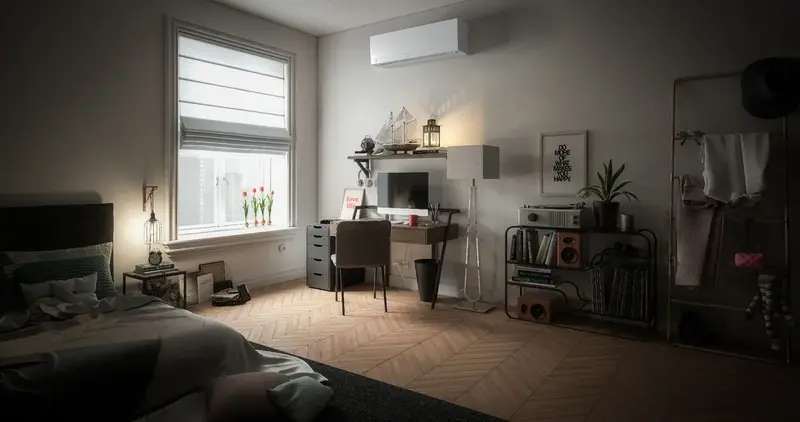
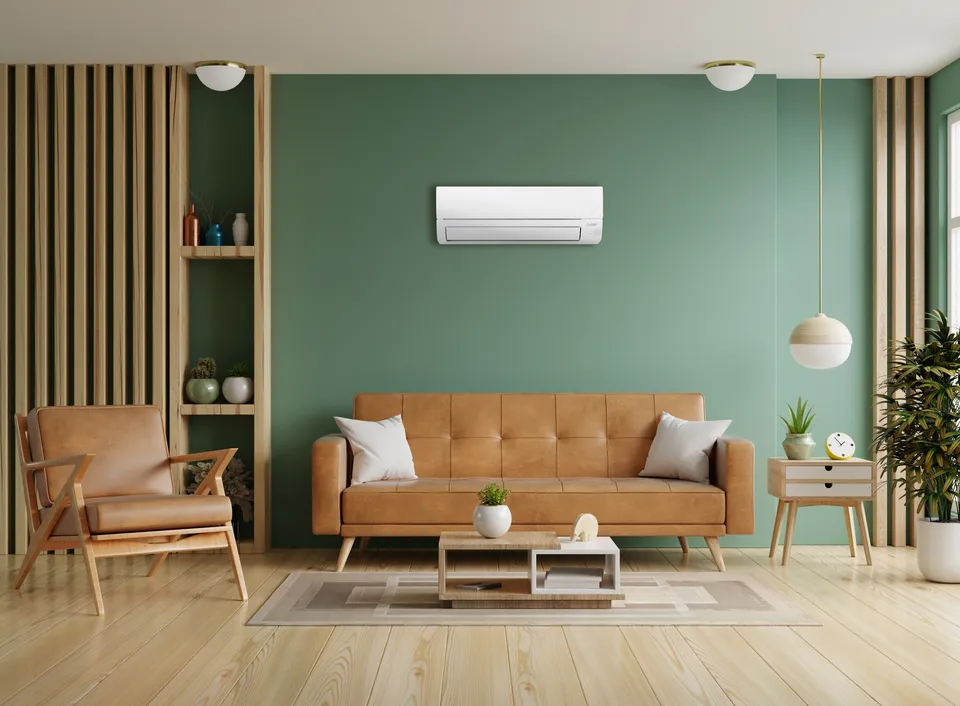
Multi-zone mini-split configurations address all three. Individual indoor air handlers in each zone — the open living area, the mezzanine, the bedroom — allow independent conditioning of each space. Inverter compressors modulate output to match the radiant discharge from masonry walls in a way that single-stage equipment cannot.
Spiral Duct + VRF: Deep Ellum's Industrial Aesthetic Meets Modern Efficiency
Deep Ellum's industrial design character creates an opportunity that few other Dallas neighborhoods offer: the chance to make the HVAC system part of the interior aesthetic rather than hiding it behind drywall ceilings.
Spiral ductwork connected to ducted VRF indoor units is increasingly the system of choice for Deep Ellum renovations and new commercial builds that want to preserve the exposed ceiling, brick, and structural beam aesthetic while still delivering efficient, multi-zone conditioned air. Exposed spiral duct — the round, ridged metal ductwork typically associated with commercial mechanical rooms — carries the industrial look that Deep Ellum tenants and property owners prize, while serving as the distribution network for a high-efficiency VRF system underneath.
How it works in practice: a Daikin or Mitsubishi ducted VRF indoor unit is connected to a network of exposed spiral duct that serves multiple diffusers throughout the space. The VRF outdoor condensing unit modulates its output to precisely match the cooling load, while the spiral duct distributes conditioned air through the space at whatever diffuser layout makes sense for the interior design. In larger venues or multi-tenant buildings, multiple VRF systems can share a single outdoor condensing unit, eliminating the rooftop unit farm that conventional commercial systems require.
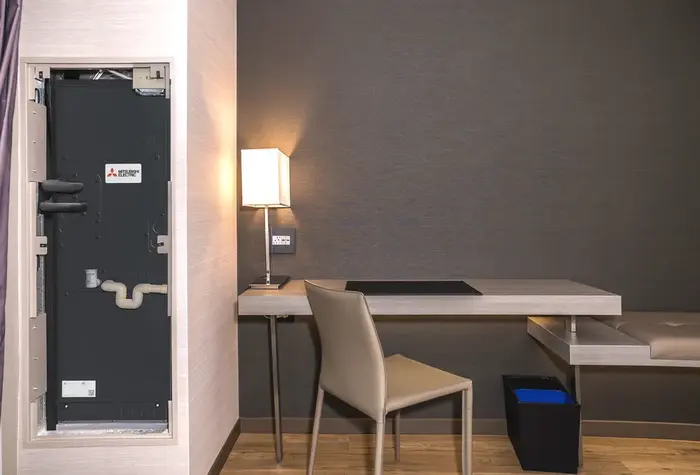
Cassette combinations in open-plan spaces. For Deep Ellum spaces with partial ceilings — mezzanines, bar areas, private event rooms — the ducted spiral duct system can be mixed with ceiling cassette indoor units where it makes sense. A cassette unit in a dropped ceiling area over the bar provides direct zone coverage without requiring duct runs, while the main dining room or event floor is served by the exposed spiral duct system. Different cassette styles — standard 4-way, 2-way, and slim 1-way — can be matched to ceiling geometry and aesthetic requirements.
New Deep Ellum development is built for this. The neighborhood has seen significant new construction and adaptive reuse over the past several years, and increasingly that development is specifying VRF + exposed spiral duct systems from the outset.
Commercial HVAC for Deep Ellum Venues and Restaurants
Deep Ellum's commercial properties face the most demanding HVAC challenge in the neighborhood: sustained high-occupancy loads during evening hours, in buildings that were never designed for modern commercial mechanical systems, in a heat island zone that keeps outdoor ambient temperatures elevated through the night.
A restaurant kitchen operating through a Friday evening in July is simultaneously generating exhaust heat from cooking equipment, body heat from a full dining room, and waste heat from the refrigeration and beverage systems — while the outdoor condenser is rejecting heat into an ambient environment that is 8–10°F hotter than regional averages.
For Deep Ellum commercial operators, Mitsubishi's commercial multi-zone systems and Daikin's commercial mini-split configurations offer the combination of high ambient performance (rated operation at outdoor temperatures up to 115°F) and zone control that allows kitchen and dining areas to be conditioned independently. For larger venue spaces, Daikin's VRF platform can serve multiple zones from a single outdoor condensing unit — eliminating the rooftop unit farm that older Deep Ellum commercial buildings typically inherit.
Oncor Rebates in Deep Ellum
Deep Ellum is in Oncor Electric Delivery's service territory. Oncor offers rebates of up to $1,000 for qualifying high-efficiency residential HVAC installations, with commercial rebate tiers available for business operators upgrading aging commercial equipment.
See how Oncor rebates and Federal incentives stack →
Read the full Dallas Urban Heat Island Research Report →
See how the AC feedback loop affects dense commercial zones like Deep Ellum →
Tools to Help You Decide
See Our Deep Ellum Installations
Browse photos from real mini-split and heat pump installations in Deep Ellum homes.
Get an Instant Estimate
Answer a few questions about your home and get a ballpark cost for your project.
Scan Your Home's Efficiency
Find out where your home is losing conditioned air and what upgrades make the most sense.